 Deshwale
Digital Infrastructure: Data Centres, Networks, and the Hidden Internet Backbone of Megacities
In brief · AI summary Megacities depend on a hidden digital infrastructure of fibre-optic cables, data centres, internet exchanges, and mobile towers that keep online services running. The article gives examples such as New York City's transatlantic cable links, Singapore's over 70 data centres, and Stockholm's reuse of data centre heat for district heating. It also notes that a 2016 power outage in Sydney's data centre district took down banking and government websites, showing how dependent cities are on these systems.
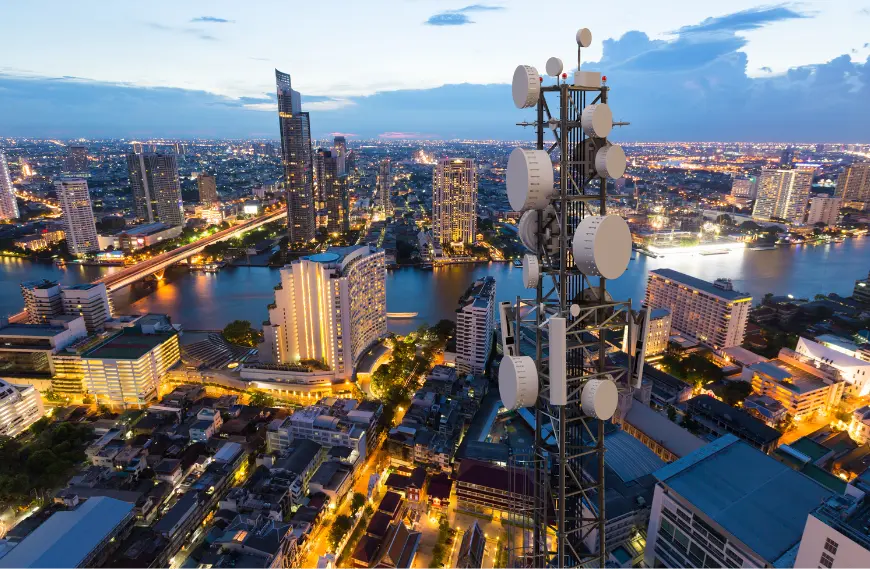
Beneath the buzzing streets of megacities lies an invisible nervous system: miles of fibre-optic cables, server farms, and towers that keep the digital world alive. Without this infrastructure, a modern city would grind to a halt.
The Digital Lifeline
Megacities are data giants: every email, video call, online purchase, or streamed movie flows through a web of physical cables and switches. For example, New York City sits atop thousands of kilometres of fibre, and is a key landing point for transatlantic internet cables connecting North America and Europe.
Singapore, a global data hub, hosts over 70 data centres, storing and processing petabytes of data daily for Asian markets. Its central location and stable power supply make it a prime spot for multinational cloud giants.
Data Centres: The New Factories
Data centres are enormous, air-conditioned warehouses filled with servers humming 24/7. A single facility can consume as much electricity as a small town. London’s Docklands houses one of Europe’s densest data centre clusters, crucial for the financial markets’ millisecond trades.
Keeping these centres cool, secure, and powered is a colossal engineering challenge. Some cities now use innovative solutions: Stockholm channels excess heat from data centres into district heating, warming thousands of homes.
Internet Exchanges
Megacities often host major internet exchange points (IXPs) where networks connect. The DE-CIX Frankfurt, the world’s largest IXP, handles over 10 terabits per second of traffic — much of it destined for or passing through Europe’s largest cities.
In Mumbai, the India Internet Exchange enables better local routing, reducing delays when Indian internet users access Indian websites.
Towers, Small Cells, and 5G
Above ground, mobile towers and rooftop antennas form the backbone of wireless connectivity. As cities adopt 5G, dense networks of small cells are being installed on streetlights and buildings to ensure ultra-fast, low-latency connections.
Seoul, one of the earliest cities with mass 5G deployment, showcases how digital infrastructure can revolutionise services from video streaming to autonomous vehicles.
Securing the Backbone
Cybersecurity is just as vital as physical security. In 2016, a power outage in Sydney’s data centre district took down banking and government websites, reminding cities how dependent they are on invisible digital lifelines.
As urban futurist Anthony Townsend put it: “A megacity’s digital infrastructure is like its circulatory system, cut it off, and nothing works.”