



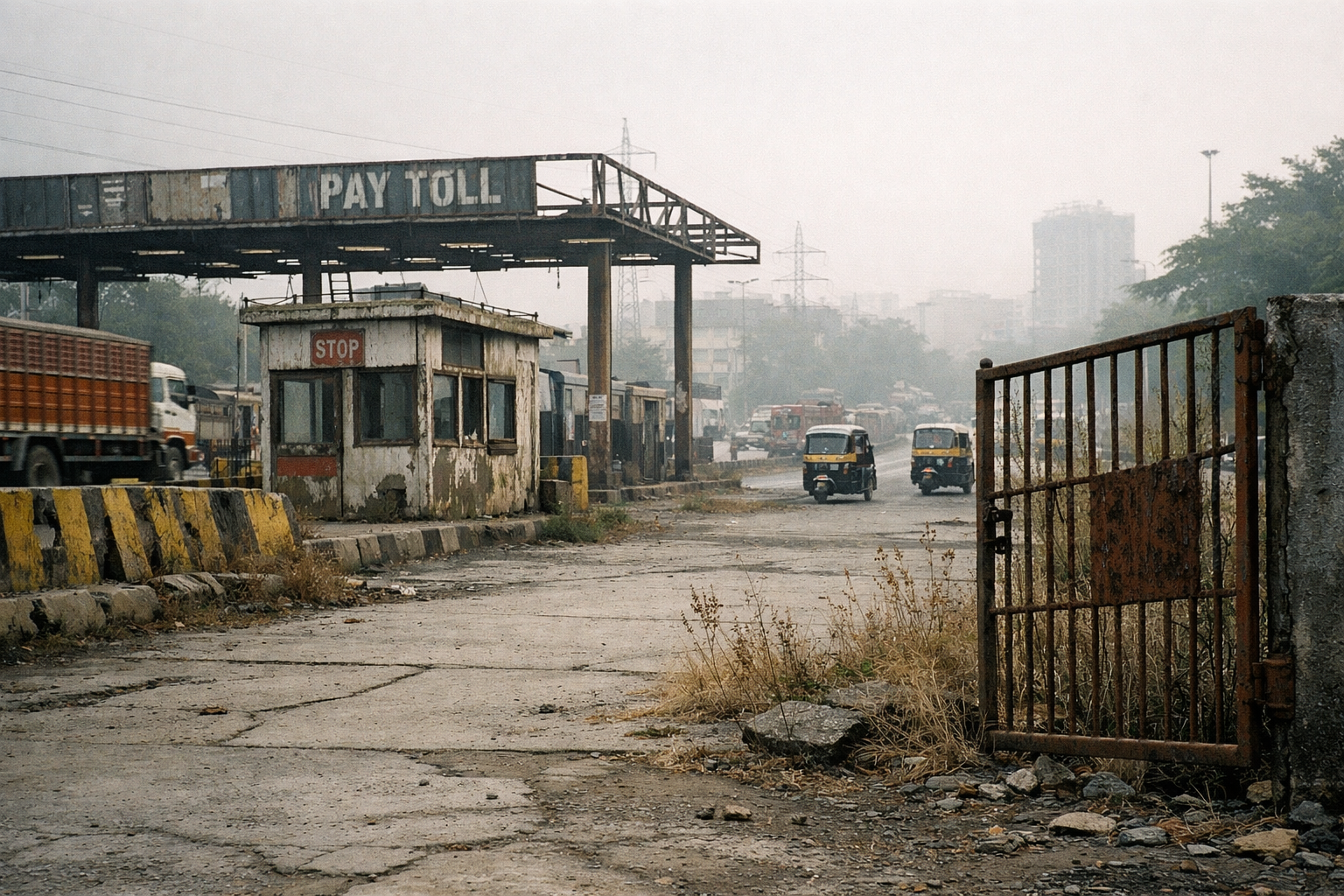
Every great city has a threshold. A point where the ordinary world ends and the city’s own logic begins. Paris has its peripherique, its ring of battered grace. Singapore has Changi, which tells you something about Singapore before you even reach the city. And Mumbai? For decades, Mumbai’s entry points have been defined by toll booths, exhaust fumes, idling trucks and the particular misery of traffic that never quite moves. That may finally be about to change. Or so the Brihanmumbai Municipal Corporation wants you to believe.
On March 10, 2026, Mayor Ritu Tawde personally inspected three of the city’s major entry check-posts and announced that the BMC will construct clock towers and arch-shaped heritage gates at four key entry points: Airoli, Dahisar, Mulund and Mankhurd. The project has been included in the 2026-27 civic budget. The stated vision is to give Mumbai gateways that reflect its social, cultural and economic identity, something that citizens, visitors and tourists can immediately read as distinctly this city’s.
It sounds good. It also sounds familiar.
The City That Forgot to Look at Itself
Before discussing what Mumbai’s new gateways might become, it is worth being honest about what the city currently looks like. Suburban Mumbai is, in large stretches, a genuinely difficult place to look at. This is not snobbery. It is observation. The arterial roads of Andheri, Ghatkopar, Borivali and Thane are a visual assault of mismatched signage, exposed wiring, crumbling compound walls, broken footpaths and buildings whose facades have not seen a coat of paint since their owners last filed a municipal complaint. Hoardings of every size compete aggressively for attention at every junction. Drains run open beside restaurants. Construction debris sits for months on pavements that pedestrians are not expected to actually use.
The suburbs were built in a hurry and it shows. Decades of rapid, unplanned densification produced neighbourhoods that function, more or less, but do not cohere visually in any meaningful way. There is no consistent street furniture, no unified civic palette, no sense that anyone sat down and asked what this neighbourhood should look like from the pavement. Mumbai’s colonial-era south is beautiful in parts precisely because it was designed with aesthetic intention. The suburbs largely were not.
This context matters. Because when the BMC talks about building heritage gates and clock towers at the city’s entry points, it is proposing a decorative frame around a picture that has not yet been painted. A grand arch at Dahisar will not make the road leading away from it any less chaotic. A clock tower at Mulund will not repair the broken footpath beneath it. The risk is that the gateways become exactly what Mumbai already has too much of: impressive announcements attached to unimpressive ground realities.
The Land at the Heart of It
Forty-three acres. That is the combined area of the five former octroi nakas sitting at Mumbai’s edges, two in Mulund and one each at Mankhurd, Dahisar and Airoli. These are not peripheral plots. They sit at points of maximum entry and exit, commanding visibility, commercial potential and strategic value that any urban planner would recognise immediately.
When the Goods and Services Tax replaced octroi in July 2017, these parcels went quiet overnight. The tax collectors left. The truck queues thinned. The dhaba owners near the nakas felt it first. Then everyone else did. For nearly nine years, this land has sat largely unused while Mumbai, a city that will fight to the death over a square foot of space in Bandra or Worli, somehow let 43 prime acres gather dust at its borders.
Now the BMC wants to develop these sites into commercial and entertainment hubs. Each location, according to Mayor Tawde, will feature shopping malls, banquet halls, restaurants, food courts, auditoriums and art galleries. Transit zones will include hotels, eateries, ticketing centres and connectivity for metro, waterway and private transport. Project-specific estimates place the Dahisar site alone at Rs. 992 crores and the Mankhurd site at Rs. 240 crores, with the total development cost across all five nakas estimated in the region of Rs. 1,300 crores.
The ambition, on paper, is real enough. The question is whether the paper will survive contact with the BMC’s actual execution record.
A Plan That Has Already Failed Once
Go to the Dahisar naka today and you will find what eight years of civic inertia looks like in physical form. The old octroi booths still stand, their paint long surrendered to the weather. The land around them is a flat, dusty expanse interrupted by parked vehicles and the occasional temporary structure. Weeds have taken whatever the concrete has not. It is a strange sight in a city where every inch is theoretically contested. Forty-three acres of Mumbai, sitting there, doing nothing.
In early 2024, the BMC had publicly proposed converting the Dahisar and Mankhurd nakas into transport and commercial hubs. The plan included interstate bus terminals, CNG and charging stations, transit accommodation and craft and culture centres. Senior civic officials indicated at the time that the tendering process would begin within a month. A tender for the Dahisar project was eventually issued in September 2024 and awarded to a contractor. Yet here we are in March 2026, with a fresh announcement, fresh photographs and a fresh set of promises. The earlier project has apparently been absorbed into this newer, grander vision. What was built in the interim is not entirely clear.
Before the 2024 proposal, almost immediately after GST was introduced in 2017, the BMC had explored multiple options for the naka sites, including passenger stations, a truck terminus, trauma centres and security posts. Delegations visited Ahmedabad to study comparable models. Reports were filed. Nothing was built.
This is a pattern the city knows well. Mumbai’s civic history is lined with proposals that arrived with great noise and departed without ceremony. When a new announcement lands in the press with photographs of a mayor at a check-post, the honest response is interest. Not quite faith.
Whose Heritage Gets Carved in Stone?
The stated design intent is to build gates and clock towers that capture Mumbai’s heritage. Mayor Tawde described the structures as representing the city’s social, cultural and economic identity. Those are large words for what will, in practice, be designed by a contractor through a tendering process managed by the BMC’s engineering department.
Which raises a genuine question. Whose version of Mumbai is being put on the gate? The city is not one thing. It is Koli fishermen and Gujarati traders, working-class intellectuals and Marathi mill workers, Tamil engineers and North Indian migrants who arrived with nothing and built something. It is also the Parsi industrialists, the Sindhi merchants, the Marwari financiers, the Muslim textile magnates and the South Indian business families whose capital, factories and employment networks physically constructed large parts of the city’s commercial skeleton. Mumbai’s prosperity was never the work of one community. It was a collective project, funded and built by businessmen and businesswomen of every linguistic and cultural stripe, often in fierce competition with each other and occasionally in quiet cooperation.
Any structure claiming to represent this city’s heritage is therefore making a curatorial choice of considerable complexity. That choice deserves public debate, not a press release.
Cities that have approached gateway redevelopment with real seriousness have spent years consulting communities, commissioning architects through open competitive processes and testing design proposals against the city’s actual social geography. There is no public record of the BMC doing any of this for these four sites.
Climate Gets No Seat at the Table
The current plan makes no visible mention of green infrastructure. Mumbai floods regularly. It also bakes. Research based on data from monitoring stations across the city recorded a temperature gap of up to 13.1 degrees Celsius between Mumbai’s hottest and coolest neighbourhoods, with high-traffic, heavily concreted zones running significantly warmer than greener, less built-up areas. In summer 2024, Mumbai’s minimum night-time temperature reached 27.1 degrees Celsius, among the highest recorded across all major Indian cities, a direct consequence of the urban heat island effect being intensified by concretisation and declining green cover. The city’s entry points, where vehicle density peaks and open land is available, are precisely where climate-responsive design could make a measurable difference.
Forty-three acres at the city’s edges, developed as malls and banquet halls, represents a significant decision about how Mumbai uses the land it controls. These entry points could instead support green buffers or urban forest corridors that reduce particulate matter and heat stress at the very locations where commuter exposure is highest. Whether that option was considered and rejected, or simply never considered, is not clear from any public document. This is the question no one seems to be asking loudly enough.
The Timing
Mumbai’s BMC elections were held in January 2026, returning a new civic administration to power after years of administrator-led governance. Mayor Tawde’s inspection of the naka sites and this announcement come within weeks of that result. The new administration is clearly moving to establish early visibility on infrastructure and beautification. These things are not improper on their own. Newly elected civic bodies announce projects. That is partly what they are elected to do.
But the nakas have been vacant since 2017. The 2024 plan went nowhere in any visible sense. A fresh mandate has now arrived. And within weeks, the mayor is at Dahisar, photographed on a road every commuter knows, talking about clock towers.
Mumbai’s residents are not easily impressed. They have watched too many projects get announced and too few get finished. The city has real needs at these entry points, including better roads, cleaner access and functional public amenities that do not require a shopping mall to justify their existence.
Clock towers would be fine. A working bus terminal would be better. A straight answer about what happened to the last plan would be the best thing of all.
Subscribe Deshwale on YouTube
