




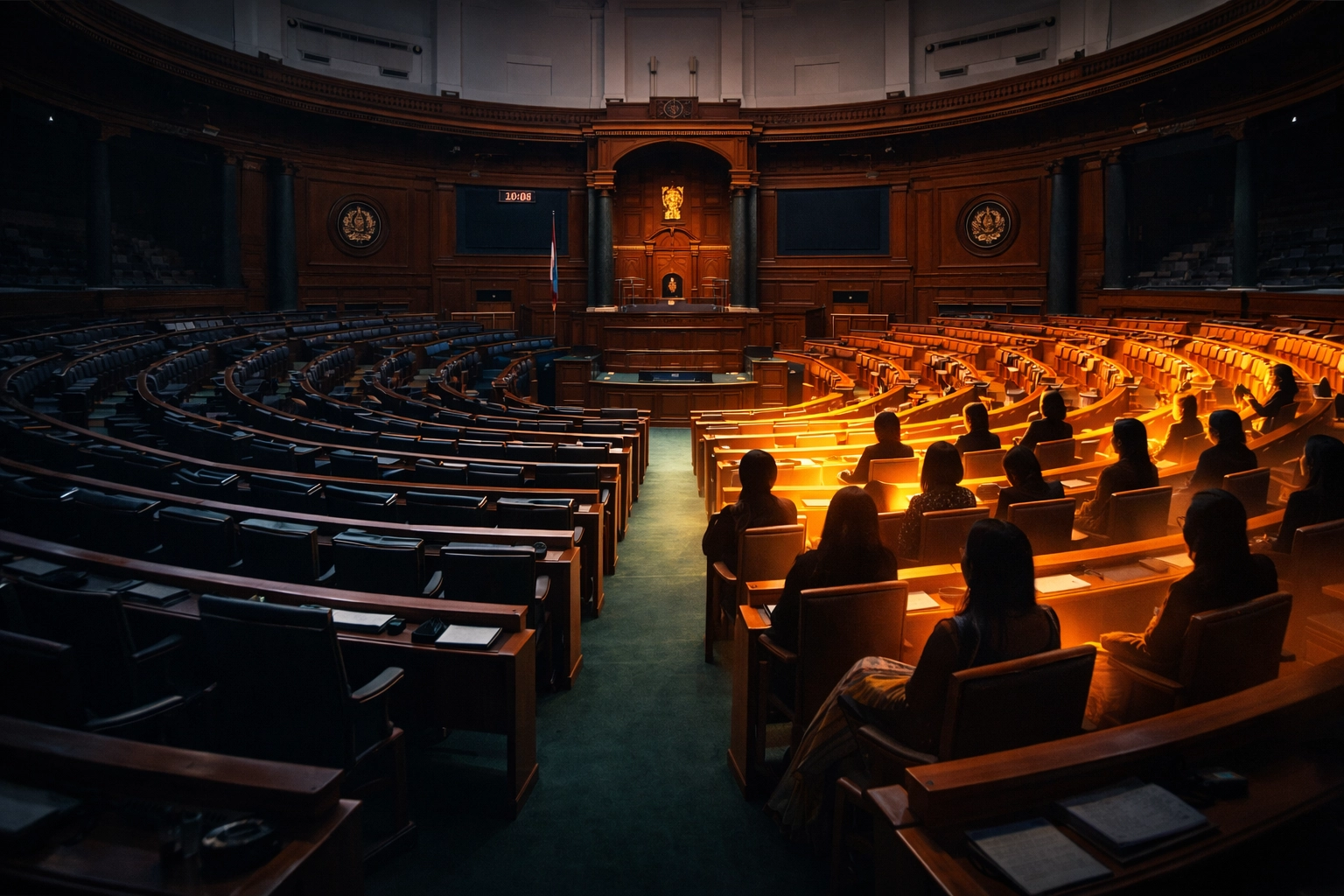
India just constitutionally guaranteed women a third of Parliament. The world’s largest democracy has done what the world’s oldest refuses to.
I. The Door That Was Never Opened
Picture Savitribai Phule the woman who, in 1848, opened India’s first school for girls in Pune and walked to it every day through a gauntlet of villagers who pelted her with dung and stones for daring to educate women. She wiped herself clean and kept walking. She kept teaching. She kept showing up, not because the system invited her in, but because she understood, with absolute clarity, that those who do not enter the room where decisions are made will have those decisions made about them.
One hundred and seventy-eight years later, India finally passed a law that says: the room must be opened. One-third of it, at minimum, must belong to women.
On 20 and 21 September 2023, both Houses of India’s Parliament seated for the first time in the new Sansad Bhavan passed the Nari Shakti Vandan Adhiniyam, the Constitution’s 106th Amendment Act, with a vote of 454 to 2 in the Lok Sabha and unanimous passage in the Rajya Sabha. The law guarantees a 33 per cent reservation for women in the Lok Sabha, all state legislative assemblies, and the Delhi Assembly. It also applies vertically meaning the reservation operates within the already-existing reserved categories for Scheduled Castes and Scheduled Tribes. On 8 April 2026, the Union Cabinet cleared three amendment bills to finally operationalise the Act, paving the way for a special Parliament session beginning 16 April 2026. The Lok Sabha is set to expand from 543 to 816 seats, with 273 of those seats roughly one-third reserved for women. Implementation is targeted for the 2029 general elections.
This is not a gift. It is the discharge of a debt that is 27 years overdue.
II. Twenty-Seven Years of Deliberate Waiting
The Women’s Reservation Bill was first introduced in Parliament in 1996, during the government of H. D. Deve Gowda. It lapsed. It was reintroduced in 1998 and 1999, under Atal Bihari Vajpayee. It lapsed again. In 2008 and 2010, it cleared the Rajya Sabha and then died in the Lok Sabha, killed not by one party but by the bipartisan consensus of men who had reasons to believe that democracy was better when they ran it.
The word for those twenty-seven years is not *delay*. The word is obstruction.
Because here is what was happening in the meantime: India’s panchayati raj institutions, village and municipal bodies had already implemented 33 per cent reservation for women since the 73rd and 74th Constitutional Amendments of 1993. One million women entered local governance. They built roads where there had been none. They dug wells. They pushed for girls’ toilets in schools. A landmark study by economists Raghabendra Chattopadhyay and Esther Duflo documented in Econometrica showed that in villages with women leaders, investment in public goods aligned closely with women’s expressed priorities. The reserved panchayats were not less effective. They were differently effective. They attended to what had been ignored.
The men in Parliament watched this happen for thirty years. They passed reports about it. They praised women in speeches. They invoked Durga and Saraswati and every goddess in the pantheon. And then they went back to their caucuses and killed the bill, again, because reserving one-third of Parliament for women meant vacating one-third of Parliament’s seats that currently belonged to them, seats through which they dispensed patronage and power and that, frankly, they had no intention of giving up.
What they were protecting was not democracy. They were protecting incumbency the single most powerful force in any legislative system, the force that ensures power reproduces itself in the image of whoever already holds it.
III. The Hollow Celebration and Its Built-In Delay
When the Modi government finally passed the Nari Shakti Vandan Adhiniyam in September 2023, the applause was immediate, the self-congratulation thunderous. Prime Minister Modi called it “among the most special occasions of my life.” Sonia Gandhi spoke of women’s journeys from smoke-filled kitchens to floodlit stadiums. The entire hall stood and clapped.
And then the implementation clause was read.
The reservation would take effect only after a delimitation exercise, which itself could only occur after the national census, a census that was already two years overdue in 2023 and has still not been conducted. Left unchanged, the Act would not have become operational until 2034 at the earliest. A law passed with fanfare in 2023 would have delivered its first woman reservation in 2034. The women of India were handed a promissory note and told to wait another decade.
This was not an administrative oversight. The census-and-delimitation trigger was written into the Act by the people who drafted it. Politicians who had obstructed this bill for twenty-seven years did not suddenly become zealots for women’s representation; they became skilled architects of delay with constitutional precision. You pass the bill, you receive the credit, you bury the implementation clause in subordinate legislation and census timelines. The headline is the gift. The fine print is the clawback.
The political opposition called it exactly what it was. Congress’s Mallikarjun Kharge stood in the Rajya Sabha and demanded immediate implementation: “Why can’t this be effective before 2024?” He was right to demand it. The 2024 Lok Sabha elections came and went with 13.62 per cent women MPs, a decline from 14.7 per cent in 2019. India, with a law guaranteeing 33 per cent on its statute books, went backwards. The promise was law. The law was not yet real.
What redeems the story is that something shifted. Facing political pressure and the undeniable absurdity of a reserved-but-inoperative constitutional amendment, the government moved. The April 2026 amendment based on the 2011 census rather than the yet-to-happen 2027 census accelerates the timeline to 2029. It is not immediate justice, but it is no longer deferred oblivion.
IV. The Word Nobody Uses:Presence
There is a word the conventional debate about this Act never quite uses with the precision it deserves: presence.
Not representation. Not empowerment. Not even equality. Presence.
Representation can be a photograph. Empowerment can be a government scheme. Equality can be a constitutional preamble that goes unenforced for generations. But presence is physical, undeniable, and structural. It means that when the budget is tabled, when defence policy is debated, when agricultural subsidies are allocated, when legislation on domestic violence or maternal healthcare or land rights is drafted a woman’s body is in the room. Her voice is on the record. Her vote counts.
The research is unambiguous on what presence does. Countries with legislated gender quotas have, on average, five percentage points higher women’s parliamentary representation than those without. Women legislators, regardless of party, tend to prioritise public health investment, education funding, and social protection in ways that male legislators statistically do not. The panchayat evidence from India thirty years of it shows that when women have formal power over resource allocation, the resources move toward what women need, which is also, very often, what their children need, what the elderly need, what marginalised communities need.
The absence of presence is not neutral. It is not a gap, an omission, a failure to invite. It is a policy choice that has been costing India for every year women were not in that room. Every maternal mortality statistic that need not have been that number. Every girl child who dropped out of school in a district whose budget was set by men who had never carried water on their heads. Every rape case that dragged through the courts for a decade because the law was written and administered by people who had never been afraid to walk home at night.
The Nari Shakti Vandan Act does not solve these problems by itself. No law does. But it fundamentally changes the architecture of who solves them. It mandates that 273 women sit in the next Lok Sabha whether or not political parties find them convenient, whether or not male incumbents find them threatening, whether or not patriarchy finds them palatable.
This is not a favour to women. This is a correction to governance.
V. The Mirror the World Needs to Hold Up
India is now doing what the United States has never done, what Israel has never done, and what most self-described democracies have talked about endlessly while treating as perpetually optional.
The United States Congress, in 2025, is 28 per cent women, the highest figure in its history, achieved after two and a half centuries of democratic governance. Not 28 per cent as a floor. Not 28 per cent as a constitutional guarantee. Twenty-eight per cent was the accidental, incremental result of individual elections in a system with no quotas, no mandates, and no mechanism to correct a structural imbalance. At the current pace of progress, gender parity in the US Congress will not be achieved for more than 80 years. The country that lectures the world about democracy and freedom is outranked on women’s political representation by Rwanda, Cuba, Nicaragua, Bolivia, Mexico, and the United Arab Emirates. Its women constitute more than half its population and hold less than a third of its seats. No law compels this to change. No amendment demands it. The system that produced the problem is trusted, without revision, to fix itself.
Israel’s Knesset, which presents itself as the only democracy in its region, consistently achieves around 25 to 30 per cent women parliamentarians and congratulates itself for the achievement. There is no quota legislation. There is no constitutional mandate. Women in Israeli politics navigate the same incumbent advantage, the same candidate-selection gatekeeping, the same informal networks built over decades of male political culture, as women everywhere else. The state that bombs other countries’ civilian nuclear programmes in the name of civilisational values has not seen fit to constitutionally guarantee its own women’s presence in the legislature.
Meanwhile, India with all its complications, all its delays, all the dynastic risk and the proxy-husband problem and the legitimate demand for OBC sub-quotas that the Act still does not address — has etched into its Constitution a number: one-third. A floor, not a ceiling. A guarantee, not an aspiration.
The objections to this Act are real and must be taken seriously. The failure to include an OBC sub-quota is a genuine lacuna — a law claiming to empower women cannot silence the particular marginalisation of Other Backward Class women, who face compounded disadvantage. The rotation of reserved seats between constituencies carries genuine risks of weakening electoral accountability, as an MP knowing she cannot stand for the same seat twice has different incentives than one building a long-term constituency relationship. The “Sarpanch Pati” phenomenon, the panchayat dynamic in which a woman holds elected office while her husband exercises the real power remains a structural threat at the parliamentary level if political parties field proxy candidates to satisfy quotas while maintaining male control.
These are not arguments against the Act. They are arguments for making it more robust, not less real. The answer to an imperfect law guaranteeing women’s presence is not to send women back to the margins while the perfect law is written. It is to legislate the corrections of OBC sub-quotas, candidate eligibility standards, and enforcement mechanisms without withdrawing the guarantee.
VI. The Long Walk Home
Savitribai Phule wiped the dung from her sari and kept walking. She understood something that twenty-seven years of parliamentary obstruction tried to disprove: that the act of showing up, of being physically, undeniably present in a space that was designed to exclude you, is itself a form of governance. Not because presence alone transforms systems it does not but because absence guarantees that they will not transform.
The Nari Shakti Vandan Adhiniyam is not the end of the argument about women’s place in Indian democracy. It is the end of the argument that the room must stay as it is.
When 273 women take their seats in the next Lok Sabha women who are farmers and lawyers and teachers and activists and first-generation graduates and yes, some of them wives and daughters of powerful men who will need to be watched, the shape of Indian governance will change. Not uniformly, not magically, not without the hard and slow work of accountability that democracy demands. But change is the point. Change is what was obstructed for twenty-seven years. Change is what has, finally, been made constitutionally obligatory.
Half the country has been waiting a long time to stop being governed at and start governing. In 2029, they will begin.
The question India must now ask itself is not whether 33 per cent is enough. It is not. The question is whether a democracy that wrote this guarantee into its constitution and then watched its own parties field proxy candidates, its own political families route power through women’s names to male hands, will have the honesty and the institutional courage to enforce the spirit of the thing it signed.
The law is written. The room must now be entered. And this time, there will be no dung to wipe away. Only the business of governing a nation that has, for too long, been governed by half.
The Nari Shakti Vandan Adhiniyam, Constitution (106th Amendment) Act, received Presidential assent on 28 September 2023. The Union Cabinet cleared amendment bills on 8 April 2026 for a special Parliament session beginning 16 April 2026. Implementation is targeted for the 2029 Lok Sabha elections.
Subscribe Deshwale on YouTube
