




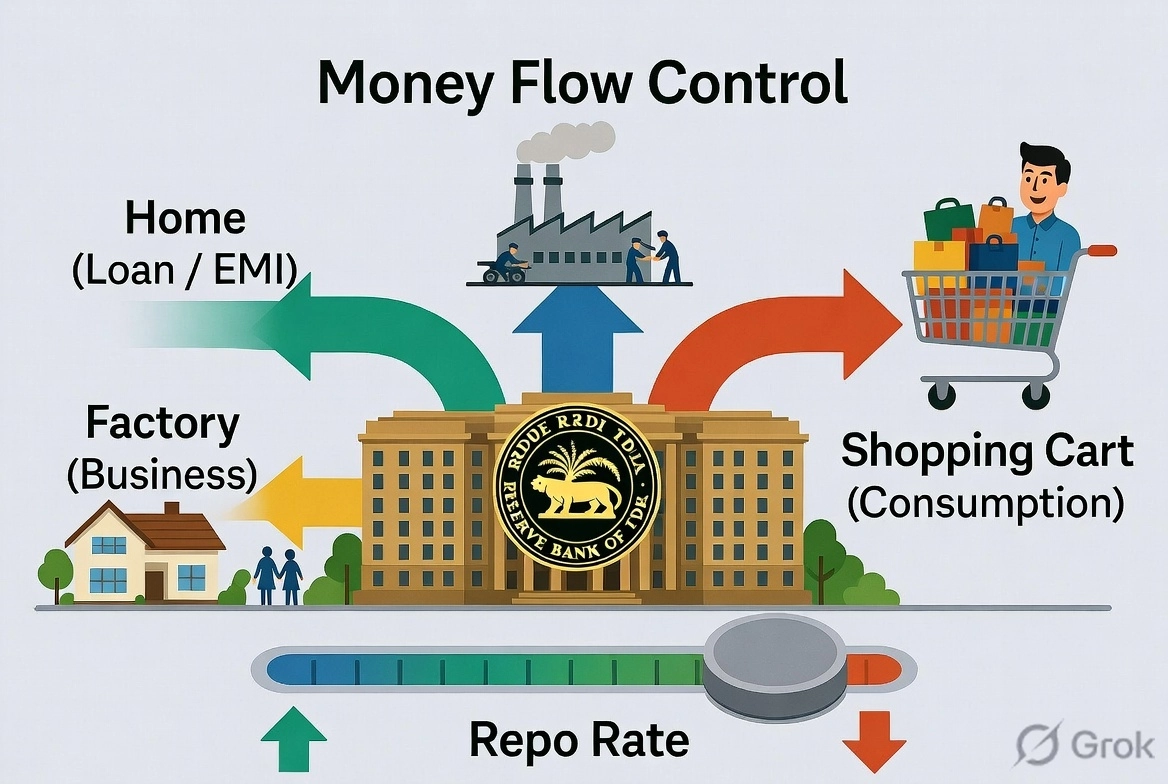
The repo rate is one of the most important tools used by the Reserve Bank of India (RBI) to manage the Indian economy. In simple terms, it is the interest rate at which the RBI lends short-term money to commercial banks against government securities (such as bonds or treasury bills). The full form of “repo” is Repurchase Option or Repurchase Agreement banks sell securities to the RBI with an agreement to buy them back later at a slightly higher price. The difference in price effectively becomes the interest paid by the banks.
When the RBI wants to encourage borrowing and spending in the economy, it lowers the repo rate. This makes loans cheaper for banks, which in turn reduces interest rates on home loans, car loans, personal loans, and business credit. On the other hand, when inflation is rising too fast, the RBI may keep the repo rate steady or raise it to make borrowing more expensive, thereby cooling down demand and prices.
In India, the repo rate is decided by the Monetary Policy Committee (MPC), a six-member body chaired by the RBI Governor. The committee meets bi-monthly (six times a year) and sets the rate based on inflation trends, economic growth, global developments, and liquidity conditions. The RBI’s primary target is to keep Consumer Price Index (CPI)inflation around 4 per cent, with a comfort band of 2–6 per cent.
How the Repo Rate Affects Everyday Indians
– Home loan borrowers: Most floating-rate home loans in India are linked to the repo rate or the Marginal Cost of Funds-based Lending Rate (MCLR). A lower repo rate generally leads to reduced Equated Monthly Instalments (EMIs).
– Fixed deposit and savings: When the repo rate is high, banks offer better returns on deposits to attract funds. When it is low, deposit rates tend to fall.
– Businesses and investment: Cheaper credit encourages companies to expand, hire more people, and invest in new projects, supporting job creation and overall growth.
– Inflation control: By influencing the cost of money, the repo rate helps the RBI keep prices of essential items like food, fuel, and vegetables in check.
India’s economy, being highly sensitive to oil prices and monsoon-driven food inflation, relies heavily on this tool. A stable and predictable repo rate environment builds confidence among investors and helps maintain the rupee’s value.
Latest RBI Announcement April 2026
On 8 April 2026, the RBI’s Monetary Policy Committee, chaired by Governor Shri Sanjay Malhotra, announced its first bi-monthly monetary policy decision for the financial year 2026-27. The MPC unanimously decided to keep the repo rate unchanged at 5.25 per cent. The policy stance was maintained at ‘neutral’, giving the central bank flexibility to respond to future developments.
This marks the second consecutive pause after a series of rate cuts in the previous financial year (a total reduction of 125 basis points). The standing deposit facility (SDF) rate remains at 5.00 per cent, while the marginal standing facility (MSF) rate and the bank rate continue at 5.50 per cent.
In its projections, the RBI estimated real GDP growth for FY 2026-27 at 6.9 per cent, with quarterly estimates ranging from 6.7 per cent to 7.2 per cent. CPI inflation for the year is projected at 4.6 per cent, comfortably within the target band but with upside risks noted due to global factors.
Governor Malhotra highlighted heightened global uncertainties, particularly the ongoing conflict in West Asia (US-Iran tensions), which has pushed crude oil prices above $100 per barrel. This poses risks of higher imported inflation and pressure on India’s current account. The central bank also flagged potential supply chain disruptions and volatility in commodity prices that could affect domestic production costs.
Despite these external headwinds, the RBI noted that India’s economic fundamentals remain strong and resilient. The decision to hold rates reflects a cautious, data-dependent approach prioritising price stability while continuing to support growth.
What This Means for You Right Now
– Loan borrowers: Your EMIs on repo-linked home, car, or personal loans are likely to remain stable in the near term. Banks are not under immediate pressure to change lending rates.
– Depositors: Fixed deposit rates are expected to stay largely unchanged for now, offering reasonable but not very high returns.
– Overall economy: The neutral stance signals that the RBI is watching inflation risks closely but remains ready to ease further if domestic growth needs support and global conditions improve.
The repo rate is a powerful yet subtle lever that influences everything from the cost of buying a house to the returns on your savings. In April 2026, by maintaining the rate at 5.25 per cent with a neutral stance, the RBI had chosen stability amid global turbulence, aiming to safeguard India’s hard-earned macroeconomic gains while keeping room for future action.
As always, the next MPC meeting will provide fresh direction based on evolving data. For ordinary citizens and businesses alike, understanding the repo rate helps make better financial decisions in an ever-changing economy. Stay informed, and let the RBI’s balanced approach work towards a stable and growing India.
Subscribe Deshwale on YouTube
