



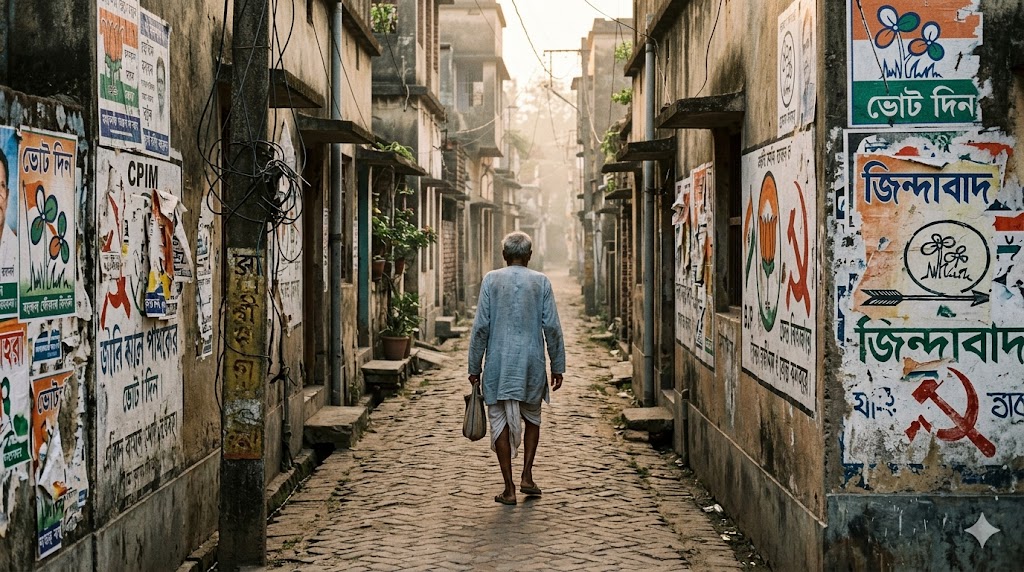
Politics and Violence: The Enduring Shadow Over West Bengal’s Electoral Culture
The political history of West Bengal has long been characterised by intense ideological battles and vibrant democratic participation. Yet alongside this tradition of political engagement lies a darker and more troubling phenomenon: the recurring presence of political violence.
From the decades of communist dominance led by the Communist Party of India (Marxist) to the contemporary rivalry between the All India Trinamool Congress of Mamata Banerjee and the Bharatiya Janata Party, electoral competition in Bengal has often been accompanied by episodes of confrontation, intimidation, and clashes between rival political groups.
Understanding this phenomenon requires looking beyond individual incidents to examine the deeper historical and institutional factors that have shaped Bengal’s political culture.
The Historical Roots of Confrontational Politics
Political mobilisation in Bengal has traditionally been passionate and ideologically charged. From the anti-colonial movements of the early twentieth century to the turbulent decades following independence, the state developed a reputation for vigorous political activism.
One particularly influential episode was the radical left-wing insurgency associated with the Naxalite Movement during the late 1960s and early 1970s. Although the movement was eventually suppressed, it left behind a legacy of militant political activism that shaped the broader culture of political contestation in the state.
By the time the Left Front assumed power in 1977, political conflict had already become deeply embedded in Bengal’s public life.
The Cadre-Based Political System
During the long tenure of the Left Front government, the political system of West Bengal became heavily structured around party cadres. The Communist Party of India (Marxist) maintained extensive networks of local workers who played a central role in electoral mobilisation, dispute resolution, and grassroots political organisation.
While this system helped the party maintain electoral dominance, it also intensified localised political rivalries. Control over village councils, trade unions, and municipal bodies often carried significant economic and administrative influence.
As a result, electoral competition sometimes evolved into struggles for territorial and organisational control between rival political groups.
Political Transition and New Rivalries
The fall of the Left Front in 2011 marked a historic political transition. However, the transformation of power did not immediately alter the underlying dynamics of cadre-based politics.
As the All India Trinamool Congress expanded its influence across the state, many local political networks shifted allegiance from the communist establishment to the new ruling party. In several regions, this transition was accompanied by confrontations between supporters of rival political organisations.
In the years that followed, the rise of the Bharatiya Janata Party as a major challenger further intensified electoral competition in West Bengal.
Elections as High-Stakes Contests
In many parts of the state, elections are not viewed merely as periodic democratic exercises but as high-stakes contests determining local political authority. Control of local institutions often carries implications for access to public resources, government programmes, and administrative influence.
This environment can encourage confrontational tactics during election campaigns, particularly in closely contested constituencies.
Incidents of political violence have been reported during various electoral cycles, including local body elections and state assembly contests. These episodes have drawn criticism from civil society groups and raised concerns about the health of democratic institutions in the state.
The Polarisation of Contemporary Politics
The growing rivalry between the All India Trinamool Congress and the Bharatiya Janata Party has introduced a new dimension to Bengal’s political landscape. The intense competition between these two parties has sharpened political polarisation in several regions.
Election campaigns have increasingly featured sharp rhetoric and highly charged public mobilisation. In such an atmosphere, local disputes sometimes escalate into broader political confrontations.
Observers note that the politicisation of local institutions and the persistence of cadre-based mobilisation continue to influence the nature of electoral competition in the state.
Institutional Challenges
Addressing the problem of political violence requires not only political restraint but also stronger institutional safeguards. Law enforcement agencies, the judiciary, and the Election Commission play crucial roles in ensuring that electoral processes remain free and fair.
Efforts to strengthen democratic norms and reduce confrontation will depend on the willingness of political actors across the spectrum to prioritise peaceful political competition.
The challenge is particularly significant in a state with a long tradition of intense political engagement such as West Bengal.
Democracy Under Strain
Despite these challenges, Bengal continues to witness high levels of voter participation and political awareness. Elections remain fiercely contested, and public debate remains vibrant.
Yet the persistence of political violence underscores a paradox within the state’s democratic life: a deeply engaged electorate operating within a political culture where confrontation has often accompanied competition.
Whether Bengal can move beyond this pattern will depend on the evolution of its political institutions and leadership in the years ahead.
Part V, the final instalment of this series, examines whether Mamata Banerjee can retain her political dominance in West Bengal, or whether the state is entering a new era of competitive bipolar politics.
