




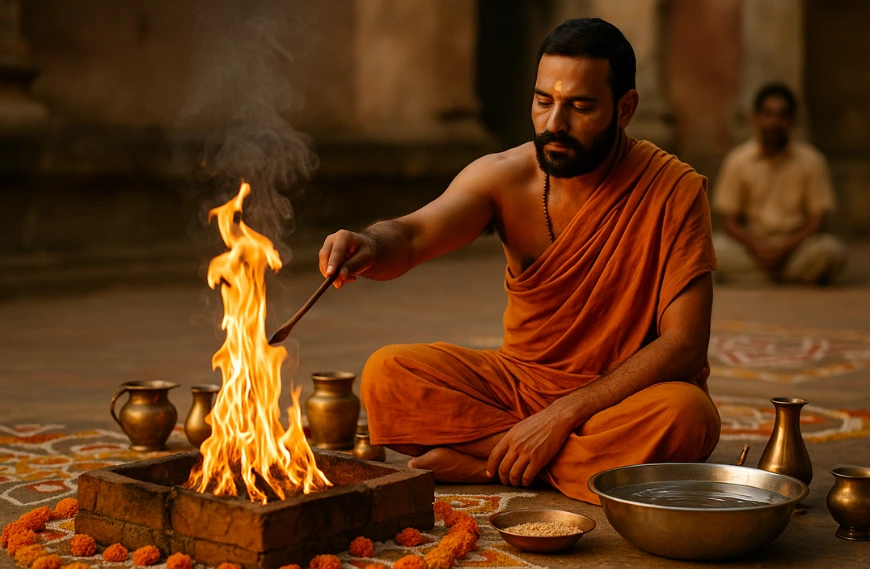
Smoke curls upwards. Flames dance in copper vessels. Water ripples in silver bowls. A yajña begins. The priest chants. The fire awakens. Water is offered. Sparks fly. Smoke rises. In each gesture lies meaning as old as time.
Vedic yajñas, or sacrificial rites, are among Hinduism’s most ancient rituals. They date to the Rig Veda, composed around 1500 BCE. The word yajña means “sacrifice,” but sacrifice here is not loss. It is exchange. The deity receives offerings. The worshipper gains blessings. Fire is the mediator, Agni, the god of flame.
Agni’s role is central. He carries oblations, ghee, grains, herbs, into the divine realm. His crackle is a language. Each sound, each sibilant, matches a mantra’s metre. The Rig Veda prescribes precise intonation. Deviate, and the mantra loses power. The science of sound is embedded here. Scholars call it śikṣā, the phonetics of Vedic chant.
Water, too, plays a vital part. Soma rituals involved pressing juice, possibly from now-lost or unidentified plants, into bowls. The liquid was both offering and elixir. It was passed between priests and imbibed. Water baths purify bodies and minds. Rivers like the Ganges become living vessels of cleansing power. “Water is the womb of the cosmos,” says Pandit Rajesh Shukla of Varanasi. “It links the human and the divine.”
Each element, fire, water, earth, air, ether, finds its place. The fire pit (vedī) is laid out in geometric precision. Sand and clay mark squares and circles. Those shapes reflect cosmic order. Fire burns at the centre. Water basins lie to the east. Offerings proceed in a choreographed dance of direction and timing.
Modern researchers examine yajña smoke. Ghee combustion releases aromatic compounds. Some studies suggest antimicrobial properties in the smoke. Traditional healing huts in the Himalayas still use yajña smoke to cleanse spaces. While initial findings are promising, comprehensive scientific validation is still ongoing. Yet practitioners have known for millennia: fire transforms. It purifies.
The yajña’s social function is equally profound. Ancient rishis performed grand public sacrifices to sustain kingdoms and ensure rains. The horse sacrifice (Aśvamedha) was a royal rite. Today’s yajñas, weddings, housewarmings, temple dedications, bind communities, though the scale and style vary across regions and traditions. Villagers gather. They share food. They sing. They witness continuity between past and present.
Performing a yajña demands expertise. Shrauta priests train for years in Vedic schools. They memorise thousands of verses. They learn hand gestures (mudrās). They master fire-tending techniques. Their lineage ensures purity of chant and ritual. Errors are not mere mistakes; they can disrupt the entire rite.
Nonetheless, adaptation has occurred. Urban yajñas may use gas-powered havan kunds instead of wood. Eco-conscious devotees choose sustainably harvested ghee and wood. Some rites omit animal sacrifice, replacing it with symbolic offerings. Yet the core remains: fire and water, chant and offering, heart and cosmos.
For many, participating in a yajña is transformative. You sit cross-legged. You feel the heat of the fire. You taste dropped ghee’s sweetness. You hear Vedic syllables vibrating in your chest. You glimpse a reality beyond the senses. As the final āghātmā (closing) mantra fades, you stand renewed.
Yajñas remind us of our place in the web of existence. They show that ritual can be both poetic and precise. They merge symbolism with sonic science. They unite communities with the cosmos. In fire’s glow and water’s flow, we touch the sacred.
