




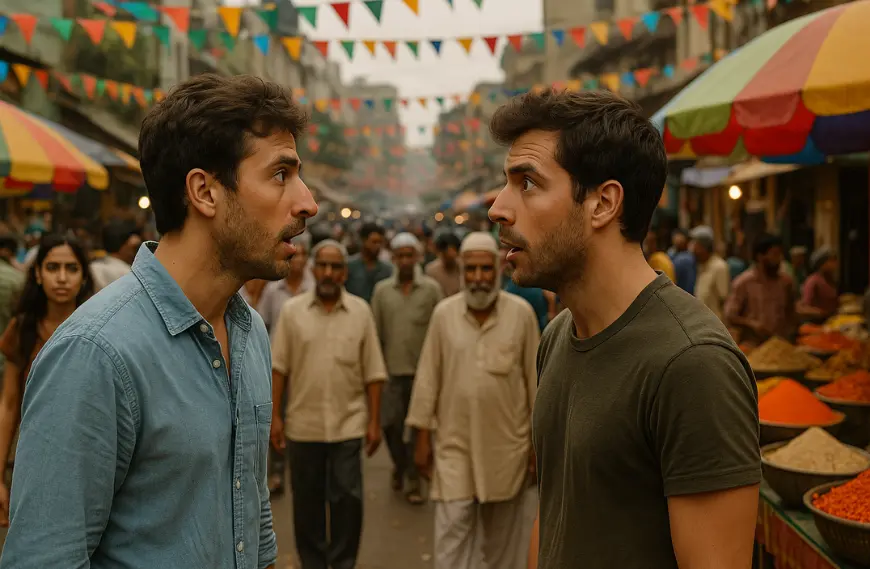
In a bustling market, a stranger’s face feels oddly familiar. During a monsoon festival, you spot your mirror image briefly. Across crowded cities or quiet villages, lookalikes ignite curiosity worldwide. Have you ever mistaken someone for a loved one? Or seen your own features echoed in another? The mystery of doppelgängers captivates hearts everywhere. This journey into science’s answers unveils a shared human story. It blends genetics, culture, and wonder into one vibrant thread. How many lookalikes roam our planet’s vast mosaic? Let’s explore a phenomenon that binds us all.
Picture weaving through a vibrant street fair, alive with music. A face stops you, eerily like your childhood friend. It’s not them, yet the resemblance startles. Science names this a doppelgänger, a twin by chance. Humans share 99.9 percent of their DNA, a profound unity. Tiny genetic tweaks, called polymorphisms, craft our unique faces. With eight billion souls on Earth, faces overlap inevitably. Probability suggests you have about seven lookalikes globally. This isn’t mere guesswork; it’s mathematical magic. In a world of billions, your twin might be closer than imagined.
Genetics only begins to unravel this enigma. The environment shapes faces as much as genes do. Diets rich in grains broaden cheeks in some regions. Coastal climates soften skin textures uniquely. These subtle forces create near-identical faces worldwide. A 2017 Stanford study confirmed this with precision. Researchers scanned thousands of faces using algorithms. They found unrelated people share striking similarities often. Genetic convergence, not shared ancestry, drives these matches. This discovery thrills, connecting biology to everyday encounters.
Facial recognition technology amplifies this wonder further. Tools like Google’s DeepFace analyze billions of images daily. They match faces with startling accuracy across cultures. A 2023 MIT study revealed a fascinating truth. Among 10,000 faces, one pair matched 95 percent closely. This is statistical destiny, not coincidence. Digital platforms now let you find your double. Upload a selfie, and discover a twin in Tokyo. Or perhaps in a spice-scented Indian bazaar. This tech weaves a global web of resemblance.
Culture adds colour to the lookalike phenomenon. In cinema-obsessed cities, star mimics draw crowds joyfully. Think of Shah Rukh Khan’s doubles at festive fairs. Or Pedro Pascal’s lookalike contest in New York, June 2025. Social media buzzed as fans crowned a Brooklyn dad. These moments echo universal delight in mimicry. From Rio’s carnivals to London’s streets, doubles entertain. They spark laughter, bridging cultures through shared human quirks. This global love for lookalikes feels like a warm embrace.
Our brains fuel this fascination, wired for faces. A skill called pareidolia seeks patterns in chaos. It’s why we see faces in clouds or crowds. A 2021 Nature study explored this human trait. Facial recognition aids survival, bonding, and trust. You spot your mother’s eyes in a stranger’s gaze. Or a sibling’s smile in a distant city. These moments feel magical, grounded in neuroscience. They remind us of humanity’s deep connections. Lookalikes aren’t just science; they’re emotional sparks.
Mathematics offers another lens, elegant and precise. The birthday paradox illustrates this beautifully. With 23 people, two likely share a birthday. Faces follow a grander version of this rule. A 2019 study by John Barrow crunched the numbers. Thousands of near-identical faces exist among billions. Your double might sip tea in a Himalayan café. Or dance at a São Paulo festival. This probability enchants, blending logic with human wonder. It makes Earth feel intimately small.
Human diversity amplifies these chance encounters. Earth’s gene pools, from African plains to Asian valleys, vary widely. Yet, genetic bottlenecks create resemblance clusters. A 2020 Genetics study traced such patterns globally. Isolated communities often share facial traits closely. This explains why a stranger in Ladakh feels familiar. Or why a Londoner mirrors a Delhiite’s smile. These echoes tie our ancestries to science’s revelations. Your lookalike might carry a shared human story.
Technology pushes this mystery into new realms. In 2024, DeepFace matched faces across continents effortlessly. It found doubles between Mumbai and Mexico City. Apps now let anyone hunt for their twin playfully. These tools excite, sparking global curiosity. Yet, privacy concerns hover like monsoon clouds. Biometric databases, like India’s Aadhaar, raise ethical questions. Finding a lookalike thrills, but safeguards matter. Science’s advances dance with responsibility.
Cinema culture fuels lookalike mania vibrantly. In 2023, a Deepika Padukone mimic charmed Hyderabad’s crowds. Such events echo ancient tales of doubles. Mythologies worldwide speak of shadow selves, like India’s epic twins. These stories blend folklore with modern science. Lookalikes feel like living myths, rooted in genetics. They captivate, tying human imagination to DNA’s dance. This fusion of story and fact enchants globally.
Social media turns lookalikes into a digital carnival. In June 2025, X posts buzzed with doppelgänger tales. A student found her twin in a viral meme. Instagram’s reels spark lookalike challenges worldwide. Billions online multiply these face matches exponentially. From monsoon-lit phones to snowy screens, people connect. This digital wave unites humanity’s curious hearts. It’s a global quest for mirrored selves.
Emotionally, lookalikes stir profound feelings. Meeting a double feels like finding a lost kin. A 2022 Psychology Today study captured this joy. People feel curiosity, warmth, even unease at times. Imagine spotting your twin at a global festival. Or in a quiet Himalayan village market. These encounters transcend science, touching the soul. They remind us of our shared human essence. Lookalikes weave emotional threads across Earth.
Philosophically, lookalikes challenge our sense of self. Are we unique if doubles exist? Ancient wisdom offers a soothing lens here. Many traditions see humanity as one spirit. Your lookalike might reflect this universal bond. Science and philosophy converge in this mystery. Seven doubles may wander Earth’s vastness. Yet, they mirror a deeper, shared identity. This thought invites introspection, warm and profound.
Future science promises more doppelgänger secrets. By 2030, genetic mapping may pinpoint lookalike locations. Biotech hubs, from Silicon Valley to Bengaluru, lead this. Yet, ethical dilemmas like identity theft loom large. Science’s march demands wisdom and care. This balance excites, blending promise with caution. The quest for lookalikes is humanity’s mirror.
As rains sweep across vibrant festivals, lookalikes unite us. From bustling cities to global screens, faces echo. Science reveals why: DNA, math, and human wiring. Your double might laugh in a Moroccan souk. Or pray in a Himalayan temple. This phenomenon binds eight billion souls. It’s a celebration of our shared humanity. So, pause when a stranger’s face feels familiar. Science whispers: we’re all connected, forever entwined.
