




Union Budget 2026 one rupee breakdownBy Sanjay Shah
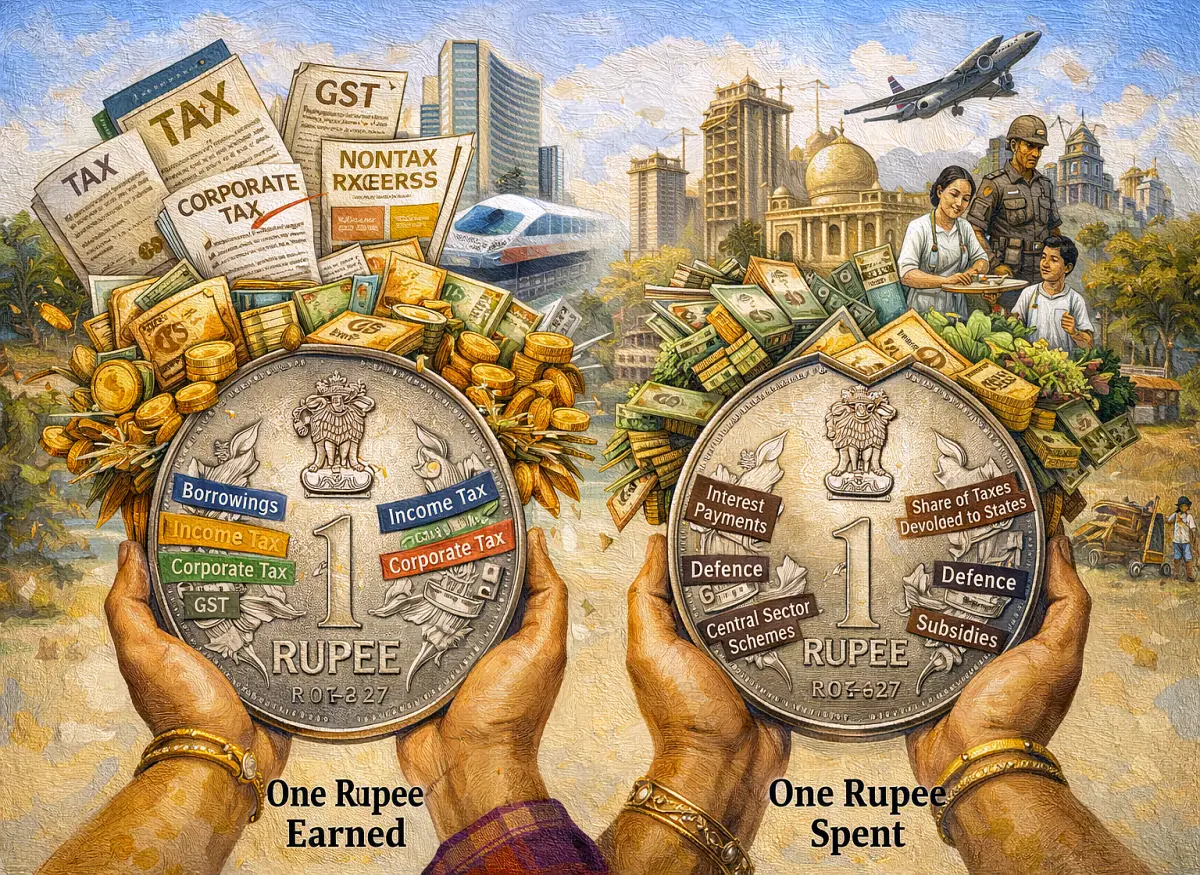
Every Budget boils down to one basic question that every household asks quietly: sarkar ka paisa aata kahan se hai, aur kharch hota kahan hai? Behind all the speeches and headlines lies simple arithmetic. The central government earns one rupee. Then it decides how to spend that rupee.
The Union Budget 2026-27, presented by Finance Minister Nirmala Sitharaman on Sunday, February 1, 2026, gives a clear picture of those choices. Total expenditure is estimated at ₹53.5 lakh crore. Total receipts, excluding borrowings, are estimated at around ₹36.5 lakh crore. The gap is filled by debt.
Let us break that one rupee down. Where it comes from. And where it goes. The numbers are based on the official Budget documents and follow the standard rupee-by-rupee presentation used by the finance ministry.
One Rupee Earned: Sources of Revenue
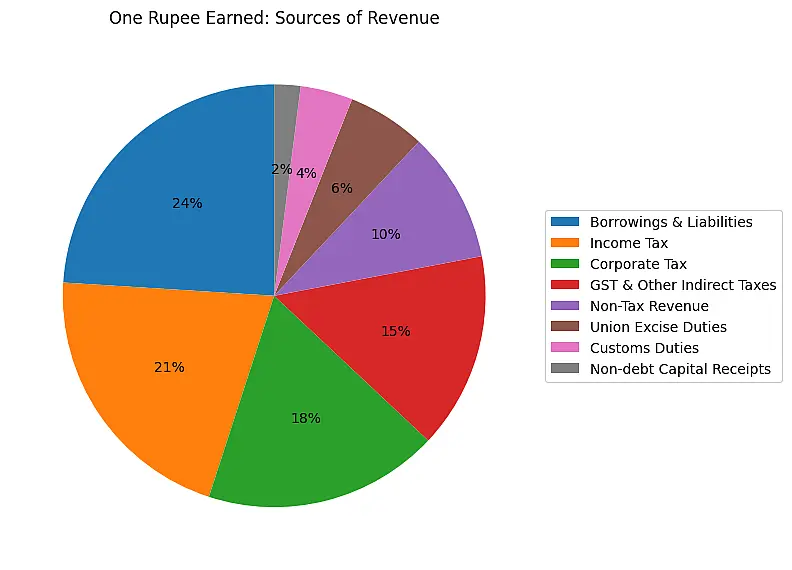
The government collects money through taxes, non-tax receipts, capital receipts and borrowings. Here is the approximate share in every rupee earned:
Borrowings and other liabilities – 24 paise
This is the largest single piece. Gross market borrowings are placed at ₹17.2 lakh crore, net borrowings at ₹11.7 lakh crore. In plain words, nearly one-fourth of the spending is funded by new debt. This keeps the fiscal deficit at 4.3% of GDP, but the debt burden will stay high for years.
Income tax – 21 paise
Personal income tax from salaried people and professionals forms a big part. No change in tax slabs or basic exemption limit means the load on the middle-class remains unchanged. Growth in this head comes mainly from better compliance and formalisation of jobs.
Corporate tax – 18 paise
Companies contribute almost one-fifth. Steady corporate profits and wider tax net have kept this stable. No major corporate tax cut was announced, so the share stays reliable.
Goods and Services Tax (GST) and other indirect taxes – 15 paise
GST is now the backbone of indirect taxes. Excise duties on fuel, tobacco and alcohol, plus customs duties, add to this pool. Inflation helps collections here, but it also hurts consumers.
Non-tax revenue – 10 paise
Dividends from public sector banks and companies; especially RBI surplus transfers; licence fees, spectrum auctions, user charges and profits from public enterprises. This head fluctuates year to year. When RBI transfers are large, the fiscal math looks comfortable.
Union excise duties – 6 paise
Mainly on fuel, tobacco and sin goods. Gradual increases continue.
Customs duties – 4 paise
Import duties. Some exemptions on critical minerals, cancer drugs and medical inputs reduce this share slightly.
Non-debt capital receipts – 2 paise
Recovery of earlier loans and small disinvestment proceeds.
Taxes (direct and indirect) make up roughly 64 paise of every rupee. Borrowings cover 24 paise. The rest comes from dividends, fees and recoveries. The heavy dependence on debt and taxes is a structural reality. Widening the tax base remains a slow process.
One Rupee Spent: Expenditure Priorities
Spending reveals the government’s real choices more than revenue ever can. Here is how one rupee is likely to be used:
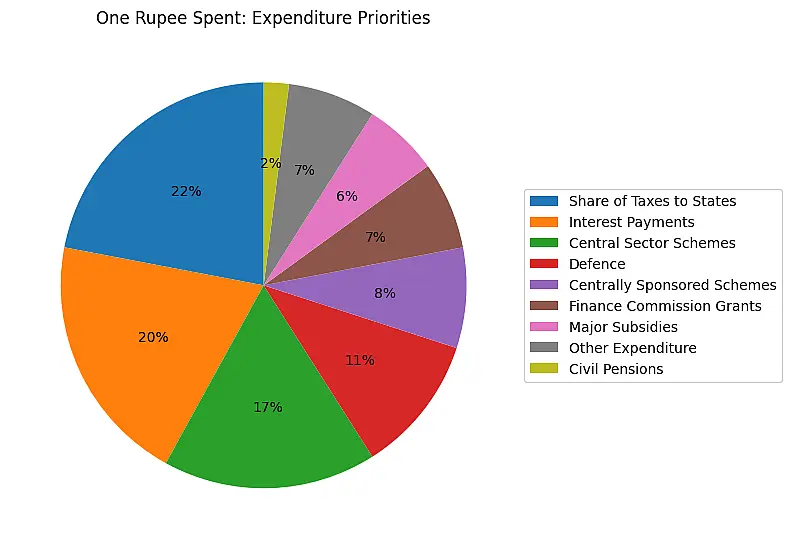
Share of taxes devolved to states – 22 paise
This is the biggest single item. States receive their constitutional share of central taxes. Higher devolution supports state spending on schools, hospitals, roads and rural schemes. It is a non-negotiable federal transfer.
Interest payments – 20 paise
The cost of servicing past debt. This remains the largest drag on the Budget. Every rupee spent on interest is one rupee not available for new schools, hospitals or job-creating projects.
Central sector schemes – 17 paise
Fully funded by the Centre. Covers major welfare programmes in health, education, agriculture, women and child development, and social justice.
Defence – 11 paise
Allocation of ₹7.85 lakh crore, the highest ever! Salaries, pensions, modernisation and capital procurement take the bulk. In the current security environment, this is seen as non-negotiable.
Centrally sponsored schemes – 8 paise
Shared funding with states. Health, education, rural development, nutrition and skill programmes fall here.
Finance Commission grants and other transfers – 7 paise
Performance-linked grants, disaster relief, post-devolution revenue deficit support.
Major subsidies – 6 paise
Food, fertiliser and petroleum subsidies. Direct benefit transfer has reduced leakages, but inflation keeps the pressure on.
Other expenditures – 7 paise
Administrative costs, small ministries, miscellaneous items.
Civil pensions – 2 paise
Retirement benefits for non-defence government employees.
Capital expenditure (capex) is budgeted at ₹12.2 lakh crore. When seen in the context of total spending, it accounts for roughly 23 paise of every rupee. This covers roads, railways, airports, defence equipment, urban development and power projects. The emphasis on capex is the strongest signal in this Budget.
What the Numbers Really Tell Us
The revenue side shows a government still leaning heavily on borrowings and taxes. 24 paise from debt is not ideal long term, but it is manageable as long as growth stays above 7% and inflation remains moderate.
On spending, interest payments at 20 paise remain a structural trap. States get a generous share, which is fair and constitutionally correct. Defence at 11 paise reflects today’s realities. Subsidies are controlled, which helps fiscal health but leaves little cushion when prices rise.
Capex is the chosen growth engine. The government clearly prefers infrastructure-led expansion over direct consumption stimulus. Whether this bet pays off depends on execution and private investment following the lead.
The Citizen’s View
For the common man, the Budget feels steady but not exciting. No big personal tax relief. No sharp reduction in fuel or cooking gas prices. At the same time, higher capex should mean better roads, faster trains and more indirect jobs over the next few years. Medical tourism hubs and duty-free cancer drugs are small but real positives for health costs. Tourism trails and guide training may create local work in hilly and tribal areas.
Critics say the Budget is too cautious. Supporters argue caution is needed when global risks are high. Both sides have a point. The real test will be on-ground delivery. Many good schemes have faltered in the past because of poor implementation.
This Budget is about managing constraints rather than breaking them. It does not promise instant relief. It does not solve every problem. But it tries to balance growth, welfare and stability within tight limits. For now, that may be the most realistic choice available.
