



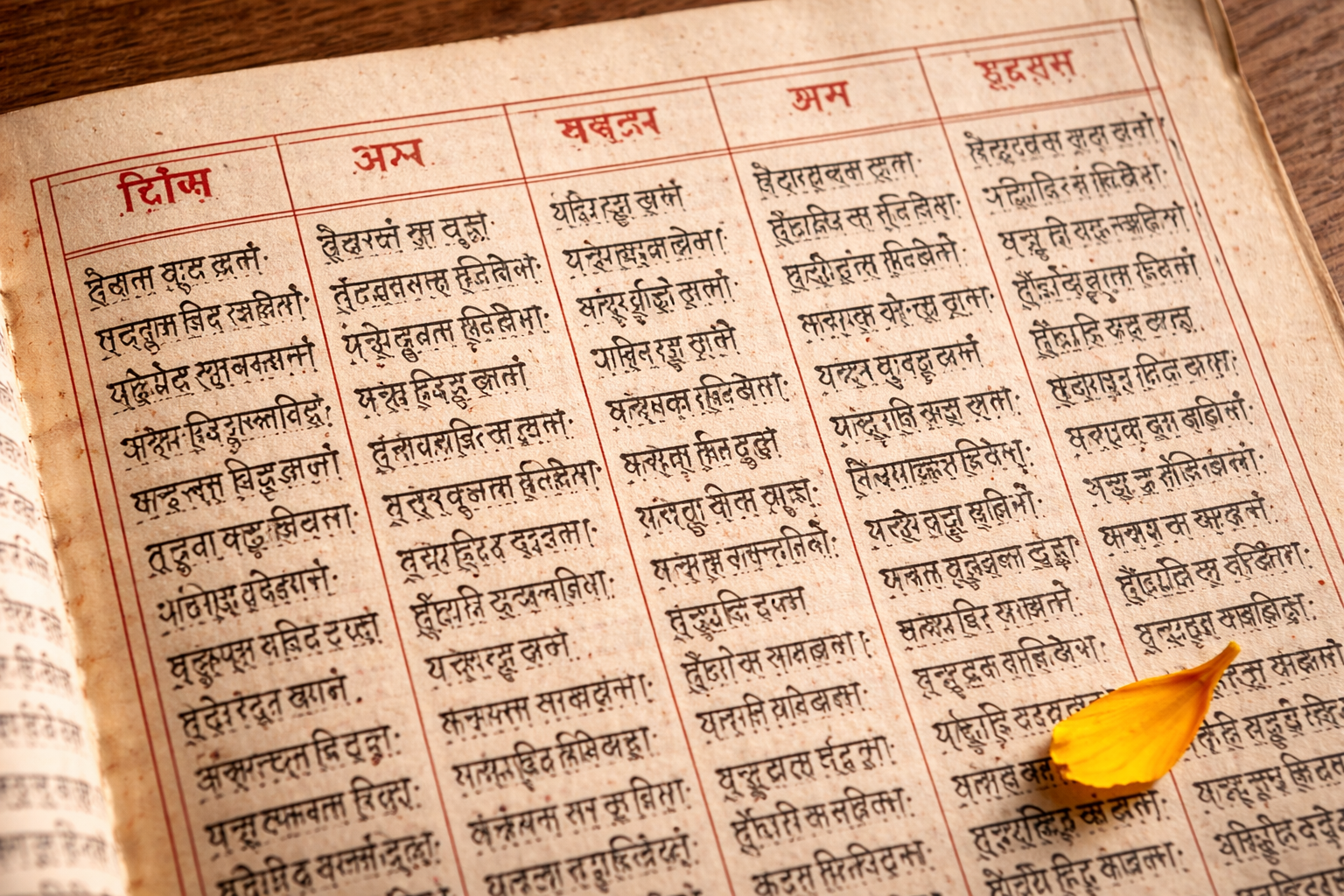
Not according to the almanac your pandit opens before naming an auspicious muhurat. Not according to the calendar your grandparents used for every wedding, every naming ceremony, every first grain. Not according to Nepal’s government, which runs its courts, its schools, and its hospitals by a system of reckoning that ticks quite differently from the one on your phone.
According to Vikram Samvat, the ancient Indian lunisolar calendar running without interruption for over two thousand years, it is currently Samvat 2082. India’s civilisational clock runs approximately 57 years ahead of the world’s administrative standard.
Sit with that. It raises a question most of us have never properly faced: what exactly is Vikram Samvat, who built it, why does it begin where it does, and how has it survived, not as a museum piece, not as religious decoration, but as the most important calendar in the daily lives of hundreds of millions of people across South Asia?
This is that story. It is stranger, deeper, and more remarkable than most people realise.
The Word Itself
The word Samvat comes from the Sanskrit Samvatsara, meaning a complete year, a full revolution, a full reckoning. A Samvat is any calendrical era anchored to a specific astronomical moment, a political founding, or a king significant enough to mark civilisational time from.
India has had dozens. The Kali Yuga Samvat. The Saptarshi Samvat. The Buddhist era. The Jain era. The Saka Samvat. Each represents a different year zero, a different starting point from which time counts forward.
What we call Vikram Samvat is one of these. And here is the first remarkable thing: the name Vikrama Samvat does not appear anywhere in the historical record before the 9th century CE. Earlier inscriptions refer to this same era by entirely different names:
- The Krita era, appearing in inscriptions from 343 CE and 371 CE
- The Kritaa era, from 404 CE
- The era of the Malava tribe, from 424 CE
- Or simply Samvat, just “the year”
The calendar existed before the name. The era we now call Vikram Samvat was in use from around 57 BCE, anchored to an astronomical or political founding in the Malava region, and was only retrospectively named after Vikramaditya centuries later, as his legend grew to fill every silence in Indian memory. This is not a flaw. It is the calendar’s first philosophical quality: it carried different names across the centuries without losing the underlying body, the way a river carries different reflections while remaining the same water.
The King Who May or May Not Have Existed
The popular story runs like this. Vikramaditya, king of Ujjain and paragon of Hindu kingship, defeated the Shaka invaders who had terrorised western India. To mark the beginning of a new, redeemed age, he inaugurated a new era. Some accounts add that he cancelled all debts across his kingdom before proclaiming it, a reset of both time and obligation.
The inscription trail tells a more complicated story.
The earliest known inscription using the word Vikrama to describe this era dates to 842 CE, the Dholpur stone inscription of the Chauhana ruler Chandamahasena. The earliest connecting the era to a king called Vikramaditya by name dates to 971 CE. The earliest literary source making this connection, the Subhashita-Ratna-Sandoha by the Jain author Amitagati, was written around 993 to 994 CE.
That means nearly a thousand years elapsed between when the era supposedly started and when anyone wrote down the founding king’s name beside it. In that gap lives one of Indian history’s richest debates.
Scholars D.C. Sircar and D.R. Bhandarkar argue that Chandragupta II of the Gupta dynasty, who reigned approximately 375 to 415 CE and adopted the honorific Vikramaditya after his own defeat of the Shaka rulers of western India, likely renamed the existing Malava-era calendar after himself. Historians Rajbali Pandey and Kailash Chand Jain argue for a genuine first-century BCE king of the Malava clan based in Ujjain. Rudolf Hoernlé credits a completely different king, Yashodharman. The historical debate remains genuinely unresolved.
What is almost certain is this: the era began around 57 BCE, anchored to an astronomical or political event in the Malava region. For its first eight centuries it was the Malava era, the Krita era, simply the Samvat. The name Vikramaditya was given to it retrospectively, extended backwards in time, like a root system laid down after the tree has already grown tall.
Sir Richard Burton, the Victorian polymath and orientalist who published his retelling of the Vikramaditya tales in 1870, captured the legend-king with precision: Vikramaditya “plays in India the part of King Arthur,” a figure whose historical core may be real, but around whom an entire civilisation’s ideals have crystallised.
In many ways this reflects the Indian approach to history. Legend does not erase fact. It preserves the spirit of an age.
Why That Year? The Astronomical Answer Nobody Talks About
Most accounts of Vikram Samvat’s origin focus on the king. Almost none ask the more precise question: why 57 BCE specifically?
There is an astronomical answer, and it is remarkable.
The era’s starting year corresponds closely to a shift in the precession of the vernal equinox, the slow wobble of Earth’s axis that causes the spring equinox point to drift backwards through the sky’s star map over a 26,000-year cycle. Around 57 BCE, this drift carried the vernal equinox across the boundary between two Nakshatras, from Ashwini into Revati. In Indian astronomical tradition, a shift in which Nakshatra holds the vernal equinox is a profound marker: the entire celestial reference frame has moved.
The astronomers of Ujjain, who had been tracking this precession carefully, recognised the moment and anchored a new era to it. The king’s political victory provided the human occasion. The equinox shift provided the cosmic justification. The two events, occurring in close temporal proximity, fused into one founding narrative.
This is what distinguishes Vikram Samvat from so many other calendrical systems: at its very origin, even if we cannot now separate king from cosmos, there is an astronomical intelligence at work. The calendar was not arbitrary. It was calibrated to the sky.
Ujjain: Where India Measured Everything
To understand the intellectual world that produced Vikram Samvat, you have to understand what Ujjain actually was.
For a significant stretch of ancient Indian history, Ujjain was the madhya rekha, the central line, India’s zero of longitude, from which all Indian astronomical calculations were made. The Surya Siddhanta, one of the foundational texts of Indian astronomy, explicitly states that the prime meridian passes through Avanti, the ancient name for Ujjain, postulating a spherical Earth and calculating geographic coordinates outward from that city.
Ptolemy, the 2nd-century Alexandrian geographer, listed Ujjain in his Geographia as “Ozene,” placing it on his world map and recording distances to surrounding Indian cities. Ptolemy’s own prime meridian ran through the Canary Islands, as his system required a westernmost reference point. But his knowledge of Ujjain’s geographic significance was real: the city appears in his records as a major reference point in the Indian subcontinent.
Every Hindu almanac calculated today, wherever in the world it is produced, is still based on Ujjain time, approximately 29 minutes behind Indian Standard Time, because IST is set to a meridian further east. The panchang your family uses in Leicester or Wembley traces its temporal zero-point to a city on the banks of the Shipra river in Madhya Pradesh.
In 1884, an international convention in Washington formally established Greenwich as the global prime meridian, driven by British naval power and commercial reach. What history books rarely mention is that they were formalising something that had already been placed, by a different civilisation, in a different city, for very similar reasons: astronomical precision, geographic authority, and the power to say, time begins here.
Maharaja Jai Singh II of Jaipur, who governed Malwa in the 1720s, built one of his five astronomical observatories, the Vedshala, in Ujjain, explicitly to honour and continue this tradition. It still publishes annual ephemerides detailing daily planetary positions. On the summer solstice, if you stand in the right spot in its courtyard at noon, your shadow disappears. That was not accident. It was chosen.
The Real Scholars of Ujjain
The most famous human story attached to Vikram Samvat is the Navratnas, the Nine Gems, the legendary court of nine exceptional scholars said to have gathered under Vikramaditya’s patronage.
Their names: Varahamihira, Kalidasa, Vararuchi, Dhanvantari, Kshapanaka, Ghatakarpara, Shanku, Amarasimha, and Vetala Bhatta.
It is a breathtaking lineup. Kalidasa, whose Abhijnanasakuntalam and Meghadutam are counted among the great works of world literature. Varahamihira, whose Brihat Samhita is an encyclopaedia of astronomy, botany, meteorology, architecture, and geography across 106 chapters, arguably the most ambitious encyclopaedia produced in the ancient world. Amarasimha, whose Amarakosha Sanskrit thesaurus remains a reference text today. Dhanvantari, physician, whose name became synonymous with Ayurvedic healing. These are not invented figures. Their works exist, are studied, are real.
But the historical record requires honesty here. Varahamihira is confirmed by scholars to have lived 505 to 587 CE, working in Ujjain during the reign of King Yashodharman, himself a ruler who carried the honorific Vikramaditya. Kalidasa is most reliably placed in the 5th century CE. Vararuchi in the 3rd or 4th century. None of these dates can be reconciled with a shared court in the 1st century BCE.
What likely happened is what often happens in civilisations that feel the ground shifting beneath them: a retrospective idealisation, a gathering of the great under one symbolic roof. The concept of Navratnas, nine exceptional minds assembled by a visionary king, became an ideal so powerful that both the Vijayanagara king Krishnadeva Raya and later the Mughal emperor Akbar adopted the framework for their own courts.
The deeper truth is this: Ujjain was a genuine intellectual powerhouse across many centuries. Varahamihira worked there in the 6th century. Brahmagupta followed in the 7th, formalising the rules of zero and negative numbers. Bhaskaracharya came later still. The lineage is real. The specific courtroom gathering of all nine at once is mythologised. But in India, myth and history have always spoken to each other rather than past each other. The Navratnas legend preserves something true, that Ujjain’s intellectual tradition was extraordinary, even while compressing centuries of genius into a single glittering court.
The Science Inside the Calendar
Here is where most popular accounts fail to go deep enough. Vikram Samvat is not a simple count of days. It is a sophisticated, interlocking astronomical system of remarkable precision.
The Lunisolar Problem, and How India Solved It
Every serious calendar must wrestle with an uncomfortable arithmetic fact: the solar year of 365.25 days and the lunar year of twelve full Moon cycles, approximately 354 days, differ by roughly eleven days annually. Follow only the Moon and your festivals drift through the seasons. Follow only the Sun and you lose the Moon entirely.
The Gregorian calendar simply follows the Sun and ignores the Moon, an administrative convenience rather than an astronomical achievement. The Islamic Hijri calendar follows only the Moon, which is why Ramzan rotates through all seasons over a 33-year cycle.
Vikram Samvat reconciles both. Using the Adhik Maas, the intercalary extra month inserted approximately once every 32 to 33 months, the calendar resynchronises the lunar year with the solar, keeping festivals anchored to their correct seasons. Holi always arrives at the cusp of winter and spring. Diwali always in autumn. Navratri twice in its proper seasonal rhythm.
What makes this striking: the solution is mathematically identical to the Metonic cycle worked out by the Greek astronomer Meton of Athens in 432 BCE, who observed that 19 solar years contain almost exactly 235 lunar months. Two civilisations, thousands of miles apart, solving the same astronomical problem with the same elegant mathematics. India encoded it in a living calendar. Greece encoded it in theory. Both were right.
The Tithi: A Day That Breathes
A Tithi is not a day in the ordinary sense. It is the time taken for the angular gap between the Moon and the Sun, as seen from Earth, to increase by exactly 12 degrees. Since the Moon does not travel at uniform speed, accelerating near perigee and slowing near apogee, this interval varies. Individual Tithis can last anywhere from just under 20 hours to nearly 27 hours.
This variability has a structural consequence most people never think through: a Tithi can begin at 2 in the afternoon and end the following morning. Sometimes a solar day contains two Tithis. Occasionally a Tithi is so long it spans two consecutive sunrises, in which case an intermediate date is effectively skipped from the calendar.
This is not imprecision. It is deliberate fidelity to what the sky is actually doing, rather than to an administrative grid imposed upon it.
If you mark your birthday by Tithi, as many traditional Hindu families still do, something remarkable is true: each year on your birthday, the Moon is in the same phase it was when you were born. The angular relationship between Sun and Moon is recreated. A Gregorian birthday is a position in Earth’s orbit around the Sun, one variable in one cycle. A Tithi birthday is a position in the relationship between two celestial bodies. It is, by any measure, a richer and more complex marker.
The Nakshatra System: The Sky Written into Language
The months of Vikram Samvat are not named after gods, emperors, or administrative convenience. They are named after the sky itself.
The full Moon of each month occurs in a specific Nakshatra, one of the 27 star-clusters through which the Moon moves during its monthly cycle. The month takes the name of that Nakshatra. Chaitra from Chitra, the star Spica in western astronomy. Vaishakha from Vishakha. Shravana, the monsoon month, from the Nakshatra Shravana.
Every time you name a Hindu month, you are describing the night sky during it. The calendar is a star map written into language. This is not metaphor. It is the design.
The Panchang: Five Limbs of Time
All of this converges in the Panchang, the Hindu almanac, whose name literally means five limbs. The five are:
- Tithi, the lunar day
- Vara, the weekday by planetary association
- Nakshatra, the lunar mansion the Moon currently occupies
- Yoga, an auspicious calculation derived from combining the longitudes of the Sun and Moon, producing 27 distinct named combinations
- Karana, half a Tithi, used for more precise timing
These five run simultaneously, each on its own independent astronomical cycle. A muhurat, the auspicious window for a wedding, a business inauguration, a naming ceremony, or a property purchase, is determined by finding a window where all five limbs align favourably. Whether or not you believe the alignment affects human affairs, the alignments themselves are real and measurable. That distinction matters.
Why the New Year Begins Where It Does
Vikram Samvat’s new year falls on Chaitra Shukla Pratipada, the first day of the waxing Moon in the month of Chaitra, coinciding with the vernal equinox period, roughly March to April.
This is when the Sun crosses the celestial equator moving northward. Day and night balance. The world tilts toward warmth. Crops begin. Rivers rise. Ancient Indian astronomers identified this as the most natural reset point in the yearly cycle, not because a committee decided it, but because the sky performs something measurable and significant on that day.
Compare this with 1 January. Julius Caesar moved the Roman new year from March to January in 46 BCE to align with the Roman consular administrative year, a purely bureaucratic decision. Pope Gregory XIII refined the calendar’s mechanics in 1582 but kept January as the start. There is no astronomical significance to 1 January whatsoever. It is a bureaucratic artifact that became a global standard through imperial power, not cosmic logic.
In this respect, Vikram Samvat’s new year is more rationally grounded than the one most of the world now celebrates with fireworks and toasts.
The Evidence in Stone
The inscription trail historians follow to reconstruct Vikram Samvat’s evolution is itself a remarkable document of civilisational continuity.
The earliest uses of this era appear in inscriptions from western India dating to the 1st and 2nd centuries CE, called the Krita era or the Malava era, named after the Malava people, the Malloi whom Alexander’s historians described encountering in the Punjab. By the 9th century, the name Vikrama Samvat appears in stone. By the 10th and 11th centuries, literary texts cement the association with the legendary king. By the medieval period, the calendar governs the ritual and commercial life of vast stretches of the subcontinent.
One fact above all deserves to stop you: the Hindi text of the Preamble of India’s Constitution records the date of its adoption, 26 November 1949, in Vikram Samvat. It reads: Margsheersh Shukla Saptami, Samvat 2006. The founding document of the world’s largest democracy carries, alongside its English text, a date inscribed in a 2,000-year-old calendar. That is not ceremony. That is a statement about who India understands itself to be.
A Calendar That Crossed Borders
Nepal adopted Vikram Samvat as its official state calendar in 1901, beginning at year 1958 VS. Today Nepal runs its courts, land registries, school terms, and government communications in Vikram Samvat. File a legal case in Kathmandu and your documents bear a VS date.
The Sikh tradition uses it as the Bikrami calendar, the calendar in which the Gurus actually lived. Guru Nanak’s birth, the founding of the Khalsa by Guru Gobind Singh, the martyrdoms of Guru Arjan Dev and Guru Tegh Bahadur are all recorded in Bikrami dates. A Punjabi in Southall looking up a Gurpurab is reaching across four centuries through a calendar anchored in Ujjain.
Historically, the calendar has been used by communities as diverse as Hindus, Sikhs, and Pashtuns of the Afghan-Pakistani borderlands. An extraordinary breadth of religious and ethnic diversity sharing a single system of reckoning time.
How India Actually Lives the Calendar
The beautiful, ungoverned complexity of how different communities mark the Vikram Samvat year reveals something important: this calendar was never imposed from above. It grew organically through centuries of practice, adapting to regional seasons, crops, and customs.
Maharashtra greets Gudi Padwa on Chaitra Shukla Pratipada. A bamboo staff dressed in silk and topped with a copper pot is raised at sunrise at every doorway, a visible declaration of new beginnings.
Karnataka and Andhra Pradesh celebrate Ugadi, where families eat Ugadi Pachadi, a dish deliberately combining six tastes in one preparation: sweet, sour, salty, bitter, pungent, and astringent. It is not a pleasant dish to eat all at once. That is the point. The year ahead will bring all of these experiences. Life’s fullness lies in welcoming them together rather than seeking only sweetness.
Sindhis celebrate Cheti Chand. Kashmiri Pandits celebrate Navreh, beginning the new year before dawn by looking into a vessel of water in which rice, a coin, a flower, and a mirror have been placed, seeing reflected in one image the sufficiency of what the year will bring.
Gujarat celebrates Bestu Varas on the day after Diwali, in Kartik. Its most distinctive ritual is Chopda Pujan, the formal worship of account books. Business owners clean their offices, decorate ledgers with marigolds and vermilion, and open a new set of books with the first entry written in red ink. The ritual is now performed over laptops and accounting software just as readily as over physical ledgers. The medium changed. The intention did not.
Two communities, same calendar year, different new year moments, one in spring and one in autumn. Each reflecting the seasonal rhythms of where they have always lived. This is not inconsistency. It is civilisational intelligence: a system flexible enough to honour multiple natural new year moments without contradiction.
The Official Calendar Nobody Uses
Here is an irony worth knowing.
In 1957, following the recommendations of the Calendar Reform Committee headed by physicist Meghnad Saha, India formally adopted the Saka Samvat as its national calendar. It is printed on the Indian Gazette. It appears on government documents. It is, officially, India’s national calendar.
Almost nobody uses it in daily life.
Vikram Samvat, without official status and without government endorsement, governs when Diwali falls, when Navratri begins, when Karva Chauth is observed, when the muhurat for your daughter’s wedding is chosen, when the traditional business community opens its new financial year, and when the almanac is consulted for the auspicious moment to lay the first brick of a new home.
It survived the Mughals. It survived British colonialism and the deliberate administrative replacement of indigenous systems. It survived the post-independence adoption of a different official calendar entirely. It survived because it is not a political institution subject to political replacement. It is embedded in how people actually live, in the timing of fasts, the naming of children, the opening of shops, the sowing of fields.
No government order can reach that deep.
The Clock and the Cosmos
Vikram Samvat 2082, the year we are currently in, includes an Adhik Maas, a thirteenth month, making it a thirteen-month year. The calendar occasionally gives itself more time, like a person who takes a longer breath before something important.
For the deshwale in Britain, the person whose family came from Gujarat or Punjab or Rajasthan or UP, Vikram Samvat is the calendar of the things that actually matter. Not the calendar of tax returns and train times, but the calendar of birth, marriage, prayer, and death. The calendar by which the significant moments of a life are timed and remembered.
That is not nostalgia. It is the recognition, quietly held across two thousand years of human experience, that time is not a neutral, uniform grid. That the sky has rhythms. That cycles of renewal are real and deserve marking with intention.
Vikram Samvat carries in its structure the accumulated astronomical intelligence of people who watched the sky not as romantic observers but as rigorous scientists who needed to know, with precision, when to plant, when to harvest, when the flood would come, and when the light would return.
Greenwich may tell you what time it is.
Vikram Samvat has been telling India what kind of time it is, for over two thousand years.
That is not a small thing to carry.
Vikram Samvat 2083 begins on 30 March 2026, the calendar’s ancient mechanism for catching up with the cosmos it has never stopped watching.
Subscribe Deshwale on YouTube
