




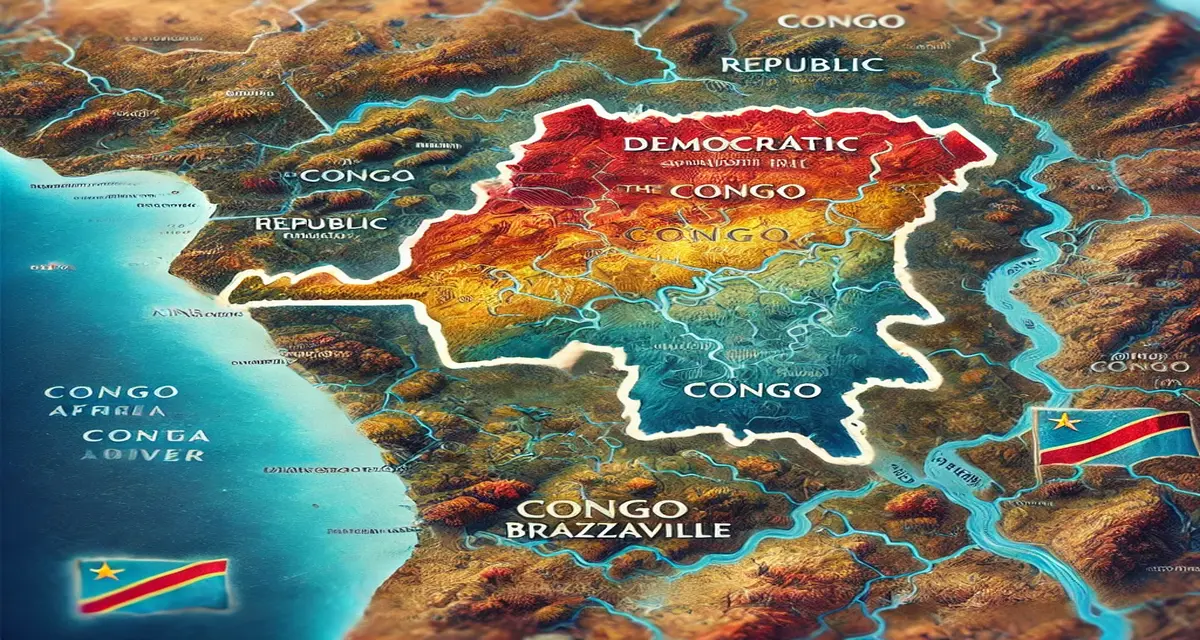
Imagine two neighbouring countries, nearly identical in name, divided only by a wide, mighty river. The Democratic Republic of the Congo (DRC) and the Republic of the Congo (CongoBrazzaville) sit side by side in the heart of Africa, each bearing the name of the great Congo River. Yet, they are distinct nations, shaped by different colonial masters, historical experiences, and political destinies.
How did this happen? Why do two separate nations exist with the same name? And what are the cultural and political ramifications of this shared identity? This article explores the fascinating and complex story of the two Congos, tracing their roots from the ancient Kingdom of Kongo to modern day geopolitical challenges.
And, in an Indian context, this tale might remind us of how Partition split India and Pakistan in 1947, creating two nations from one civilisation. Though not a perfect parallel, the division of the Congos carries echoes of how external powers can shape the fate of a people.
1. The Origins: The Kingdom of Kongo and the Mighty River
Long before European colonisers arrived in Africa, there existed a powerful kingdom that straddled parts of what are now Angola, the DRC, and the Republic of the Congo—the Kingdom of Kongo (14th–19th century). This African empire was renowned for its advanced political structure, trade networks, and vibrant culture.
The Congo River, the second longest river in Africa after the Nile, played a crucial role in shaping the region. The river’s name was derived from the people of Kongo, who dominated its banks and had an extensive network of trade, diplomacy, and military influence.
By the 15th century, Portuguese explorers arrived on African shores, drawn by the wealth of the Kongo Kingdom. This marked the beginning of European interest in the region a curiosity that would soon turn into colonial conquest.
2. The Scramble for Africa: Belgium vs. France
The late 19th century saw a frantic rush among European powers to seize African territories in what became known as the Scramble for Africa. The Berlin Conference of 188485, attended by European leaders (but no Africans), was a turning point. It divided Africa into colonies, drawing borders with little regard for existing ethnic or cultural identities.
Belgian Congo (Now the DRC)
King Leopold II of Belgium had a personal ambition to own a colony. Using the explorer Henry Morton Stanley, he claimed vast territories along the Congo River, calling them the Congo Free State in 1885. Unlike other European colonies, which were controlled by governments, this land was Leopold’s personal possession—a horrific experiment in private colonial rule.
The Congo Free State became a brutal rubber plantation, where millions of Congolese were forced into labour. Those who did not meet rubber quotas were mutilated, with hands and feet chopped off as punishment. Leopold’s rule resulted in the death of an estimated 10 million Congolese one of history’s greatest human atrocities.
By 1908, international outrage forced Belgium to take over the colony from Leopold, renaming it the Belgian Congo. It remained under Belgian rule until its independence in 1960.
French Congo (Now the Republic of the Congo)
Meanwhile, across the river, the French were expanding their own empire. They established the French Congo in 1882, later integrating it into French Equatorial Africa (AEF). This colony, which included parts of presentday Gabon, Chad, and the Central African Republic, was mainly exploited for raw materials and forced labour.
Unlike Belgian Congo, where the violence was infamous, French Congo’s brutality was more structured under the corvée system, forcing people to work in railways and plantations. Independence came in 1960, leading to the birth of the Republic of the Congo.
3. PostColonial Chaos: Diverging Paths
When both Congos became independent in 1960, their trajectories were drastically different.
The Democratic Republic of the Congo (DRC)
Independence from Belgium in June 1960
First Prime Minister: Patrice Lumumba, a nationalist leader
Political chaos led to Lumumba’s assassination (1961)
Mobutu Sese Seko seized power in 1965, renaming the country Zaire in 1971
Mobutu ruled as a dictator for 32 years, creating a corrupt and repressive state
Civil wars and conflicts have plagued the country since his fall in 1997
The Republic of the Congo
Independence from France in August 1960
Experienced coups and political instability
A socialist government ruled from 1969 to 1991
Since then, it has maintained relative stability but remains politically fragile
While the DRC has been marred by wars, dictatorships, and foreign interference, the Republic of the Congo has had a less tumultuous but still fragile existence.
4. A Shared Name, A Divided Identity
The fact that both nations retained “Congo” in their names reflects their common heritage but also causes confusion. To differentiate them:
The Democratic Republic of the Congo (DRC) is often called CongoKinshasa (after its capital, Kinshasa).
The Republic of the Congo is referred to as CongoBrazzaville (after its capital, Brazzaville).
Interestingly, their capitals are the closest capital cities in the world, separated only by the Congo River.
5. India and the Congos: A Connection?
India and the two Congos may seem worlds apart, but historical and economic ties exist:
India played a major role in peacekeeping missions in the DRC, with Indian troops deployed under UN peacekeeping forces.
The DRC, rich in cobalt and minerals, supplies resources crucial for India’s technology and manufacturing sectors.
Bollywood has a surprising fanbase in Congo, with Hindi films being extremely popular, much like in other African countries.
Indian businesses have invested in both Congos, particularly in pharmaceuticals, textiles, and mining.
Just as Partition shaped India and Pakistan, colonialism shaped the two Congos—a single culturalhistorical entity divided by foreign hands.
Conclusion: Two Congos, One History
The existence of two Congos is a testament to the deep scars of colonialism. Though sharing a common past, they took different paths under their colonial rulers, leading to distinct yet interconnected national identities.
Even today, both nations struggle with political instability, economic challenges, and postcolonial legacies. However, their resilience mirrors that of many postcolonial nations, including India—nations forced to navigate modernity while carrying the weight of history.
Perhaps, one day, the two Congos will find a way to forge a closer relationship, much like India and its own divided past. Until then, they remain two nations with one name, forever linked by history, geography, and a river that refuses to separate them.
Do you think the two Congos will ever reunite? Share your thoughts in the comments!
Yes! Here are some more cases where two (or more) countries share a name:
5. Macedonia
North Macedonia – A Balkan country that was part of Yugoslavia until 1991.
Macedonia (Greek region) – A historical and cultural region in northern Greece.
Greece opposed the former Yugoslav republic using the name “Macedonia,” leading to a dispute that was resolved in 2019 when the country was officially renamed North Macedonia.
6. Tanzania and Zambia (Tanganyika & Northern Rhodesia)
Before merging with Zanzibar in 1964, Tanzania was called Tanganyika.
Nearby Zambia was once called Northern Rhodesia under British rule.
While they don’t share the exact name now, they have historical ties and were once part of Britishcontrolled Central Africa.
7. The Gambia and Zambia
While not identical, both countries’ names derive from major rivers:
The Gambia – Named after the Gambia River.
Zambia – Named after the Zambezi River.
8. America
United States of America (USA) – The wellknown North American country.
United Mexican States (Mexico) – While people commonly refer to it as Mexico, its official name includes “Estados Unidos,” meaning “United States.”
Historically, both countries used variations of “United States” in their names.
These naming overlaps usually stem from colonial history, geographic features, or cultural heritage. Would you like a deep dive into any of these?
