



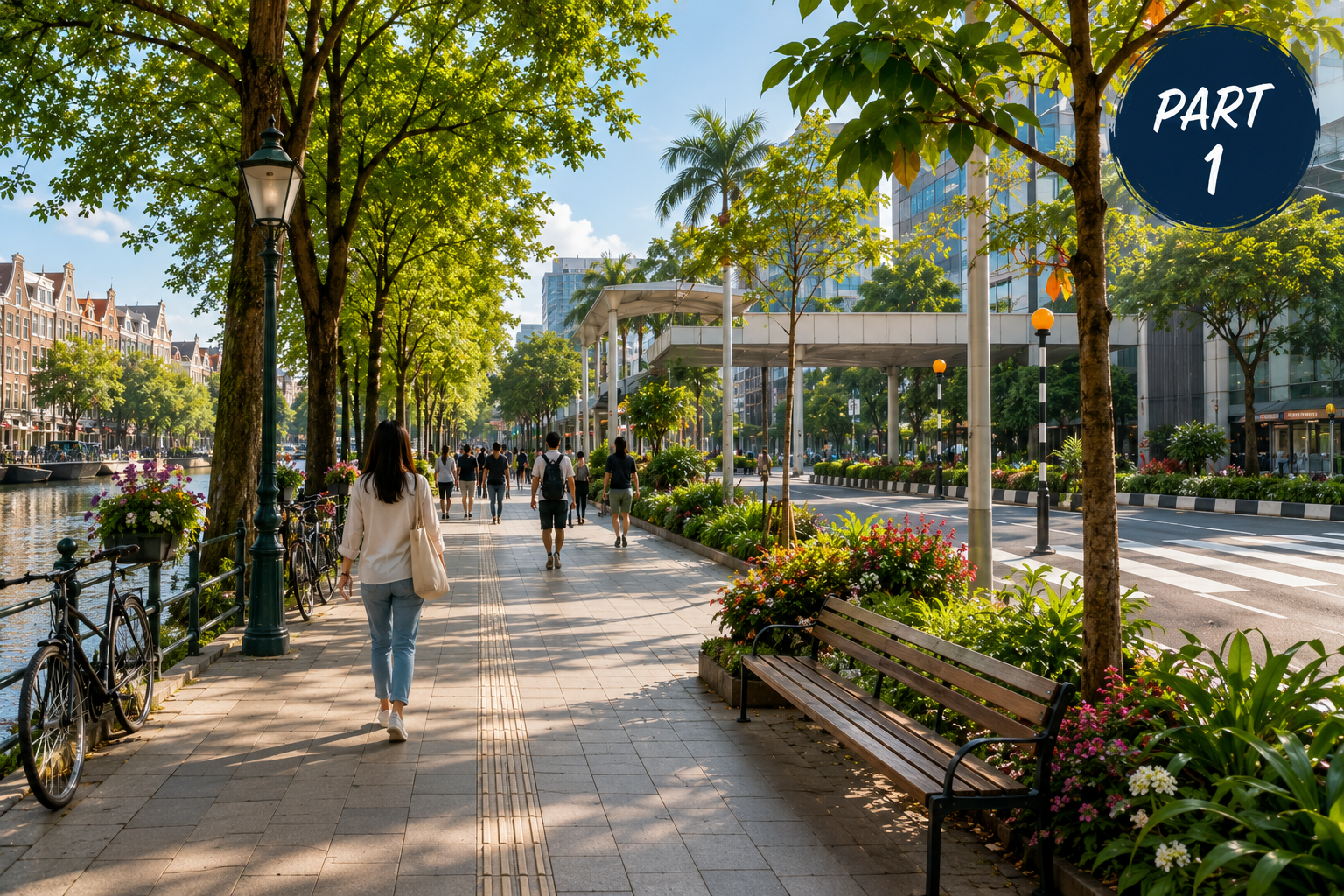
A footpath is one of the most basic pieces of infrastructure in any city.
Yet it is also one of the most misunderstood.
Many cities believe that laying concrete blocks, adding a kerb and painting a zebra crossing is enough to create a pedestrian-friendly street. But a truly good footpath is tested differently. Can an elderly person walk on it comfortably? Can a wheelchair user move without obstacles? Can a blind person navigate it safely? Can a child walk to school without fear? If the answer to these questions is no, then the footpath has already failed.
Around the world, several countries have transformed walking into one of the safest and most convenient ways to travel. Instead of treating pedestrians as an afterthought, they have designed entire cities around people. Their approach offers valuable lessons for countries like India, where pedestrians often struggle for space despite being among the largest road users.
More than just a pavement
The world’s best pedestrian infrastructure is not judged by how attractive the pavement looks. It is judged by how well it works. A good footpath should be continuous without ending abruptly, wide enough for people to walk comfortably, free from obstructions, accessible for people with disabilities and connected to public places like schools, parks, railway stations and bus stops. Safe road crossings, proper lighting, weather protection, good drainage and regular maintenance are equally important.
Urban planners say walking should be viewed as a complete transport system rather than a strip of pavement built beside a road. When pedestrians are forced to walk on roads because the footpath suddenly disappears or is blocked by vehicles and utility boxes, the entire network breaks down.
The Netherlands has made walking a science
Among all countries, the Netherlands is often considered one of the finest examples of pedestrian-friendly planning.Although the country is famous for cycling, it has also developed one of the world’s most advanced pedestrian systems. Instead of designing isolated pavements, Dutch planners create connected walking networks that link homes with schools, shops, parks, railway stations and bus stops.
The country’s road design guidelines place strong emphasis on accessibility, continuity, safety and comfort. Different streets are designed differently depending on their purpose. Busy roads separate pedestrians from vehicles, while quieter neighbourhood streets use traffic-calming measures that allow people to walk comfortably.
Another important Dutch principle is making walking enjoyable. Well-designed streets include seating areas, shops, trees, open public spaces and attractive surroundings that encourage people to spend time outdoors instead of treating walking as a burden.
Singapore proves climate matters
While the Netherlands shows how to design walkable cities in Europe, Singapore demonstrates how pedestrian infrastructure can succeed in a hot and humid tropical climate.
Rather than asking citizens to simply walk more, Singapore identified the reasons why people avoid walking and addressed them through planning.Long stretches of sheltered walkways protect pedestrians from intense sunlight and heavy rain. These covered pathways connect residential neighbourhoods directly with MRT stations, bus interchanges and major public facilities, making public transport much easier to access.
Singapore has also started separating pedestrians from cyclists in several locations to reduce conflicts between slower walkers and faster-moving bicycles. This approach recognises that different road users require different types of infrastructure instead of forcing everyone to share the same space.
Japan and other countries offer valuable lessons
Japan presents another successful model of pedestrian planning. Despite having some of the world’s busiest cities, Japanese streets remain remarkably organised because of disciplined traffic behaviour, efficient public transport and well-maintained pedestrian infrastructure.
Accessibility also receives significant attention. Barrier-free pathways, tactile paving, lifts and accessible railway stations make it easier for elderly people and persons with disabilities to move independently.Countries like Switzerland and Denmark focus on slightly different aspects. Switzerland integrates walking with trains, buses and trams, ensuring pedestrians can easily switch between different modes of transport. Denmark, particularly Copenhagen, has redesigned neighbourhoods so that schools, shops, parks and daily services are within walking distance, reducing the need for unnecessary travel.
Although each country follows its own approach, they all share one common principle. They do not treat pedestrians as obstacles to traffic. They treat pedestrians as traffic itself.
Subscribe Deshwale on YouTube
