



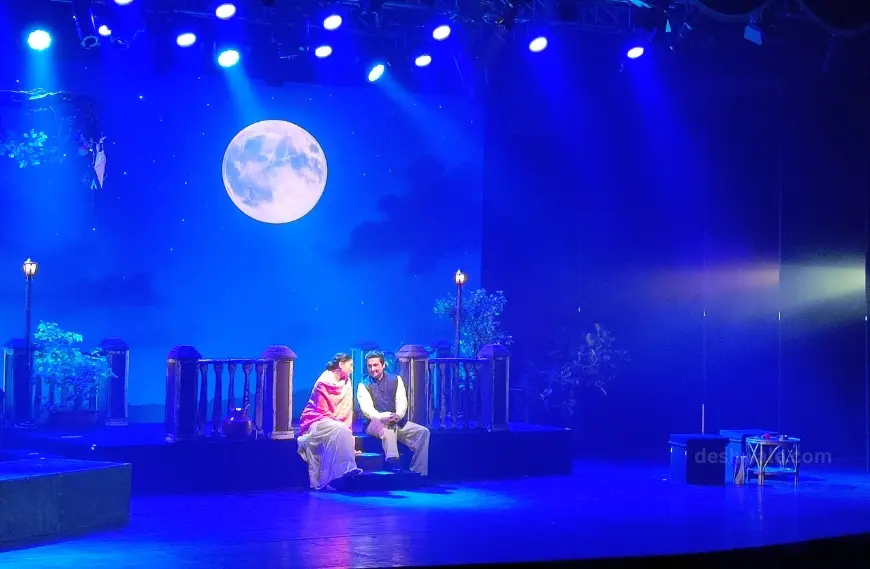
There are some stories that never end. They echo not in the pages of a book, but in sighs, silences, and verse. One such story returned to the stage on the evening of 13 July 2025, when the poetic play Ek Mulaqat lit up the St. Andrew Auditorium in Bandra with its haunting blend of longing, regret and lyrical brilliance.
At its heart, ‘Ek Mulaqat’ is not a conventional love story. It does not offer closure or drama. Instead, it draws the audience into the lingering space between two literary giants… ‘Sahir Ludhianvi’ and ‘Amrita Pritam’… who never quite came together, yet never truly drifted apart.
The Indian stage has long been a mirror to society, but when theatre borrows the rhythm of poetry, something magical unfolds. ‘Ek Mulaqat’ belongs to this rare genre… ‘A poetic play’, where conversations bleed into verses, and silences often speak louder than dialogue.
The show was a complete houseful, with a visibly moved audience that included special guests like veteran actor Shatrughan Sinha and filmmaker Anees Bazmee. Their presence only added to the weight of a performance already soaked in nostalgia and cultural depth.
A story told in silences and sher
Written by Summana Ahmed and Saif Hyder Hasan, and directed by Hasan himself, the play imagines a final meeting between Sahir and Amrita… two lovers separated not by fate, but by timing and temperament. Shekhar Suman as Sahir was powerful yet restrained, carrying the weight of unspoken love with every pause and glance. Geetika Tyagi brought grace and quiet vulnerability to Amrita, her gaze often speaking the words her lips refused to.
Their chemistry did not sizzle… it lingered. Like unsent letters or unfinished poems.
The set design was minimal, letting the words do the heavy lifting. The background music was gentle and melancholic, like an echo of old radio stations playing forgotten ghazals. Every element… light, sound, costume… seemed designed to disappear into the poetry itself.
Verses that shook the soul
There were moments that drew gasps, others that pulled sighs. But one moment that stopped time altogether was Shekhar Suman’s recitation of Sahir’s fierce feminist poem:
“Aurat ne janam diya mardon ko, mardon ne usse bazaar diya…”
His voice thundered through the hall, peeling back layers of society’s hypocrisy. The poem… raw, confrontational, and decades ahead of its time… found its voice again, and the auditorium erupted into applause. Goosebumps turned into standing ovations.
Another line that lingered was Sahir’s signature couplet:
“Woh afsana jise anjaam tak lana na ho mumkin,
Use ek khoobsurat mod dekar chhodna achha.”
The play understood this idea perfectly. It did not try to resolve the unresolved. It simply let the poetry and pain sit beside each other, like old lovers sipping silence.
A performance to remember
From an audience perspective, ‘Ek Mulaqat’ felt deeply personal. As if you were not just watching Sahir and Amrita, but confronting your own what-ifs. The performances were not theatrical… They were intimate. You did not feel like clapping… you felt like writing a poem of your own.
Amrita and Sahir’s story, immortalised in their poetry and now on stage, continues to captivate. While both poets found other partners… Amrita with artist Imroz and Sahir with singer Sudha Malhotra… Their connection remained a poignant chapter in their lives. Ek Mulaqat captures this essence, reminding us that some loves are too profound to be bound by convention.
Ek Mulaqat is not just a play… It’s a celebration of poetry, passion, and the silences that speak louder than words. For anyone who believes in the power of art to capture the human soul, this is a must-see
Director Saif Hyder Hasan deserves full credit for preserving the emotional truth of this story without turning it into melodrama. His choice to keep the staging simple and let the language shine was both brave and effective.
The director confirmed that ‘Ek Mulaqat’ will return to Mumbai for more shows in the coming week. And for Delhi audiences, a double treat awaits in August with two scheduled performances at the iconic Kamani Auditorium.
If you have not watched it yet, here is your chance to experience a love that never died, and a poetry that never faded. ‘Ek Mulaqat’ does not just remind us of Sahir and Amrita’s love… it reminds us of our own capacity to feel, to remember, and to leave certain stories beautifully unfinished.
Because sometimes, the most powerful endings are the ones that never happen.
Here is Sahir Ludhianvi’s feminist poem:
Aurat ne janam diya mardon ko, mardon ne usey bazaar diya
Jab jee chaha masla kuchla, jab jee chaha dhutkar diya
Tulti hai kahin deenaron mein, bikti hai kahin bazaaron mein
Nangi nachayi jati hai ayyashon ke darbaron mein
Yeh woh be-izzat cheez hai jo bat jati hai izzat-daron mein
Aurat ne janam diya mardon ko, mardon ne usey bazaar diya
Mardon ke liye har zulm rawa, aurat ke liye rona bhi khata
Mardon ke liye har aish ka haq, aurat ke liye jeena bhi saza
Mardon ke liye lakhon sejen, aurat ke liye bas ek chita
Aurat ne janam diya mardon ko, mardon ne usey bazaar diya
Jin seenon ne inko doodh diya, un seenon ko bevapar kiya
Jis kokh mein inka jism dhala, us kokh ka karobar kiya
Jis tan se ugey kopal ban kar, us tan ko zaleel-o-khwaar kiya
Aurat ne janam diya mardon ko, mardon ne usey bazaar diya
Sansar ki har ik be-sharmi, gurbat ki god mein palti hai
Chaklon hi mein aakar rukti hai, faakon se jo raah niklati hai
Mardon ki hawas hai jo aksar, aurat ke paap mein dhalti hai
Aurat ne janam diya mardon ko, mardon ne usey bazaar diya
Aurat sansar ki qismat hai, phir bhi taqdeer ki heti hai
Avatar payambar jannati hai, phir bhi shaitan ki beti hai
Yeh woh bad-qismat maa hai jo beton ki sej pe leti hai
Aurat ne janam diya mardon ko, mardon ne usey bazaar diya
