



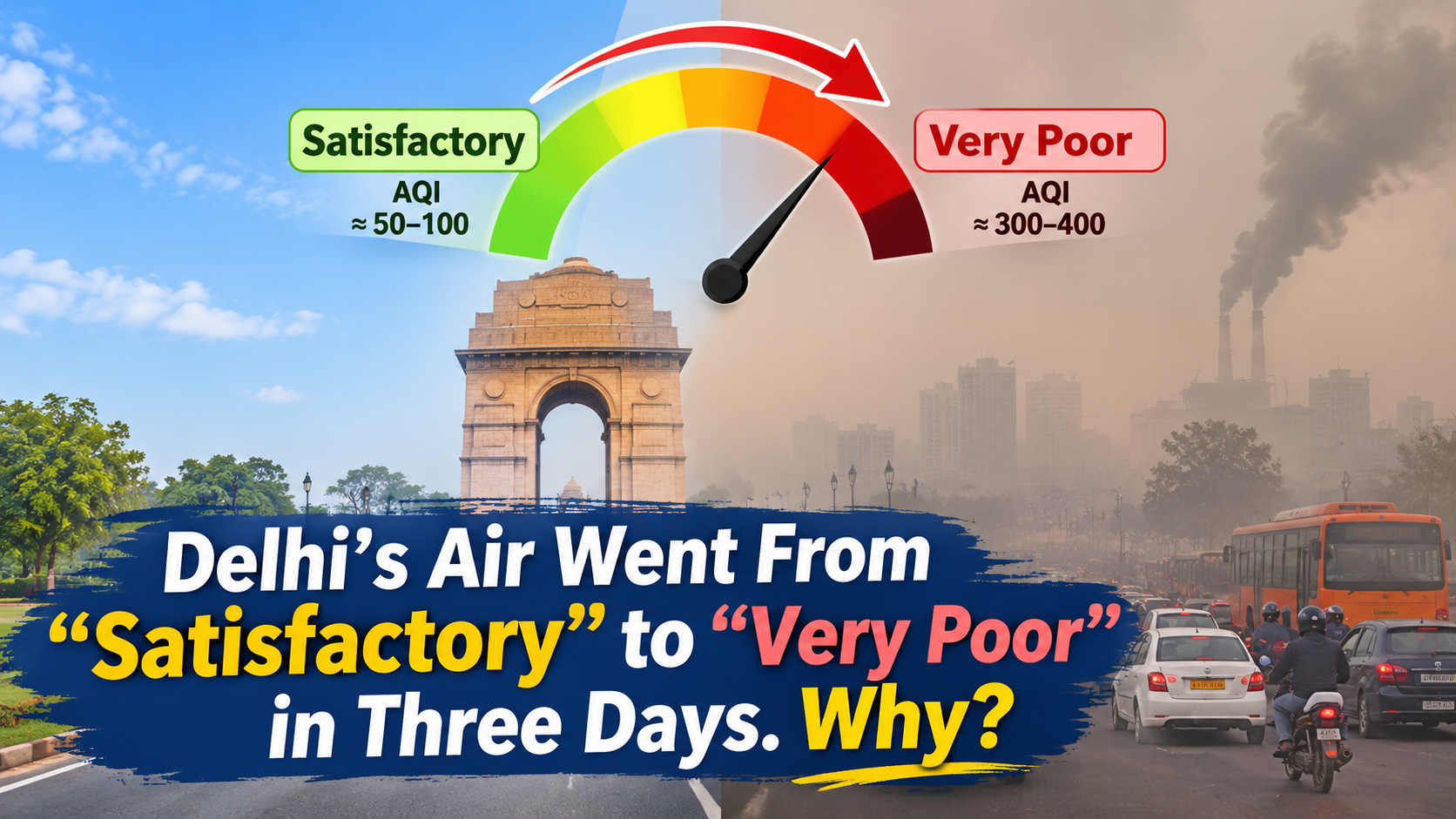
A few days ago, Delhi’s air was in good shape. Heavy rain at the end of October helped, and the month turned out to be the cleanest October since 2015, with an average AQI of 167, according to a CREA analysis reported by PTI. Now the city is under a layer of smog again.
The change has been very quick. According to the Central Pollution Control Board (CPCB), Delhi’s AQI was 60 on 30 October, the cleanest October day since 2022. It was 117 on 31 October, 261 on 1 November and 324 on 2 November. That made 2 November the first “very poor” day of the season. “Very poor” means an AQI between 301 and 400.
On the morning of 3 November, the city’s AQI was around 330 at 8 am, and CPCB data showed 332 at 9 am. Eight of Delhi’s 57 monitoring stations were in the “severe” category, which starts above 400. Jahangirpuri was the worst hit, at about 451. Private platforms showed even higher numbers. AQI.in, which tracks air quality using the US AQI scale rather than India’s, recorded a peak of 466 just after midnight on 2 November. The two scales differ, so the official CPCB figures are the ones to rely on. Whichever data you look at, the air got much worse in a very short time.
Now, why did this happen? It starts with the rain. Cyclone Arnab made landfall near Yanam on the Andhra Pradesh coast on 28 October, bringing heavy rain to Andhra Pradesh and parts of southern Odisha. Together with a western disturbance, it brought rain and strong winds to Delhi on 29 and 30 October. Delhi recorded 61.4 mm of rain in the 24 hours to 8:30 am on 30 October, its wettest October day in four years. Rain washes some pollution out of the air, and strong winds blow the rest away. That is why the air got better.
But the relief did not last. The sources of pollution were still there. When the weather turned dry again, smoke and dust from vehicles, factories, construction, roads and waste burning began to build up once more.
The wind also changed direction. After the storm passed, winds started coming from the northwest again. Satellite data seen by the India Meteorological Department showed that smoke from Punjab, Haryana and Pakistan began blowing towards Delhi and nearby areas from late Sunday, 1 November.
Farm fires are a big part of this. A senior CPCB official said the rain stopped many farmers from harvesting their crops in October, and that many are now rushing to finish. That means more stubble burning, which is the burning of leftover crop stalks in the fields.
Punjab’s data shows how fast the numbers rose. The state recorded 194 farm fires on 29 October, taking the season’s total past 1,000. The peak came on 31 October, when 292 fires were recorded in a single day. The total stood at 1,514 on 1 November and 1,612 by 2 November. Monday’s count of 98 was lower than Sunday’s 175, but the smoke has already built up.
The weather is not helping either. There is less sunlight, and winds are weak, especially at night and in the early morning. When the wind is slow and the air cannot rise, the pollution has nowhere to go. Experts call this poor ventilation. The Air Quality Early Warning System expects the AQI to stay in the “very poor” range from 3 to 5 November.
Delhi is also entering its yearly pollution season after the monsoon. Every year around this time, the weather makes it harder for pollution to clear out.
The air is full of tiny particles. PM10 and PM2.5 were the main pollutants on Monday. PM10 means particles that are 10 micrometres or smaller. PM2.5 particles are even smaller, and they can go deep into the lungs.
The authorities have started taking steps. On Monday, 2 November, the Commission for Air Quality Management (CAQM) brought Stage II of the Graded Response Action Plan, or GRAP, into force across the whole National Capital Region. GRAP is a plan with emergency steps that become stricter as the air gets worse. Stage II is meant for “very poor” air and works along with the Stage I steps.
Under this stage, roads are to be cleaned with machines more often, water is to be sprinkled to control dust, and anti-smog guns are to be used. Inspections at construction sites are being stepped up. Parking fees are being raised to discourage private vehicles. Using diesel generators for regular purposes, and burning coal and firewood, is banned except for essential services. Delhi and NCR governments have also been asked to stagger office hours. Delhi Police are checking vehicles at the Ghazipur border as well, as restrictions on non-BS-VI vehicles registered outside Delhi take effect.
Things may not get better soon. Diwali falls on Sunday, 8 November. A senior CPCB official said no relief is forecast in the coming week. Heavy cracker bursting on Diwali would only make things worse.
The clean air at the end of October came from rain and wind. The causes of pollution had not gone anywhere, so they returned as soon as the weather changed.
The numbers can differ from one platform to another, so it is best to check the CPCB for the official AQI. But every source shows the same thing. Delhi’s air has become much worse in just a few days.
Subscribe Deshwale on YouTube
