



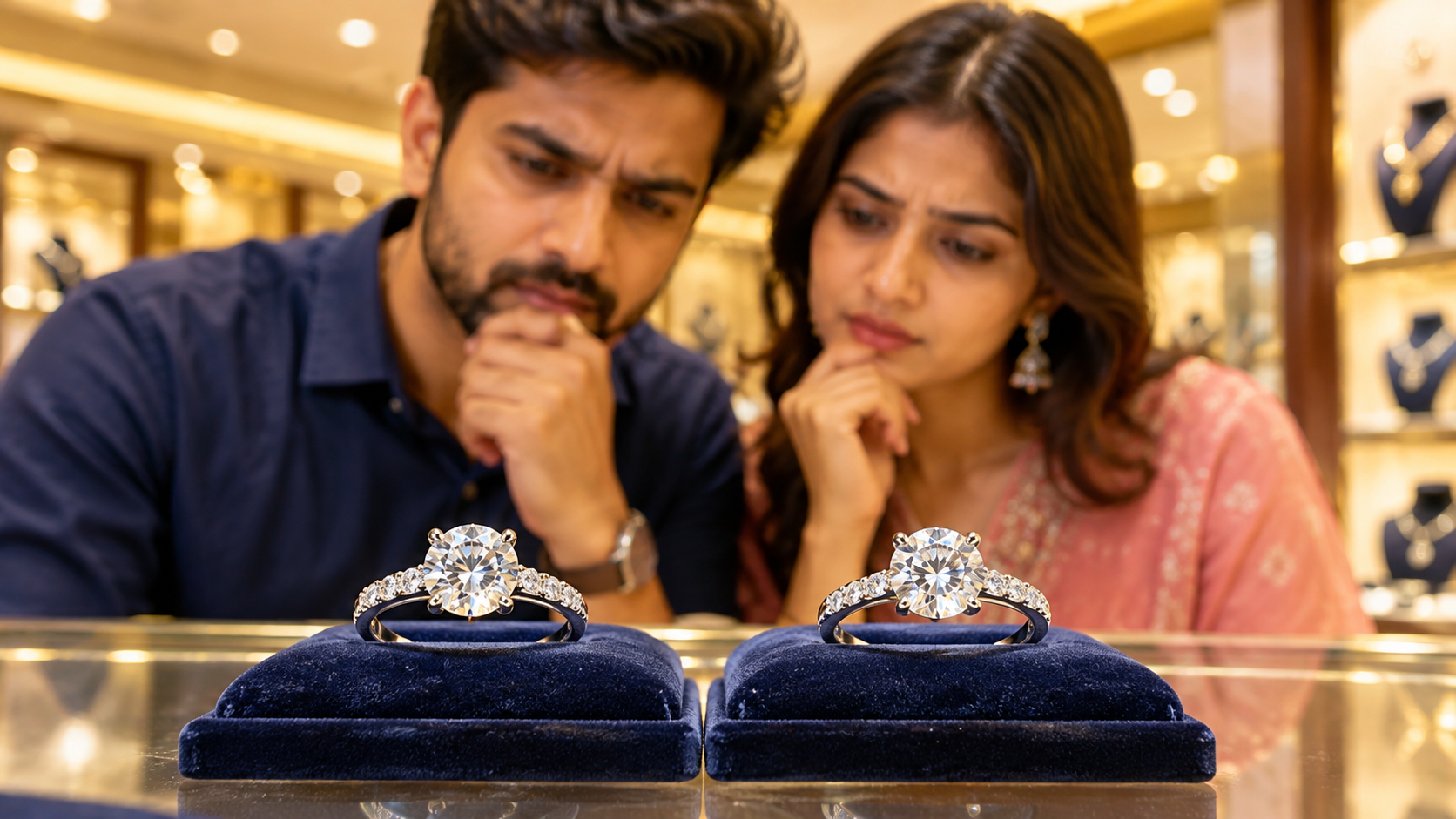
Picture a couple standing at a jewellery counter in wedding season. The salesperson places two rings on the velvet tray. Both have a diamond. Both sparkle the same way under the shop lights. One has come out of the earth, the other out of a machine, and the second costs a lot less. You would think the choice is easy. But watch long enough and you will see many couples ask a few more questions, exchange a look, and walk out without buying either.
That is the strange thing about lab-grown diamonds in India right now. The category keeps growing, yet plenty of buyers still hold back.
First, a quick word on what these stones are, because there is still some confusion. A lab-grown diamond is not a fake diamond and not a glass lookalike. It is made of carbon, just like a mined one, and has the same chemical and physical properties. The difference is the birthplace. A natural diamond forms deep inside the Earth over a very long time. A lab-grown one is grown in a machine, using methods called CVD (chemical vapour deposition) or HPHT (high pressure, high temperature). India matters a lot in this story. Surat, the city known for cutting and polishing diamonds, has been moving towards growing them too.
The growth numbers are real, though they are forecasts and estimates. Research firm Fortune Business Insights puts the global lab-grown diamond market at about $29.5 billion in 2025 and expects it to reach nearly $92 billion by 2034. Other research firms give different figures, so treat these as one view, not the final word. For India, Wazir Advisors estimates the lab-grown market at Rs 3,452 crore in FY25, growing to Rs 5,179 crore by FY28. That sounds big until you place it next to the whole Indian diamond market, which the same firm values at about Rs 53,512 crore. Lab-grown is still the smaller player.
So why the hesitation? Start with the price. Over the last few years, lab-grown diamonds have become much cheaper, because more and more of them are being made. For a shopper, that is a nice surprise at first. Then the second thought arrives. If it is this cheap today, will it be cheaper next year? Some retailers say the fall has slowed down in 2026, but nobody can promise that the bottom has been reached. Buying something whose price might keep dropping does not feel comfortable, especially when the purchase is meant to mark an engagement or a wedding.
Then comes the question people often ask last but think about first: what if I ever want to sell it? Here the answer is not very reassuring. There is no official rate for what a lab-grown stone fetches second-hand, and the estimates floating around vary a lot. A natural diamond also sells for less than its shop price, so nobody should expect to get back everything they paid. But natural diamonds have an older, more settled resale market. Even many sellers of lab-grown pieces describe them as something you buy to enjoy, not to invest in. If you are thinking of buying one, ask the jeweller about buyback and exchange terms, and get the answer in writing. Every brand has its own rules.
Money, though, is only half of it. In many Indian families, a diamond is not just a stone. It is a statement. People notice what was bought, and sometimes they guess what it cost. A buyer may worry that relatives will see a lab-grown ring as the cheaper option, or even read it as less effort or less love. Parents and in-laws often feel more at ease with a natural stone because it fits the picture of jewellery they grew up with. You can be completely convinced by the logic and still dread explaining your choice at every family function. That worry is real, and it is hard to fix with facts.
Trust is the other big issue. Since the two kinds look the same to the naked eye, buyers want paper proof of what they are getting. That is where certificates come in, and this part has become a little tricky. The Gemological Institute of America, better known as GIA, has graded lab-grown diamonds since 2007. But from 1 October 2025, it stopped giving detailed colour and clarity grades for D-to-Z lab-grown diamonds. It now places them in two broad groups, called “Premium” and “Standard”. Other labs, such as IGI, still give detailed grades. GIA also marks every lab-grown diamond it assesses with a tiny laser inscription that says “Laboratory-Grown”, along with a report number. All of this is useful, but it also means two certificates from two labs may not read the same way. A first-time buyer staring at those papers can easily feel lost, and when people feel lost, they tend to go back to what they already know.
So, should you buy a lab-grown diamond? There is no single answer, and anyone who gives you one is guessing. If you want a bigger or better-looking stone for the same budget, and you plan to wear it often, a lab-grown diamond can make good sense. If tradition matters to you, or you want something with a more established resale market, a natural diamond is still the safer pick, though even that is never a guaranteed investment.
Whichever you choose, a few habits will protect you. Ask for a certificate from a well-known lab. Check that the report number on the paper matches the one inscribed on the stone. And get the buyback policy in writing before you pay.
In the end, the sparkle was never really the problem. The price drop is real, and the stone is a real diamond. What buyers are still working out is something less simple: what they want a diamond to mean, and what the people around them expect it to mean.
Subscribe Deshwale on YouTube
