



Most of us have that one thing at home we cannot bring ourselves to throw away. It could be a cup gifted by a friend, a plate passed down by a grandparent, or an old object that reminds us of a special time in our lives. It may not be expensive, but it means something to us.
Now imagine that favourite cup slipping from your hand and breaking into pieces. Would you throw it away or try to repair it?
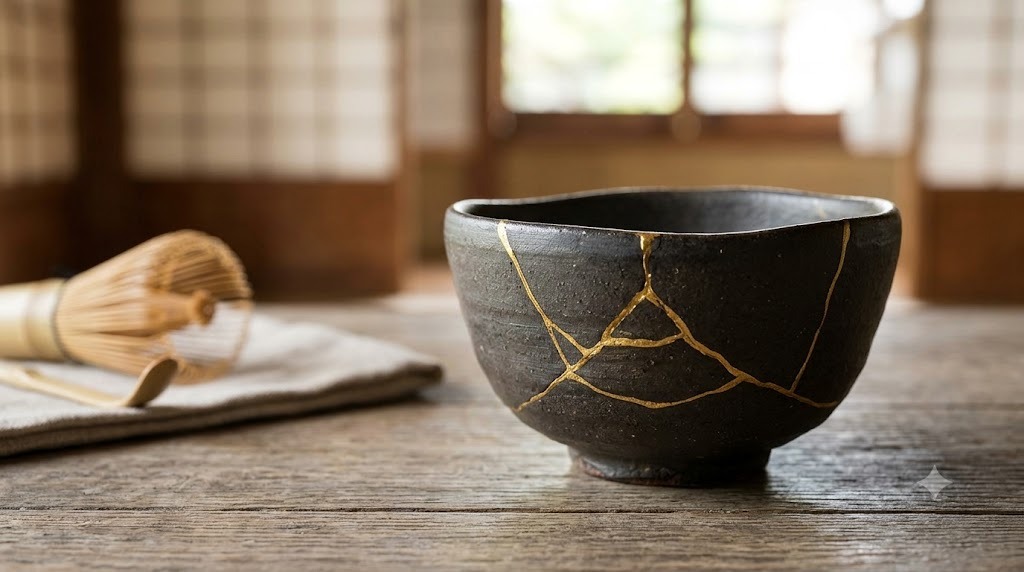
In Japan, an ancient craft offers an unusual answer. It is called kintsugi, a traditional way of repairing broken pottery with lacquer and often highlighting the repaired cracks with gold. Instead of hiding the damage, the craft makes it part of the object’s appearance.
At first, the idea may seem strange. Why put gold on something that is already broken? The answer lies in how kintsugi changes the way we look at an object. It shows that something does not have to look untouched to remain beautiful or valuable.
What Makes a Broken Cup Special Again?
Traditional kintsugi uses urushi, a natural lacquer made from the sap of the lacquer tree, to join broken ceramic pieces. Craftspeople may then apply powdered gold or silver to the repaired lines. The process involves several stages and requires patience because the lacquer needs suitable conditions and time to cure. A traditional repair can take weeks or even months.
The result is different from simply gluing a broken cup back together. The cracks become visible lines that form a pattern of their own. Every repair looks different because every break is different.
Think about an old family photograph. Its paper may become faded, or its edges may wear away, but we do not necessarily value it less. We keep it because of the people and memories connected to it.
Objects can hold that kind of meaning, too. A cup used during conversations with a loved one, a bowl brought home from a memorable trip, or a gift received years ago can become part of our personal story. Replacing it may be easy, but finding another one that carries the same memories is not.
Kintsugi does not mean every damaged object must be saved. It simply offers another possibility: instead of seeing only what has been lost, we can also notice what remains.
The Japanese Story Behind the Golden Lines
The exact origins of kintsugi are uncertain, but the craft became more widespread in Japan alongside tea culture in the late 16th century. Tea bowls were valued objects, and repairing them allowed people to continue using pieces that mattered to them.
A popular legend connects the craft to Ashikaga Yoshimasa, a Japanese shogun who lived in the 15th century. According to the story, he sent a treasured tea bowl to China for repair. When it returned held together with metal staples, he was dissatisfied with its appearance and asked Japanese craftspeople to find a more attractive solution.
This story is often repeated, but it has not been established as the confirmed origin of kintsugi.
The craft is also frequently linked with wabi-sabi, a Japanese aesthetic associated with finding beauty in imperfection, ageing and the passing of time. However, wabi-sabi is a broader idea, not simply a philosophy about broken pottery.
What makes kintsugi interesting is that it does not attempt to recreate the past exactly. The repaired object has changed, and its new appearance acknowledges that change.
Why Do We Always Want Things to Look New?
Look around us today. Phones are replaced when newer models arrive, clothes are often discarded when trends change, and household items can be cheaper to replace than repair. There are practical reasons for this, of course. Not everything can or should be repaired.
But we sometimes confuse looking new with being valuable.
A repaired object may carry more personal meaning than a brand-new one. A table with marks from years of family meals may be more precious to its owner than a polished table bought yesterday. A well-used book may have folded pages and notes in the margins, yet those signs of use can make it special.
Kintsugi encourages us to consider the value of keeping and repairing things. It can support a culture of reuse, although traditional restoration requires specialist skill, time and materials, so it is not always the cheaper option.
There is also an important practical point. Traditional urushi lacquer can irritate the skin before it has fully cured, and not every modern repair kit uses traditional materials. A repaired cup should not automatically be assumed safe for food or drink; that depends on the materials and the repair method.
The Beauty Is in the Care
Kintsugi is often used as a metaphor for human life, but its meaning need not be exaggerated. People experience loss, disappointment and change in different ways. Not every difficult experience makes someone stronger, and not every loss can be repaired.
Perhaps the more meaningful lesson is that damage does not always erase value.
A broken cup will never be exactly the same as it was before. Yet, with the right care, it may still be useful and worth keeping. Its repaired lines become part of its story, not something that needs to be hidden.
The next time something you value breaks, you may decide that replacing it is the right choice. Or you may discover that it is worth repairing.
Either way, kintsugi leaves us with a question worth considering: do we value things only when they are perfect, or can we also value the time, memories and care that make them ours?
Subscribe Deshwale on YouTube
