



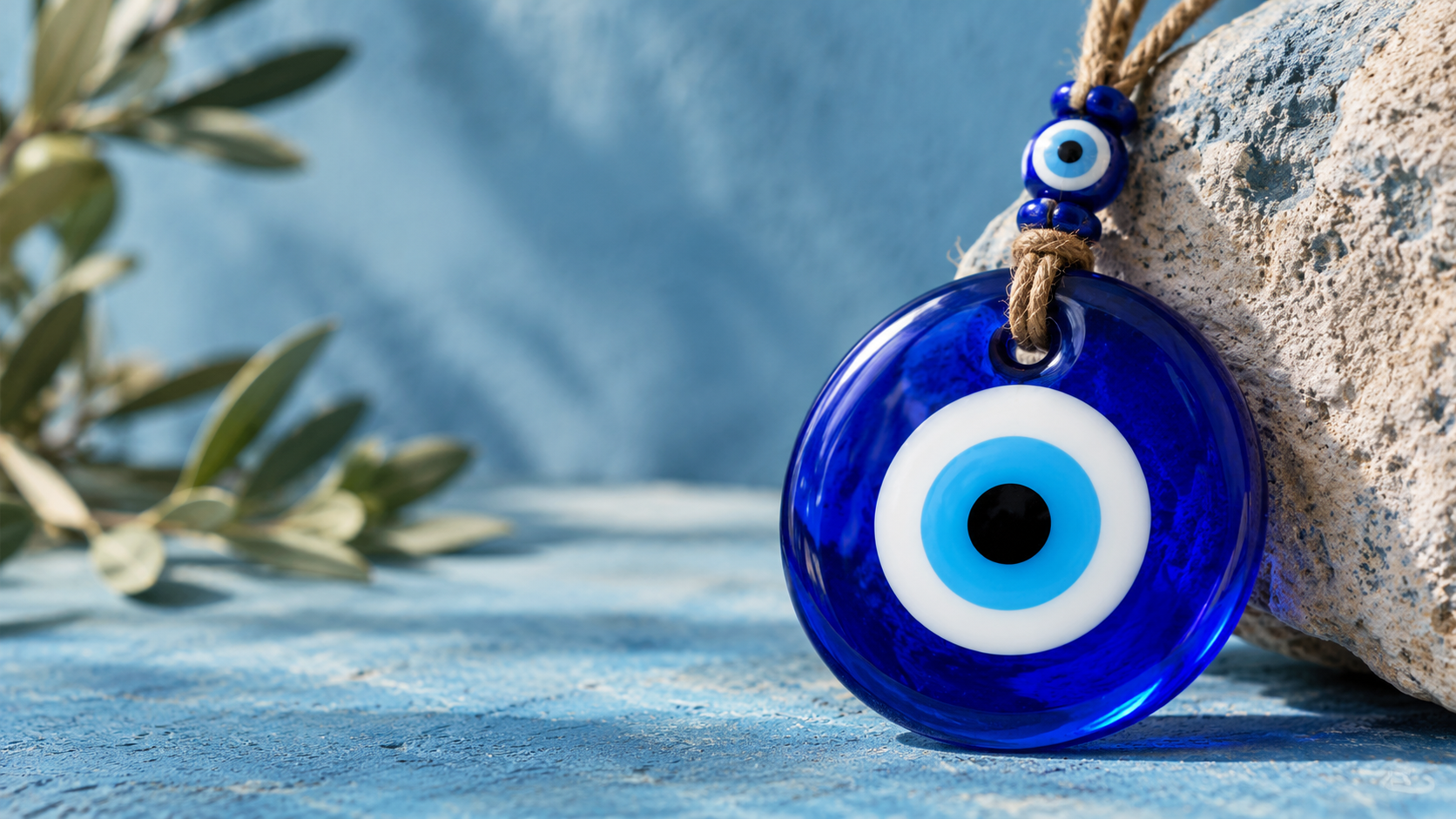
Have you ever seen a mother put a tiny black dot behind her child’s ear, even when the child is dressed in the finest clothes? Or noticed a blue eye hanging near the entrance of a shop, home or car? Perhaps you have seen lemon and green chillies tied together outside a business.
These small things may look different, but they share a familiar thought: the wish to protect something precious from nazar, or the evil eye.
In India, many of us have grown up hearing phrases such as “nazar na lage” or “kisi ki nazar lag gayi”. Sometimes, even after a compliment about a child, a new home or a successful business, someone may make a small protective gesture. But why do people use a black dot in one place and a bright blue eye in another? And where did that eye symbol come from?
Before the Blue Eye Became Fashionable
Today, the blue eye appears on bracelets, necklaces, key rings and home decorations. Some people wear it as a fashion accessory, while others see it as a traditional symbol of protection.
Known in Turkey as nazar boncuğu, the familiar charm is made from coloured glass, usually with circles of dark blue, light blue, white and black. It is strongly associated with Turkish culture, but the belief in the evil eye is not exclusive to Turkey. Similar beliefs and protective customs exist across parts of the Mediterranean, the Middle East and South Asia.
There is no known person who invented the evil eye belief or designed its first symbol. Different cultures developed their own ways of representing protection. Ancient Egyptian objects, for example, included the Wedjat eye, associated with healing, regeneration and protection. However, this does not prove that the modern Turkish blue eye originated in Egypt.
The Turkish glass bead has its own story. A Turkish cultural heritage account describes how glassworkers who came from Egypt to İzmir brought bead-making techniques that local craftspeople learned and developed further. The eye design eventually became part of this glassmaking tradition. Its exact inventor is unknown.
Why Is the Eye Blue?
Why did a bright blue eye become such a recognisable symbol?
There is no single, firmly established explanation for the choice of colour. Blue has acquired different symbolic meanings across cultures, and some traditional explanations connect it with the colour of people’s eyes and the belief that an envious gaze could bring harm. These are cultural interpretations, not proven explanations of how the custom began.
There is also a practical reason for the bead’s striking appearance. Traditional makers use coloured glass to create its layered eye pattern. Cobalt compounds, for instance, can produce a deep blue colour in glass.
But does the bead actually stop bad luck or protect someone from another person’s envy? There is no reliable scientific evidence that it can prevent supernatural harm. Its cultural importance, however, does not depend on proving that it has such powers. For many people, it represents reassurance, tradition and the wish to keep loved ones safe.
India Had Its Own Ways of Saying “Nazar Na Lage”
Different Indian communities have long had their own ways of guarding against the evil eye.
A 1895 issue of The Indian Antiquary recorded the practice of applying lamp-black to children’s cheeks to ward off the evil eye. It also described black marks and threads used in different communities. These accounts show that such customs were documented in India more than a century ago, although they do not establish exactly when the practices began.
The customs continue in different forms today. Some families use a black dot or thread, while others perform nazar utarna through rituals familiar to their community. Lemon and green chillies are also used in some households and businesses.
Interestingly, the customs are not always separate. A study of 59 mothers in a tribal community in Tamil Nadu, conducted in 2017 and published in 2023, found that 37.3 per cent reported tying a blue-bead chain or garlic thread around newborns’ necks to guard against the evil eye. The research covered 11 villages in Sittilingi Panchayat, so its findings should not be treated as representative of all Indian families. Still, it shows how different protective customs can exist side by side.
More Than a Dot or a Bead
Think about what happens when a family brings home a newborn, moves into a new house or opens a shop. Along with the celebrations, someone may suggest a small gesture to keep away nazar. It could be a black dot, a thread, a prayer or a blue bead.
For many people, these gestures are connected with childhood memories, family traditions and the comfort of doing something familiar. The object may differ from one household to another, but the feeling behind it is often recognisable: people want their loved ones to remain safe and their happiness to last.
Perhaps that is why the blue eye has travelled so easily from traditional glassmaking to modern fashion. It carries a meaning that many people understand, even when they come from different backgrounds.
The next time you see a black dot behind a child’s ear or a blue eye hanging beside a doorway, look beyond the object. It tells a story of how people express care, hope and concern through traditions passed down over generations. We may not all believe in the same things, but the wish to protect what matters to us is something many of us share.
Subscribe Deshwale on YouTube
