



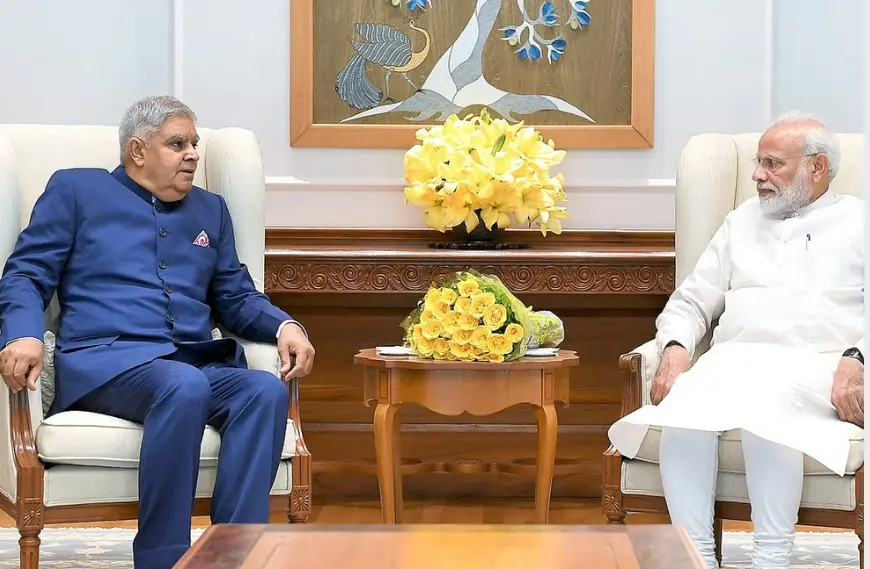
When Jagdeep Dhankhar handed in his resignation as India’s Vice President, the news didn’t just break — it stunned. It came without warning, just as Parliament’s Monsoon Session was kicking off. Within hours, a post from the President confirmed it: Jagdeep Dhankhar’s resignation had been accepted, effective immediately.
It’s not every day that a sitting Vice President walks away mid-term. So naturally, the country paused. Was it really just about health? Or is there more going on behind the scenes?
A personal decision or a political earthquake?
On paper, the reason was clear. Dhankhar cited medical advice and said he needed to prioritise his health. At 74, after decades in public life… including recent years in high-pressure roles, this is not an unbelievable move.
But what made it shocking was the timing. Until a few hours before, Dhankhar was meeting with MPs and colleagues like nothing was amiss. By evening, he had resigned. That kind of swift turnaround always raises eyebrows in Delhi.
The opposition, especially Congress, did not hold back. Senior leader Jairam Ramesh posted that the resignation was not only shocking but unimaginable. He hinted there might be more going on than what’s officially been said. And let’s be honest… When seasoned politicians say things like that, people listen.
The constitution kicks in
Once Dhankhar submitted his resignation, Article 67(a) of the Indian Constitution came into play. This provision allows a Vice President to resign at any time by writing to the President.
Simple as that? Yes. But the speed of it all still felt unusual. The Ministry of Home Affairs issued the formal notification. The Rajya Sabha Chair read it out, and Parliament adjourned early. Just like that, one of the top constitutional posts in India fell vacant.
It was a textbook process… but the timing made it anything but routine.
Monsoon session, interrupted
The resignation landed on Day One of Parliament’s Monsoon Session. A time when debates, bills, and crucial discussions are usually set in motion.
Instead, the day began with confusion. Members walked into the Rajya Sabha expecting business as usual. They got a resignation announcement.
When politics is this tightly scripted, such sudden exits don’t just cause ripples. They shake the floor. The Chair was taken over temporarily by Deputy Chairman Harivansh Narayan Singh. But the sense of disruption lingered.
This was not just any day. It was the first day. And the House had lost its presiding officer.
Health in high office
Let’s not forget the personal side of this. Being Vice President of India is not just symbolic. It’s long hours, daily pressure, public expectations.
At 74, Jagdeep Dhankhar’s health may well have reached a point where continuing became difficult. And if that’s the case, his decision to step down, rather than hold on… should be respected.
We often glorify leaders who keep going no matter what. But perhaps it’s time to also respect those who step back when they need to. In that sense, this move is rare, and even brave.
Public office takes a toll. And Dhankhar is not the only senior leader who has made such a choice in recent years.
Modi’s calm, congress’ curiosity
PM Modi took a neutral tone. His post on X wished Dhankhar good health and thanked him for his service. No drama, no dig, just a short message.
But if you read between the lines, it was notably brief. That kind of diplomatic silence is often louder than words.
Contrast that with Congress’ tone. Jairam Ramesh clearly suggested that this was not just about health. According to him, Dhankhar had seemed perfectly fine just hours earlier. If true, it begs a bigger question: Did something else happen behind closed doors?
What Happens to Rajya Sabha now?
Dhankhar was not just Vice President. He was also the Chairperson of the Rajya Sabha… the Upper House of Parliament. With him gone, Deputy Chairman Harivansh steps in for now.
This change comes at a delicate time. The Monsoon Session has key bills on the table. A new Chairperson will be required soon. But until then, leadership in the House will run on a temporary basis.
These transitions are built into our system. But they are not always smooth.
A rare political move
Resigning mid-term from such a high office is extremely rare in Indian politics. Most leaders finish their full term, even if things get rocky.
The last time something like this happened, it was under very different circumstances. That’s what makes this even more curious.
For political historians and trivia nerds, this is one for the books.
The social media buzz
As news of Jagdeep Dhankhar’s resignation broke, social media exploded. Some praised the decision. Others speculated wildly. A few even called it a political strategy.
In today’s world, public conversation often happens online. And platforms like X are where the battle of narratives begins.
It’s not always about facts. Sometimes, it’s about perception.
So, what do we know for sure?
Here’s what’s clear:
- Jagdeep Dhankhar has resigned, citing health reasons.
- The resignation is official, accepted, and in effect.
- Parliament’s Monsoon Session began with this unexpected shift.
- Political parties are reacting very differently to the news.
What’s less clear is what this means for the months ahead. Will there be a ripple effect inside the BJP? Will the opposition use this as ammunition? Or will the matter quietly fade away?
In politics, not everything is what it seems. And not every resignation is just about the letter handed in.
Jagdeep Dhankhar’s resignation has opened up more questions than answers. Whether it’s health, pressure, politics, or all three… we will have to wait and watch.
For now, India’s Vice Presidency is empty. And the story is just beginning.
