



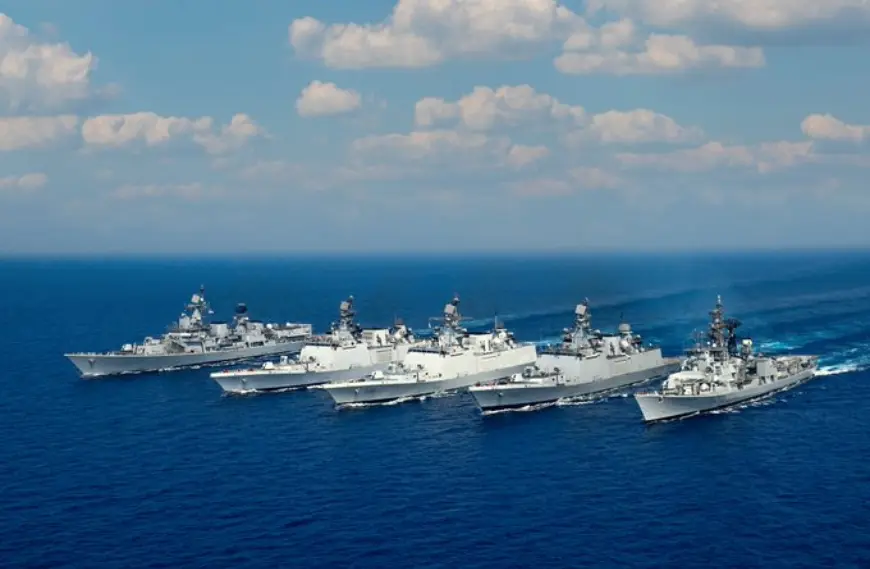
India has strengthened its maritime defence with the induction of INS Androth, a new Anti-Submarine Warfare (ASW) shallow-water craft, into the Navy. Built under the “Make in India” initiative by Garden Reach Shipbuilders and Engineers (GRSE), the ship marks another step in India’s plan to modernise its naval fleet. But more than just adding a warship, this move highlights the larger strategy keeping the Indian Ocean Region (IOR) safe and secure.
Why the Indian ocean is crucial
The Indian Ocean is not only India’s backyard but also a vital global waterway. Nearly 80% of global oil trade and a large part of world trade passes through this region. For India, most imports, including crude oil, come via these sea routes. That is why keeping these waters secure is a matter of both economic survival and national security.
In recent years, China has increased its naval presence in the Indian Ocean. Its submarines, warships, and bases in countries like Djibouti, Pakistan, and Sri Lanka have caused concern in New Delhi. These moves are part of China’s ‘string of pearls’ strategy, where it tries to expand influence through ports and military access across the IOR. For India, this is a direct challenge.
The role of INS AndRoth
This is where INS Androth becomes important. It is designed for shallow-water operations, which larger destroyers or frigates cannot easily handle. Submarines often try to hide in shallow coastal waters, making detection very difficult. INS Androth is equipped with advanced sonar systems, lightweight torpedoes, and anti-submarine weapons that can track and neutralise such threats.
The ship also supports coastal surveillance, escort duties, and protection of India’s island territories like the Andaman and Nicobar Islands or Lakshadweep. With these capabilities, it strengthens India’s ability to deter adversaries and safeguard maritime borders.
Strategic significance beyond defence
Commissioning INS Androth also sends a strong message to the international community. It shows that India is serious about being a net security provider in the Indian Ocean. Smaller nations in the region, such as Maldives, Mauritius, and Seychelles, look to India for maritime support. With better-equipped vessels, India can play that leadership role more effectively.
Apart from countering China, these ships are useful against other challenges such as piracy, illegal fishing, drug smuggling, and terrorism at sea. The Indian Ocean is becoming a hotspot for such non-traditional threats, and India needs a capable fleet to respond quickly.
Building indigenous strength
Another important angle is the indigenous design and construction of INS Androth. Built by GRSE in Kolkata, the vessel reflects India’s growing capacity in defence manufacturing. This supports the government’s ‘Amanirbhar’ Bharat’ push for self-reliance and reduces dependence on foreign suppliers for critical military hardware.
The induction of INS Androth is not just about adding one more ship to the Navy. It is part of a larger maritime strategy aimed at protecting trade routes, securing island territories, countering China’s influence, and preparing for future challenges. With such modern vessels, India is reinforcing its role as a strong and reliable power in the Indian Ocean.
At a time when global attention is shifting to the Indo-Pacific, India is making sure that the Indian Ocean remains safe, free, and open with its Navy at the heart of this effort.
