



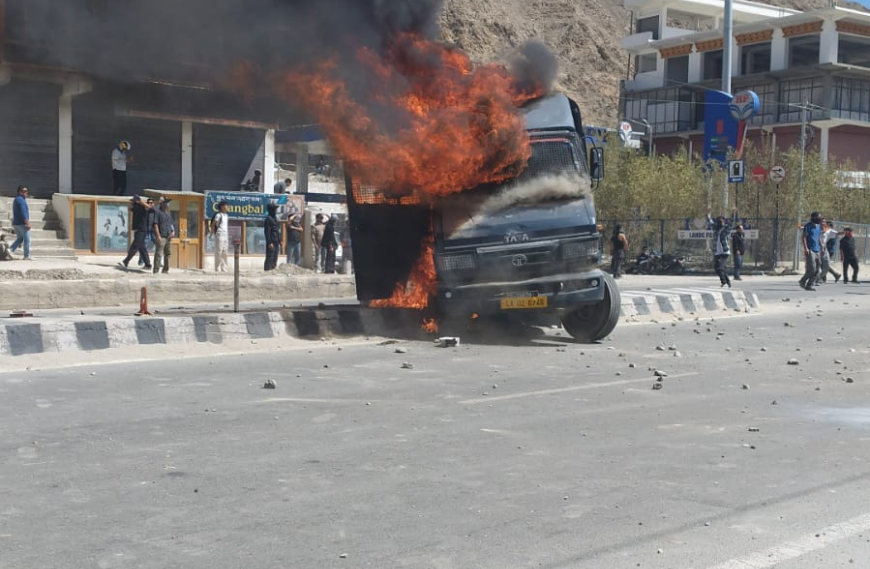
Recently, Ladakh, the beautiful region known for its mountains and valleys, has faced violent incidents that have raised serious concerns about law and order. Tensions increased in Leh and nearby areas, leading to clashes between local groups and authorities. While the reasons are complex, most reports suggest that local grievances about governance, representation, and development triggered the unrest. People feel that their voices are not always heard, and this frustration has boiled over in some cases.
Several local organizations and youth groups have been active in highlighting these issues. They are calling for better governance, fair representation, and attention to the development needs of Ladakh. Security forces were deployed to control the situation and restore peace. Their presence was important to prevent the violence from spreading further.
During this time, Sonam Wangchuk, the well-known educator and innovator from Ladakh, was mentioned in media reports. Wangchuk is famous for his work in education and environmental conservation and has always been a voice for Ladakh’s youth. It is important to clarify that his involvement in the current unrest is focused on advocacy and raising awareness about local issues, not in promoting or instigating any violence. Sonam Wangchuk is also the son of Sonam Wangyal, a former Congress MLA and minister in Jammu and Kashmir, which sometimes draws additional attention to his public statements.
The recent incidents show how sensitive the situation in Ladakh can be. It is a region of great strategic importance for India and has a diverse population with unique needs and concerns. The authorities, including the local administration and central government, are now trying to address the complaints of the community while maintaining law and order. Political and social leaders are emphasizing dialogue, understanding, and peaceful resolution to prevent further escalation.
This unrest is also a reminder that Ladakh’s stability depends on active engagement with its residents. It highlights the need for continued attention to local issues, better communication between authorities and communities, and empowerment of youth and local groups. Addressing the core problems, rather than only controlling the symptoms, will help ensure long-term peace and development in the region.
Ladakh is not just a scenic region; it is a sensitive area with social and political complexities. Understanding these issues and focusing on dialogue and peaceful solutions is the key to keeping the region safe and stable.
