



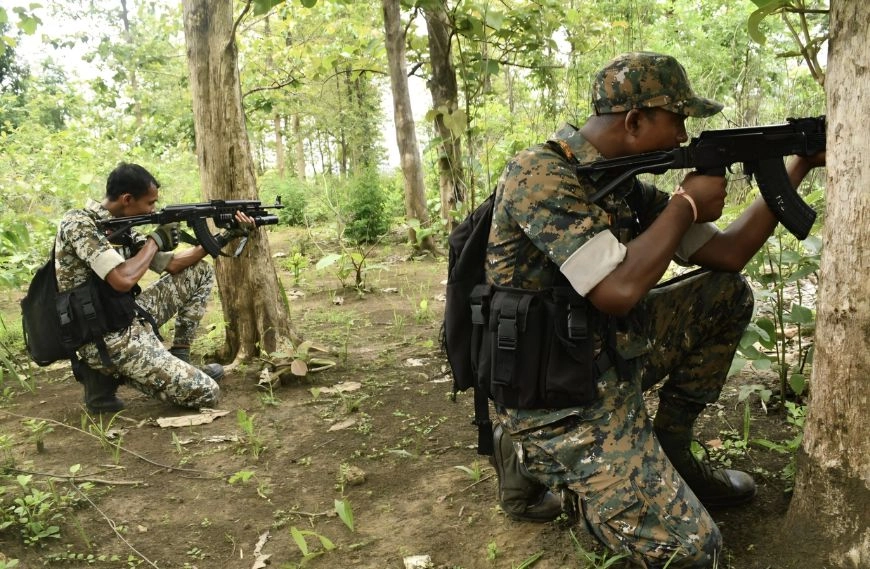
The recent anti-Maoist operations in Chhattisgarh that led to the killing of 14 Maoist cadres were the result of specific intelligence inputs and coordinated action by specialised security units. The encounters took place in two separate locations in the Bastar region Sukma and Bijapur and were carried out by teams of the District Reserve Guard (DRG), a unit trained specifically for counter-insurgency operations in the state’s forested terrain.
According to police officials, the operations were launched after credible intelligence indicated the presence of armed Maoist groups in the region. In Sukma district, inputs suggested that a group of Maoists had assembled in forest areas under the Kistaram and Konta police station limits. Around the same time, a separate intelligence alert pointed to Maoist movement in the Basaguda–Tarrem belt of neighbouring Bijapur district. These inputs were assessed and verified before security forces were mobilised.
Based on this information, DRG teams moved into the identified areas during the early hours, a time typically chosen to gain a tactical advantage in dense jungle conditions. Security officials said the teams advanced cautiously, using prior reconnaissance and local knowledge to navigate difficult terrain. Contact was made when Maoist cadres opened fire on the advancing personnel, following which exchanges of gunfire took place.
In the Sukma encounter, 12 Maoists were killed during the firefight. Police later confirmed that one of those killed was Mangdu, identified as a local area committee secretary of the Maoist organisation. This indicated that the intelligence had successfully tracked the presence of a senior operative. In the second encounter in Bijapur, two Maoists were killed in a separate exchange of fire.
After the firing stopped, security forces conducted thorough searches of the encounter sites. Several weapons were recovered, including automatic rifles such as AK-47s and INSAS rifles, along with other arms and ammunition. Officials said the recovery of these weapons confirmed that the Maoists involved were armed and prepared for combat.
The District Reserve Guard played a central role in both operations. The unit is made up largely of local recruits who are familiar with the terrain and operating conditions of Bastar. Their understanding of the forests, combined with counter-insurgency training and coordination with senior police leadership, allows them to act quickly on intelligence inputs and carry out targeted operations.
Officials said the encounters are part of an ongoing campaign to weaken Maoist networks in central India by disrupting leadership structures and armed groups. Security operations in the Bastar region have increasingly relied on intelligence-based actions rather than large-scale sweeps, with an emphasis on precision and coordination.
Authorities have stated that further details will be shared once all post-operation procedures are completed. The latest encounters underline the importance of actionable intelligence and inter-unit coordination in counter-insurgency efforts, particularly in regions where terrain and local conditions present significant challenges.
Subscribe Deshwale on YouTube
