



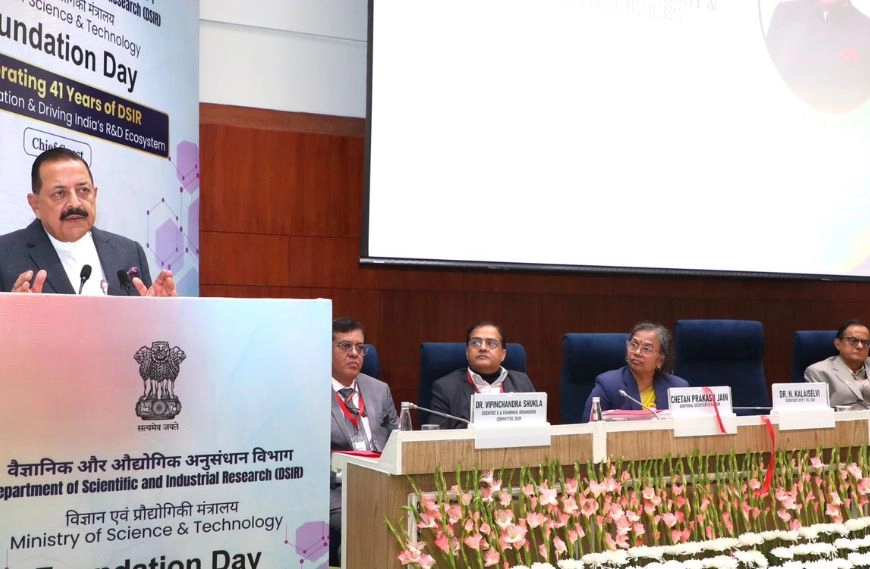
The Government of India has announced a major policy change to support deep‑tech startups and strengthen the country’s research and innovation ecosystem. The decision was revealed on the 42nd Foundation Day of the Department of Scientific and Industrial Research (DSIR), which operates under the Ministry of Science & Technology.
Union Minister Dr Jitendra Singh, who oversees multiple science and technology departments, stated that the previous requirement for startups to exist for at least three years before receiving recognition from DSIR has been removed. This change aims to help early‑stage deep‑tech startups gain official recognition sooner, providing them with credibility and access to government support. Earlier, startups had to demonstrate three years of activity under the Industrial Research and Development Promotion Programme to qualify for recognition. The new rule removes this condition, enabling younger startups with strong technological potential to benefit from DSIR schemes.
Dr Singh explained that the move will allow young innovators and founders to gain momentum even in the initial stages of their ventures. He emphasised that the change reflects the government’s confidence in Indian innovators and its commitment to nurturing the startup ecosystem. The minister also highlighted the ₹1 lakh crore Research, Development and Innovation (RDI) Fund, which primarily supports more mature startups, while the rule change ensures that early-stage deep‑tech ventures can also progress faster.
During the Foundation Day celebrations, Dr Singh spoke about the longstanding connection between DSIR and the Council of Scientific and Industrial Research (CSIR). DSIR, established from CSIR, continues to collaborate closely to support research, technology transfer, and partnerships with industry across sectors. He also pointed out that India’s scientific and technological capabilities have gained global trust, from vaccines and medical devices to homegrown innovations that are now exported worldwide, demonstrating that the country is both self-reliant and a trusted technology partner.
The minister further highlighted the role of women in the innovation ecosystem, noting that over 10,000 women beneficiaries, including more than 55 women-led self‑help groups, have availed DSIR schemes, reflecting growing inclusion in science and technology.
As part of the celebrations, four new initiatives were announced. These include updated DSIR guidelines to recognise in-house R&D centres of deep‑tech startups without the three-year age requirement, the PRISM Network Platform – TOCIC Innovator Pulse to strengthen innovation pipelines, Creative India 2025 under the PRISM scheme to promote technology-driven entrepreneurship, and a DSIR Disaster Management Plan to improve preparedness and resilience.
The event also saw agreements to establish a Skill Satellite Centre in Chhattisgarh aimed at technology-led skill development and rural women’s livelihoods. Senior officials from CSIR, the Department of Space, the Ministry of Earth Sciences, and other scientific organisations attended the function.
Dr Singh concluded by reaffirming the government’s commitment to advancing India’s capabilities in critical technology areas, including energy transition, semiconductors, artificial intelligence, robotics, and space technologies. He said that removing the three-year rule for startup recognition is an important step toward building a future-ready and technology-sovereign India.
Subscribe Deshwale on YouTube
