



By: Hiren Gandhi
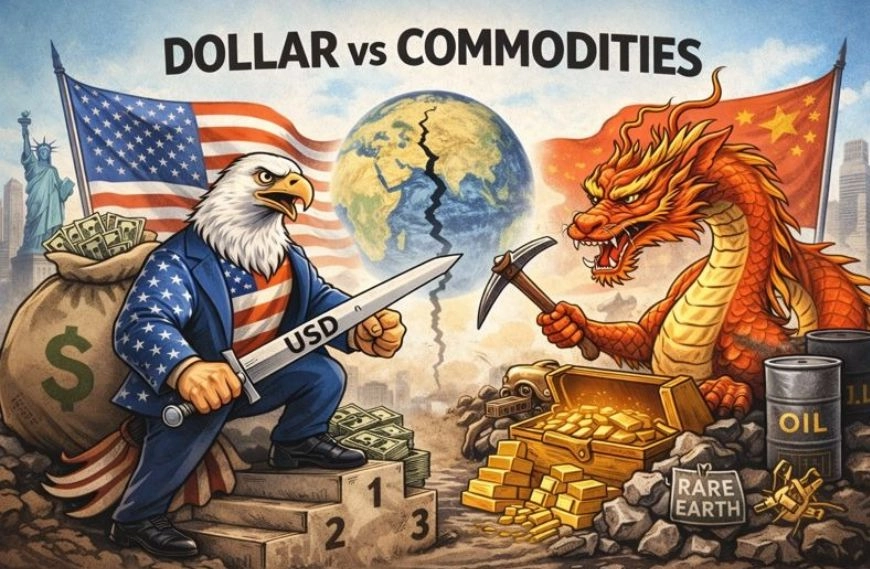
The world’s most consequential battle today is not unfolding on military frontlines. Instead, it is being fought quietly across banks, ports, mines, supply chains, and central bank vaults. At the heart of this global contest are two competing pillars of power: the US Dollar and physical commodities.
On one side stands the US Dollar, long regarded as the backbone of global finance and international trade. On the other side are tangible assets such as gold, energy resources, metals, minerals, and rare earth elements, which are increasingly shaping geopolitical influence. This is not a war of weapons, but a struggle over trust, control, and access to real resources.
From Money Power to Resource Power
Between the 1990s and early 2010s, global dominance was largely defined by financial strength alone. Control over money, particularly the US Dollar, translated directly into power. However, the post-2025 world reflects a fundamental shift. Power is no longer defined by currency alone, but by a combination of money and resources.
In simple terms, money still matters, but without access to commodities, its influence is limited.
How the Dollar Became the World’s Anchor
Following World War II, the United States shaped the global financial system around the dollar. International trade was conducted in USD, central banks held dollar reserves, and oil transactions were priced in dollars, forming what came to be known as the petrodollar system.
This framework gave the US a unique advantage. It could issue its own currency while the rest of the world accepted it for trade and reserves. Economists refer to this as an “exorbitant privilege,” allowing America to finance deficits without immediate consequences.
From Currency to Strategic Weapon
This raised concerns across emerging economies. The question became unavoidable: if economic stability depends entirely on the dollar, where does national sovereignty stand? This concern accelerated the global push toward de-dollarization.
Over time, the dollar evolved from a medium of exchange into a geopolitical tool. The US leveraged its dominance over global banking networks to impose sanctions, restrict access to financial systems, and freeze foreign assets. Countries such as Russia and Iran experienced the direct impact of these measures.
Reserve data reflects this gradual shift. While the dollar remains dominant, its share in global reserves has declined, while gold and alternative assets have steadily increased.
China’s Resource-First Strategy
While the US strengthened financial influence, China pursued control over physical supply chains. Beijing focused on manufacturing dominance, strategic minerals, and commodity security.
Gold accumulation became a key pillar. Unlike currency reserves, gold is not tied to any nation’s debt and cannot be frozen by external authorities. Rising global uncertainty has pushed gold prices sharply higher, underlining its renewed relevance.
Even more critical is China’s dominance in rare earth processing. These materials are essential for electric vehicles, renewable energy, electronics, defense systems, and advanced technologies. China controls the vast majority of global rare earth processing and has secured overseas mining assets through long-term infrastructure and trade partnerships.
In effect, while the US controls the flow of money, China controls the flow of materials.
A Dividing World Economy
The global system is gradually splitting into two broad blocs. One is anchored in the dollar-based financial order led by the United States and its allies. The other is emerging around commodity-rich nations, manufacturing hubs, and alternative payment systems promoted by China, Russia, and BRICS countries.
This transition is expected to reshape supply chains, increase price volatility, and create new trade corridors. The world is no longer moving toward a single superpower model but toward multiple centers of influence.
The Role of Digital Assets
Bitcoin and other digital currencies exist outside traditional power structures. They are borderless and decentralized, but extreme volatility prevents them from functioning as stable global reserves. For now, they remain alternatives rather than replacements.
Outlook: Paper Power vs Real Power
According to Hiren Gandhi of ReNis Agro International, the immediate future still belongs to the dollar due to its entrenched position in global trade and finance. However, over the long term, nations controlling real assets will gain strategic advantage.
The defining economic contest of this decade is clear: financial dominance versus resource control. As the balance shifts, the global order is being rewritten, not through conflict, but through commodities.

Secretary — InGlobal Business Foundation (IBF)
Director — ReNis Agro International LLP, Ahmedabad, India
Subscribe Deshwale on YouTube
