



By: Hiren Gandhi
India’s export-oriented industry is looking to Budget 2026 for decisive support as global trade tensions intensify. With tariff wars between the United States, Europe, and China impacting export costs and competitiveness, Indian exporters face mounting challenges. The US, India’s largest export market, has imposed tariffs of up to 50% on several products, prompting global buyers to consider reducing sourcing from India.
The government is expected to address these challenges through targeted measures in the upcoming budget, industry experts say.
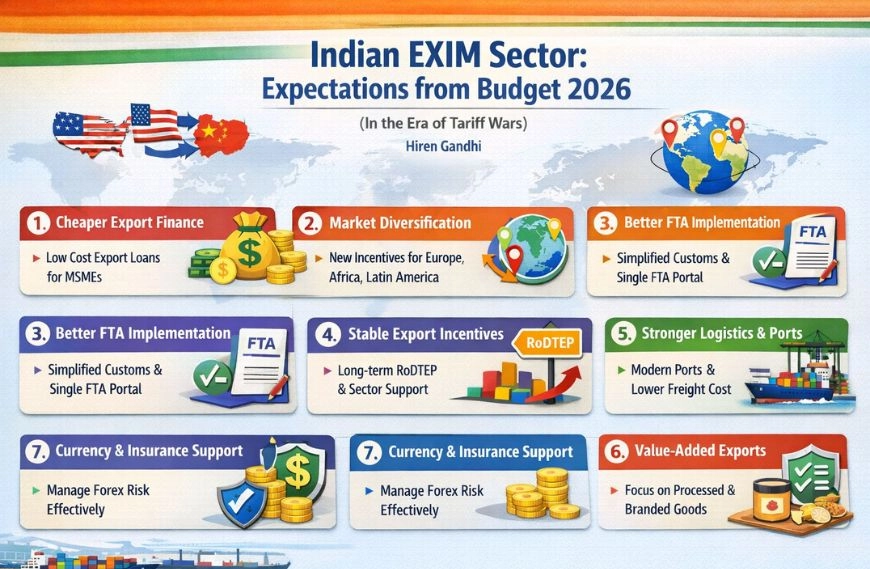
Making Export Finance Cheaper and Simpler
Working capital remains the biggest hurdle for exporters. The EXIM community expects Budget 2026 to reduce interest rates on pre-shipment and post-shipment export loans, introduce dedicated credit lines for MSME exporters, and simplify banking documentation through fully digital processes. These steps aim to reduce financial burdens and make exporting more accessible.
Incentives for Market Diversification
Relying heavily on the US market has proven risky. Exporters hope the budget will introduce incentives specifically for Europe, Africa, CIS countries, and Latin America. Government-backed schemes to support entry into new markets are also anticipated, ensuring that export risks are spread across multiple regions.
Effective Implementation of FTAs
Many exporters have yet to benefit fully from India’s Free Trade Agreements due to complex customs procedures and impractical rules of origin. Budget 2026 is expected to simplify customs processes, make rules of origin practical and transparent, and launch a single digital FTA portal, enabling small and medium exporters to gain real advantages.
Stability in RoDTEP and Export Incentives
For effective planning, exporters need policy certainty. Long-term RoDTEP rates and focused incentives for agriculture, spices, food products, and textiles are expected to provide cost certainty and ease export strategy planning.
Strengthening Logistics and Port Infrastructure
High logistics costs remain a significant concern. Industry stakeholders expect investments in modernizing ports, ICDs, and warehousing, alongside measures like coastal shipping and dedicated export corridors, to reduce freight costs and enhance “Export from India” initiatives.
ECGC as a Risk Shield
In the era of tariff wars, risk management is crucial. Exporters anticipate faster and simpler ECGC procedures, reduced insurance premiums for MSMEs, country-wise and buyer-wise credit risk assessments, and higher coverage limits for those with strong track records.
Addressing Currency Risk and Promoting Value-Added Exports
Volatile currency rates pose additional risks. Experts expect easier forex hedging, faster export credit insurance claim settlement, and policies encouraging processed foods, packaged spices, and branded products, boosting export value over volume.
Industry insiders say that if Budget 2026 effectively addresses export finance, market diversification, ECGC risk protection, FTA implementation, and logistics infrastructure, India can emerge “not just as a survivor of tariff wars, but as a global trade leader.”

Secretary — InGlobal Business Foundation (IBF)
Director — ReNis Agro International LLP, Ahmedabad, India
Subscribe Deshwale on YouTube
