



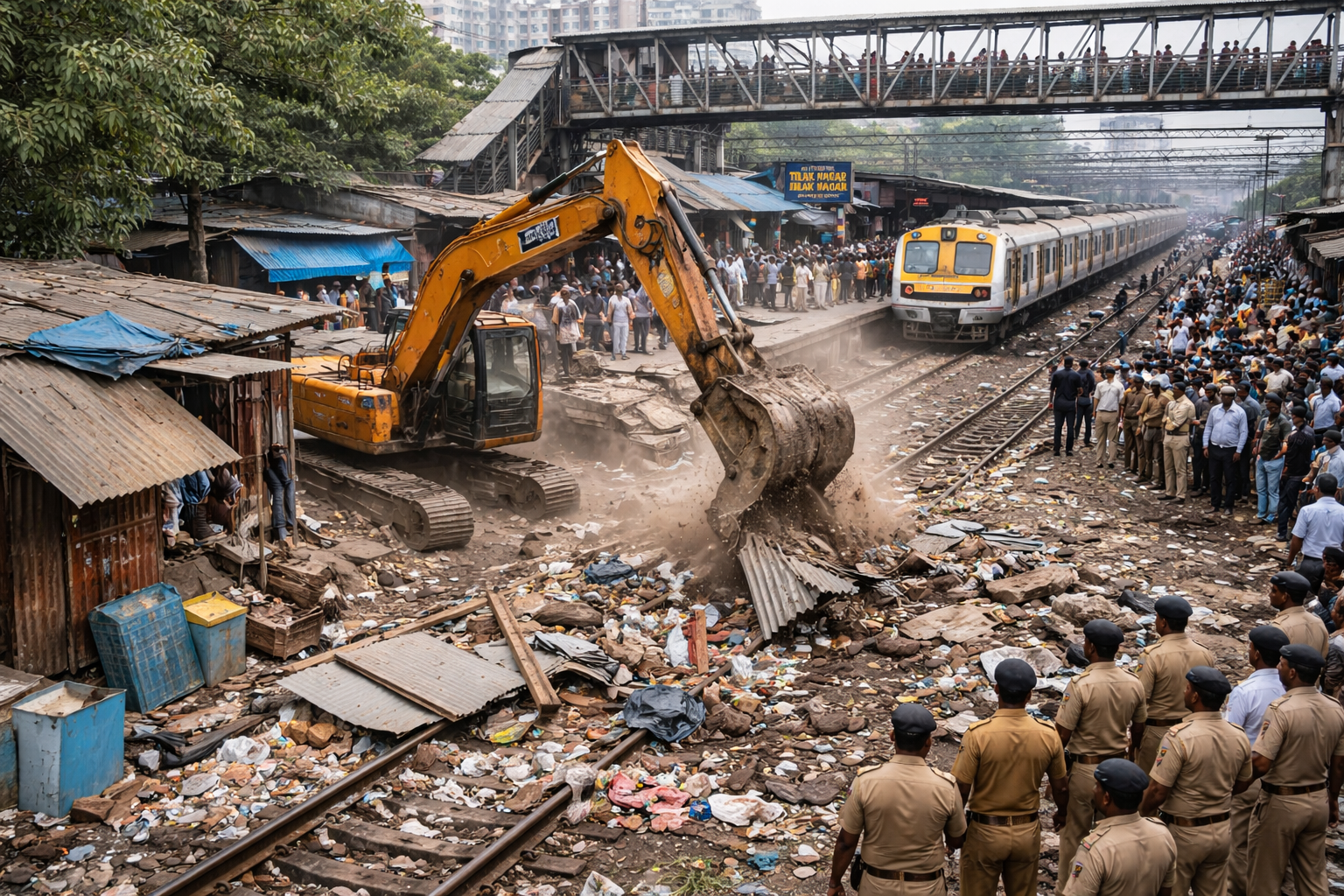
The demolition of an illegal structure outside Tilak Nagar railway station on Mumbai’s Harbour line offers a good example of swift civic action. Acting on a commuter’s complaint posted on a social networking platform, the Railway Protection Force cleared the encroached site and confirmed that it has been secured to prevent fresh occupation. The episode, however, raises an uncomfortable question. Why must public land violations reach social media before the state responds? Will the menace of encroachments in Mumbai ever be nipped in the bud?
Encroachments on government land have long plagued Mumbai. Pavements, railway corridors, coastal stretches and reserved plots across the city stand occupied in violation of law. Despite repeated court interventions and demolition drives, illegal occupation of public land continues almost unchecked, pointing to deeper structural failures in urban governance.
Mumbai’s government land is held by multiple agencies, including the Municipal Corporation of Greater Mumbai, the Maharashtra government, MHADA, MMRDA and Indian Railways. These lands are designated for public housing, transport infrastructure, open spaces, hospitals and civic amenities. Their systematic encroachment directly undermines planned urban development and public service delivery.
The causes are both socio-economic and political. On one hand, Mumbai’s housing crisis leaves low-income migrants with few legal options. High land prices and limited rental housing force thousands into informal settlements on vacant public land. On the other hand, many encroachments have little to do with survival. Pavements become permanent shops, railway land turns into godowns, and open plots are commercialised with impunity. Such occupations often flourish due to political patronage, delayed enforcement and weak institutional coordination.
The consequences are visible across the city. Encroachments choke drainage systems, worsening flooding during monsoons. Road widening projects stall. Footpaths vanish, forcing pedestrians onto traffic-clogged streets. Open spaces shrink, pushing Mumbai further into an urban deficit that directly affects public health, mobility and climate resilience.
Encroached zones also lack basic services such as sanitation and waste management. Fire hazards are acute, particularly near railway lines and congested settlements, where emergency access is nearly impossible. The cost of these failures is borne not just by encroachers, but by the city at large.
At the governance level, the persistence of encroachments reflects inconsistent enforcement of the law. While statutes clearly prohibit illegal occupation of public land, action is often reactive. Demolitions follow court orders, accidents or media pressure, rather than proactive monitoring. Legal disputes drag on for years, allowing encroachments to become entrenched. In many cases, cleared land is re-occupied within months, exposing the absence of post-clearance safeguards.
Selective enforcement further erodes public trust. Ordinary citizens face swift penalties for minor violations, while large-scale encroachments on valuable public land often remain untouched. This uneven application of the law normalises illegality and weakens the credibility of civic institutions.
Courts have repeatedly held that government land cannot be regularised simply because it has been occupied for long periods. At the same time, they have emphasised humane rehabilitation for vulnerable populations. The policy challenge lies in enforcing the law without converting illegality into entitlement, while ensuring that genuine housing needs are addressed.
Addressing the encroachment crisis requires structural reform. Affordable and rental housing must be expanded at scale. Land records should be digitised and publicly accessible. Agencies must use satellite mapping and GIS systems to detect and prevent fresh encroachments. Most importantly, enforcement must be insulated from political interference.
The Tilak Nagar demolition should not remain an exception triggered by online outrage. For Mumbai to function as a lawful and liveable city, protecting government land must become a matter of routine governance, not episodic reaction.
Subscribe Deshwale on YouTube
Share.Facebook
