



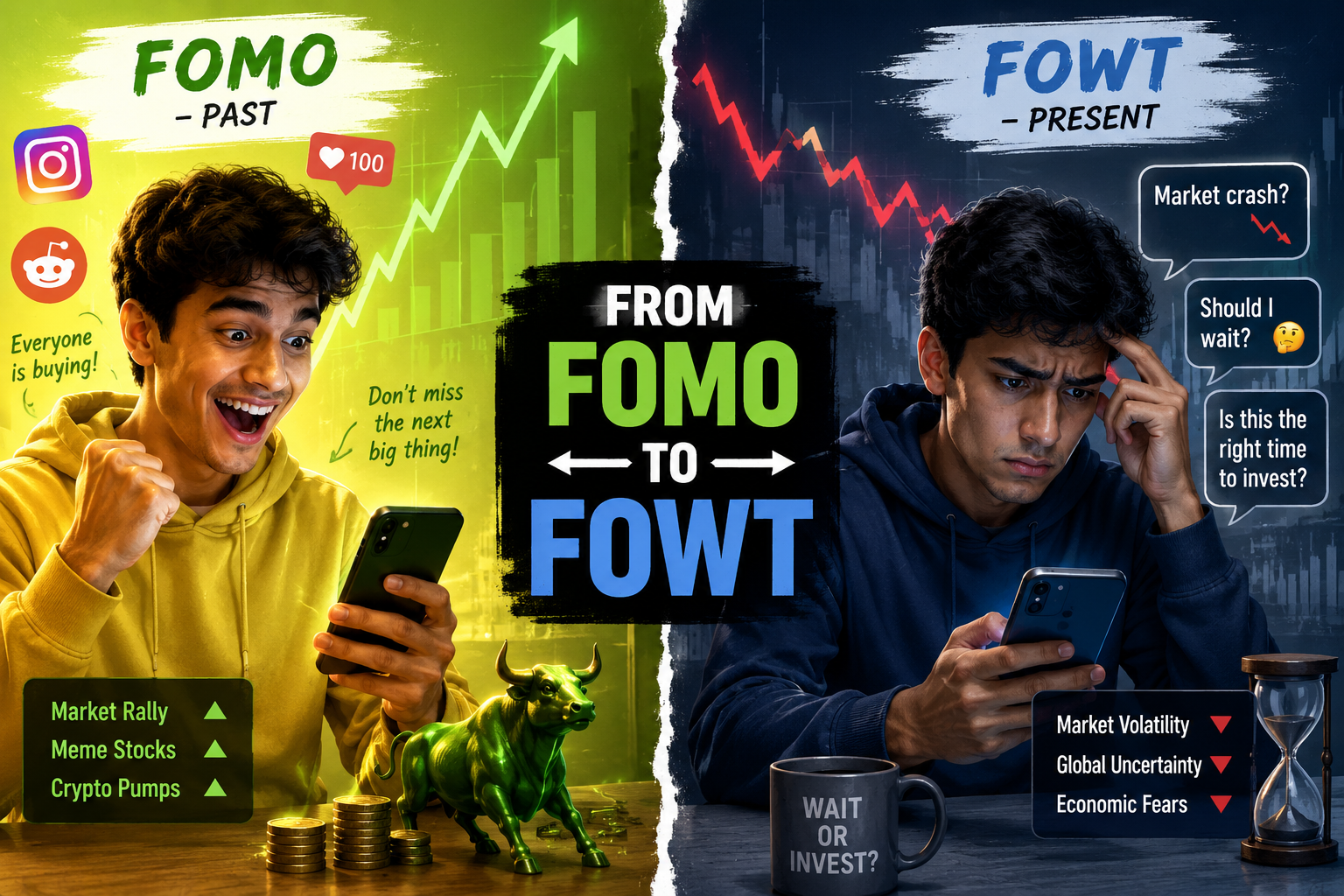
Not long ago, Gen Z investors were the poster children of fearless market enthusiasm. Fuelled by Reddit threads, TikTok finance influencers, and zero-commission trading apps, they poured money into meme stocks, cryptocurrencies, and IPOs with the kind of conviction that left older generations quietly baffled. The driving emotion was FOMO Fear of Missing Out and it worked, right up until it didn’t.
Now, a quieter but equally powerful feeling has taken its place. Meet FOWT Fear of Wrong Timing. It is the paralysing anxiety of jumping into the market at precisely the wrong moment. And for millions of young investors in India and around the world, it has become the defining emotion of their financial lives in 2025 and 2026.
“The shift from FOMO to FOWT is not a retreat from investing, it is, in many ways, a sign of growing up.”
To understand FOWT, you have to go back to the pandemic boom. Between 2020 and 2021, retail investing exploded. Markets climbed aggressively while the world was locked down, and an entire generation discovered the stock market through their phone screens. For many Gen Z investors, their first trade was a winning one. That early luck was intoxicating and also dangerous, because it created a false sense of market predictability.
Then reality arrived. Inflation spiked. Interest rates rose sharply. Tech stocks cratered. Crypto, the asset class that had made some Gen Z investors feel invincible, lost over 70% of its value from peak to trough. The investors who had entered the market without strategy watched their early gains evaporate. For a generation that prides itself on research, social awareness, and not repeating the mistakes of millennials it stung.
55%
of Gen Z investors hold cryptocurrency
19
average age Gen Z starts investing
1 in 5
Gen Z investors influenced by social media
FOWT is the psychological hangover from that experience. It is not the fear of the stock market itself most Gen Z investors still believe in long-term wealth creation. Rather, it is a deep, almost obsessive worry about when to invest. Should I wait for the correction? Is this rally real or a dead cat bounce? What if I buy today and the market drops 15% next week? These questions, once the exclusive territory of anxious middle-aged investors, now dominate the group chats and comment sections of Gen Z.
The irony is significant. In trying to avoid the impulsiveness that defined FOMO, many young investors have swung too far in the opposite direction into inaction. Waiting for the “perfect” entry point is one of the oldest and most expensive mistakes in investing history. Markets do not send invitations. As the legendary investor Peter Lynch once observed, far more money has been lost by investors preparing for corrections than in the corrections themselves.
“Waiting for the perfect entry point is one of the oldest and most expensive mistakes in investing history.”
What makes FOWT particularly potent for Gen Z is the media environment they inhabit. Financial content on Instagram and YouTube is heavily optimised for drama crash predictions, bubble warnings, and doomsday charts get far more engagement than quiet, consistent, long-term investing advice. Every week brings a new macro risk: geopolitical tension, central bank decisions, currency fluctuations. For a generation that consumes news in real time and is wired to process risk acutely, the signal is always blinking red.
The solution is not to dismiss FOWT entirely. Caution is healthy. Knowing what you own and why is intelligent investing. But caution must be distinguished from paralysis. Financial experts consistently point to one antidote that cuts through the noise: systematic investing. A Systematic Investment Plan, or SIP, removes the burden of timing altogether. By investing a fixed amount every month regardless of market conditions, you buy more units when prices are low and fewer when prices are high, a natural averaging effect that works in your favour over time.
Time in the market, as the old adage goes, beats timing the market. For Gen Z with decades of compounding ahead of them this truth is even more powerful. A 22-year-old who invests consistently for 35 years will almost certainly outperform a 22-year-old who spent those same years waiting for the ideal moment that never quite arrived.
The shift from FOMO to FOWT is not a step backward. It reflects a generation that has been burned, has paid attention, and is now thinking harder about money than any generation before it. That instinct to pause and question is genuinely valuable. The challenge now is learning to act despite the uncertainty because in investing, as in life, waiting for perfect conditions is often just another name for waiting forever.
Subscribe Deshwale on YouTube
