



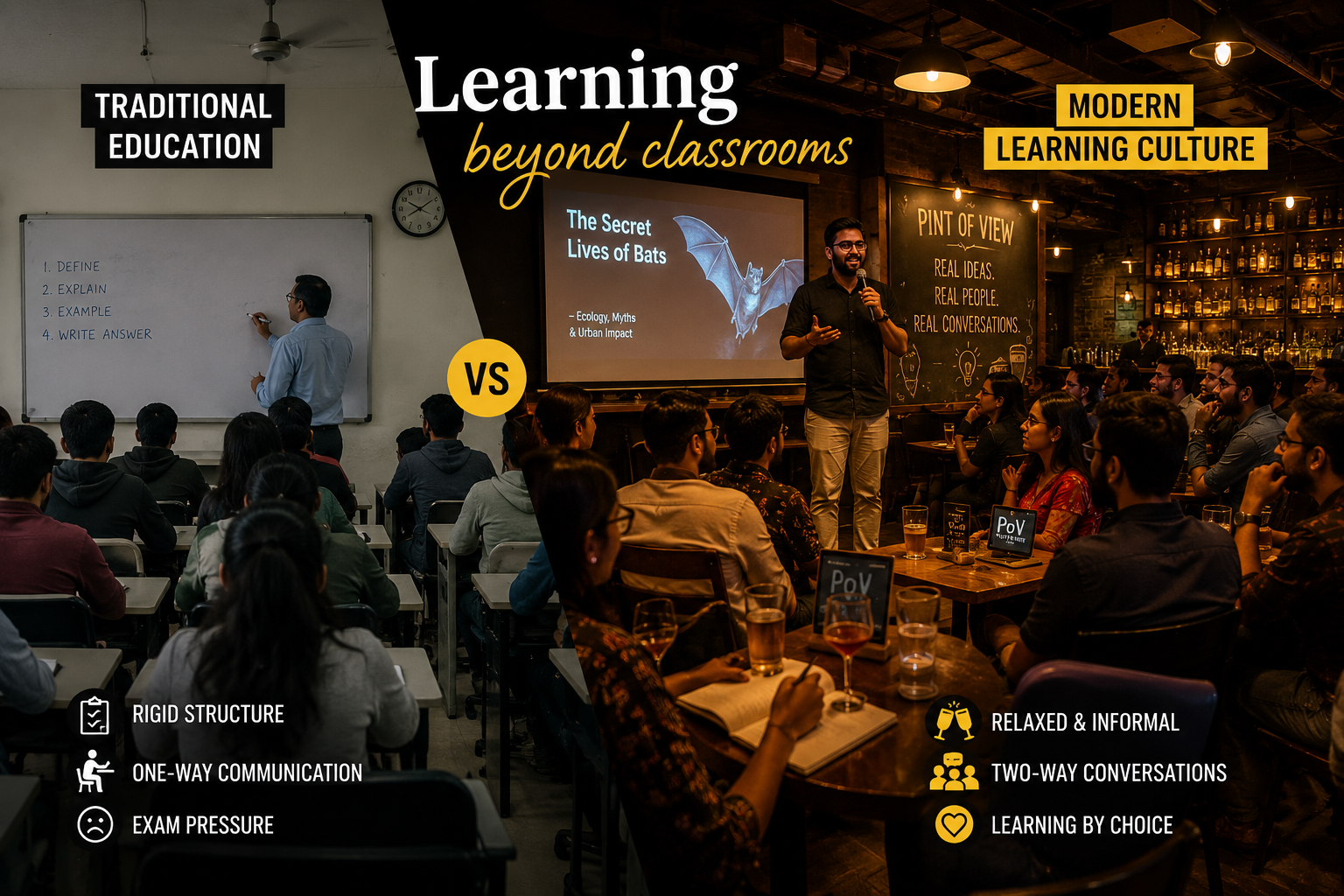
Picture this: It is a Sunday evening in Bengaluru. A conservationist walks up to a microphone, takes a deep breath, and begins talking about the secret lives of bats. The room is packed. People are scribbling notes, asking questions, and leaning forward in their seats. There is not a whiteboard or a projector screen in sight but there is a bar counter, a cocktail menu, and the quiet hum of a city unwinding after a week.
This is not a university. This is not a seminar hall. This is a bar. And this is where some of the most exciting learning in India is happening right now.
The idea that started it all
The movement has a name: Pint of View, or PoV. Launched in Bengaluru, it is a Sunday sundowner lecture series that brings scientific research, bold ideas, and expert knowledge out of university campuses and into informal, everyday spaces, specifically bars.
PoV is run by Harsh Snehanshu and Shruti Sah, the same duo behind Cubbon Reads, Bengaluru’s beloved silent reading movement, along with machine learning engineer Meghna Choudhary. The concept was inspired by a similar event series in the United States called Lectures on Tap, which has become so popular in cities like New York, Boston, and Chicago that it sells out weeks in advance.
Snehanshu describes PoV as a “grown-up edition” of school lectures, one that comes without grades, without gatekeeping, and without the pressure that makes most people tune out in traditional classrooms.
What actually happens at these events
The format is simple but effective. An expert, a university professor, a researcher, a scientist, or a specialist gives a talk on a topic they know deeply. The audience sits with drinks in hand, notebooks on laps, and asks questions freely. There are no formal evaluations, no attendance registers, and no institutional rules to follow.
The topics covered so far have been anything but ordinary. PoV has hosted sessions on visual thinking, the secret lives of bats, the meaning behind Indian textiles, and India’s growing heat crisis. In Delhi, a prominent Indian dancer named Navtej Johar once grabbed the mic at a bar in Hauz Khas and delivered a lecture on the philosophy of dance and yoga.
One recent event in Bengaluru’s Indiranagar neighbourhood drew around 70 people, who showed up with pens, notebooks, tablets, and drinks to hear expert Kaustubh Khare speak on visual thinking. After the talk ended at 5:30 PM, Khare fielded questions until 7:10 PM not because he had to, but because the audience simply did not want to stop.
The reason these events are connecting with people comes down to one thing: the setting changes everything.
Formal classrooms carry a weight that is hard to shake the fear of saying something wrong, the pressure of being evaluated, the stiffness of sitting in rows and being talked at. A bar removes all of that. As Snehanshu explains, there is an enormous amount of high-quality research and thinking locked inside institutions, often physically and socially inaccessible to ordinary people. By moving lectures into public spaces like bars, that knowledge becomes approachable.
For speakers, the experience is equally rewarding. Khare noted that unlike traditional classrooms where audiences are often homogenous and attend more out of obligation than interest, bar lectures attract a genuinely diverse crowd. At his own session, the audience included medical practitioners, lawyers, dancers, and designers, all there entirely by choice.
The events are ticketed, starting at ₹500, which Shruti Sah sees as a positive sign. “We have had startup founders, climate researchers, artists, musicians, dancers, and even real estate professionals come over,” she notes. The fact that people are paying to attend proves they are coming for the love of learning not because they have to.
It is not just Bengaluru
While Bengaluru may have led the charge, the movement has found enthusiastic audiences in Delhi as well. Groups like Nerd Nite and unLecture organise similar events in the capital. Nerd Nite, which originally started in Boston in 2003, now has chapters in over 100 cities worldwide, and its Delhi branch opened in 2025.
unLecture was started by 22-year-old Mishka Lepps along with her college friends Sonalika Aggarwal and Kezia Anna Mammen all graduates of St Stephen’s College with the goal of recreating the stimulating intellectual atmosphere of university life after graduation.
A word of caution
While the enthusiasm around bar lectures is well-deserved, experts point out that these spaces are not without their limitations. As academic Subramanian, who goes by doctorofpopculture on Instagram, cautions: “A bar is not automatically a more democratic classroom.” Bars and similar venues may appear open and public, but they remain privately governed and accessible only to those who can afford the ticket price, travel to the venue, and feel comfortable in that kind of environment.
The informality is real. But so is the barrier of entry for those outside urban, English-speaking, economically comfortable circles.
What this movement quietly signals is a deep frustration and a genuine hunger. India’s young professionals are not tired of learning. They are tired of the way they have been asked to learn: in rigid spaces, under surveillance, on someone else’s terms.
Bar lectures are not replacing universities. They are filling a gap that universities have long ignored the need for knowledge that feels human, conversations that feel free, and learning that feels like a choice rather than a chore.
And if a cold drink makes all of that a little easier? Well, that is probably not a bad thing either.
Subscribe Deshwale on YouTube
