



By: Ragini Chaubey
Today, on 7 May 2026, the world celebrates the 165th birth anniversary of Rabindranath Tagore, poet, philosopher, musician, and Nobel laureate. Born in Calcutta in 1861, Tagore wasn’t just a writer; he was a civilisation unto himself. His words shaped nations, his music became anthems, and his thoughts continue to echo across generations. As we pause to honour this extraordinary soul, here are 11 fascinating facts about the man behind the legend that most of us never learnt in school.
1. first Nobel laureate.
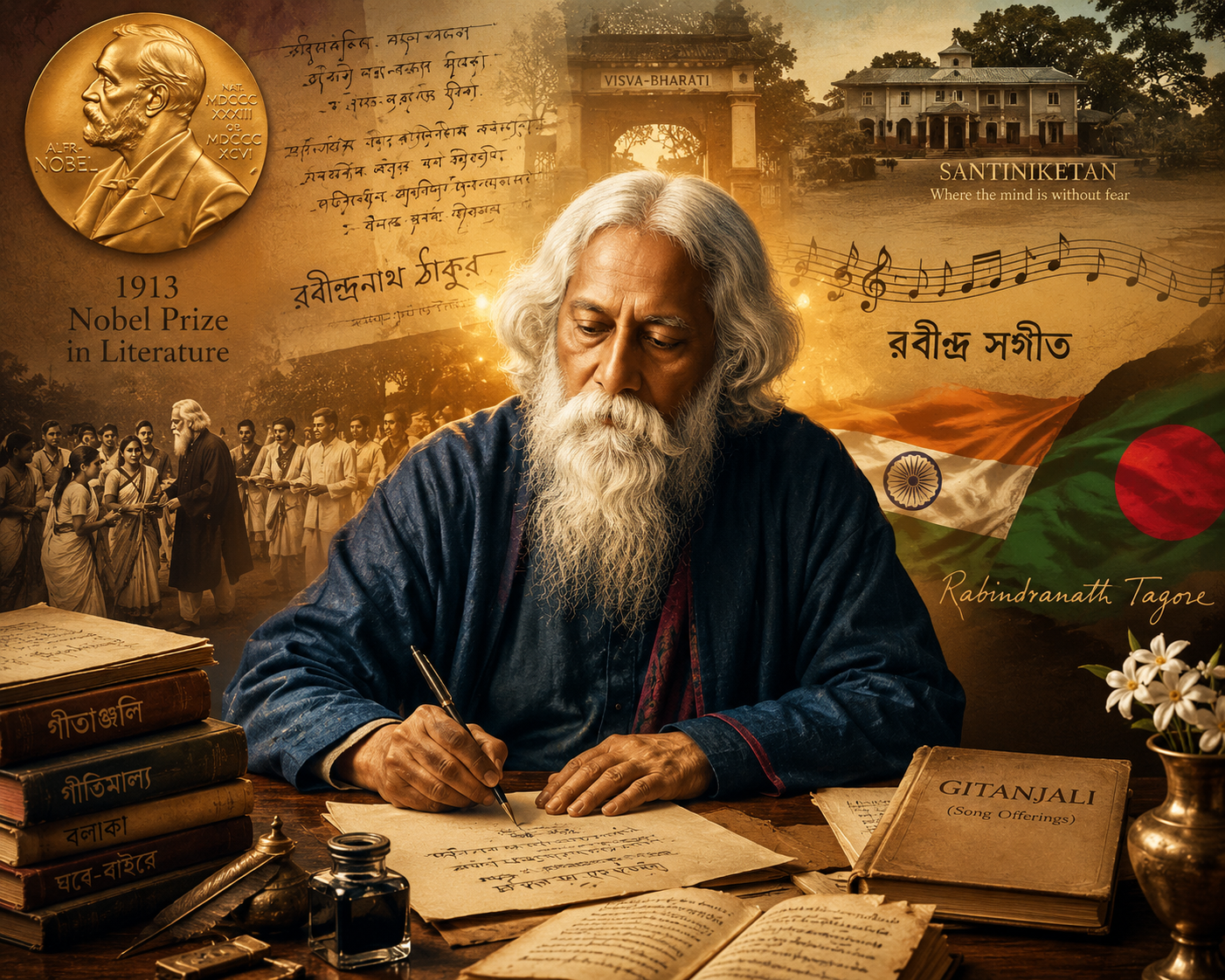
In 1913, Tagore became the first Asian to win a Nobel Prize, specifically the Nobel Prize in Literature and also the first non-European and the first lyricist to receive this honour.
2.The youngest of thirteen.
Tagore, fondly called “Rabi,” was born on 7 May 1861 in the Jorasanko mansion in Calcutta. He was the youngest of thirteen surviving children of Debendranath Tagore and Sarada Devi.
3.A rebel against classrooms.
Tagore largely avoided formal schooling and preferred roaming freely around the family estate, the nearby town of Bolpur, and Panihati. Nature and observation were his true teachers.
4.Shakespeare over law books.
His father sent him to Brighton, England to become a barrister. He briefly attended University College London but dropped out, choosing instead to independently study Shakespeare’s Coriolanus, Antony and Cleopatra, and Thomas Browne’s Religio Medici.
5.The controversial meeting with Mussolini.
In 1926, Tagore visited Italy and met Mussolini in Rome. His silence on the encounter drew criticism in some circles, revealing how even great thinkers could face scrutiny for political ambiguity.
6. The man behind three national anthems.
Most people know Tagore wrote “Jana Gana Mana” (India) and “Amar Sonar Bangla” (Bangladesh). Fewer know he also inspired Sri Lanka’s national anthem “Sri Lanka Matha” some even believe he composed it entirely.
7. Nobel money built a university
. Tagore invested his entire Nobel Prize money into founding Visva-Bharati in Shantiniketan, a school built on his unique education philosophy that nurtured luminaries like Amartya Sen, Satyajit Ray, and Indira Gandhi.
8. Son of the Bengali Renaissance.
His father Debendranath Tagore was a towering figure of the Bengali Renaissance. Rabindranath carried that torch forward, profoundly reshaping Bengali art, literature, music, and theatre.
9. 2,000 songs to his name
Tagore composed nearly 2,000 songs collectively known as Rabindra Sangeet. Most of these were deeply inspired by his travels and experiences across the world.
10.He gave Raksha Bandhan a new meaning.
During the 1905 partition of Bengal, Tagore used Raksha Bandhan as a powerful symbol of Hindu-Muslim unity encouraging people of both communities to tie threads on each other’s wrists as a protest against the British policy of divide and rule.
11. A Himalayan classroom at age eleven.
When Tagore was just eleven, his father took him on a long journey to the Himalayas. During this trip, he personally taught Tagore mathematics, Sanskrit, and ancient religious texts a curriculum unlike any school could offer.
Rabindranath Tagore was not just a man of words, he was a movement. On this Jayanti, as we look back at his extraordinary life, we are reminded that true greatness lies in questioning, creating, and never confining oneself to a single identity. His legacy is not preserved in books alone; it lives on in every Indian who has hummed “Jana Gana Mana,” every Bangladeshi who has sung “Amar Sonar Bangla,” and every mind that has been set free by the power of literature. Happy Tagore Jayanti.
Subscribe Deshwale on YouTube
