



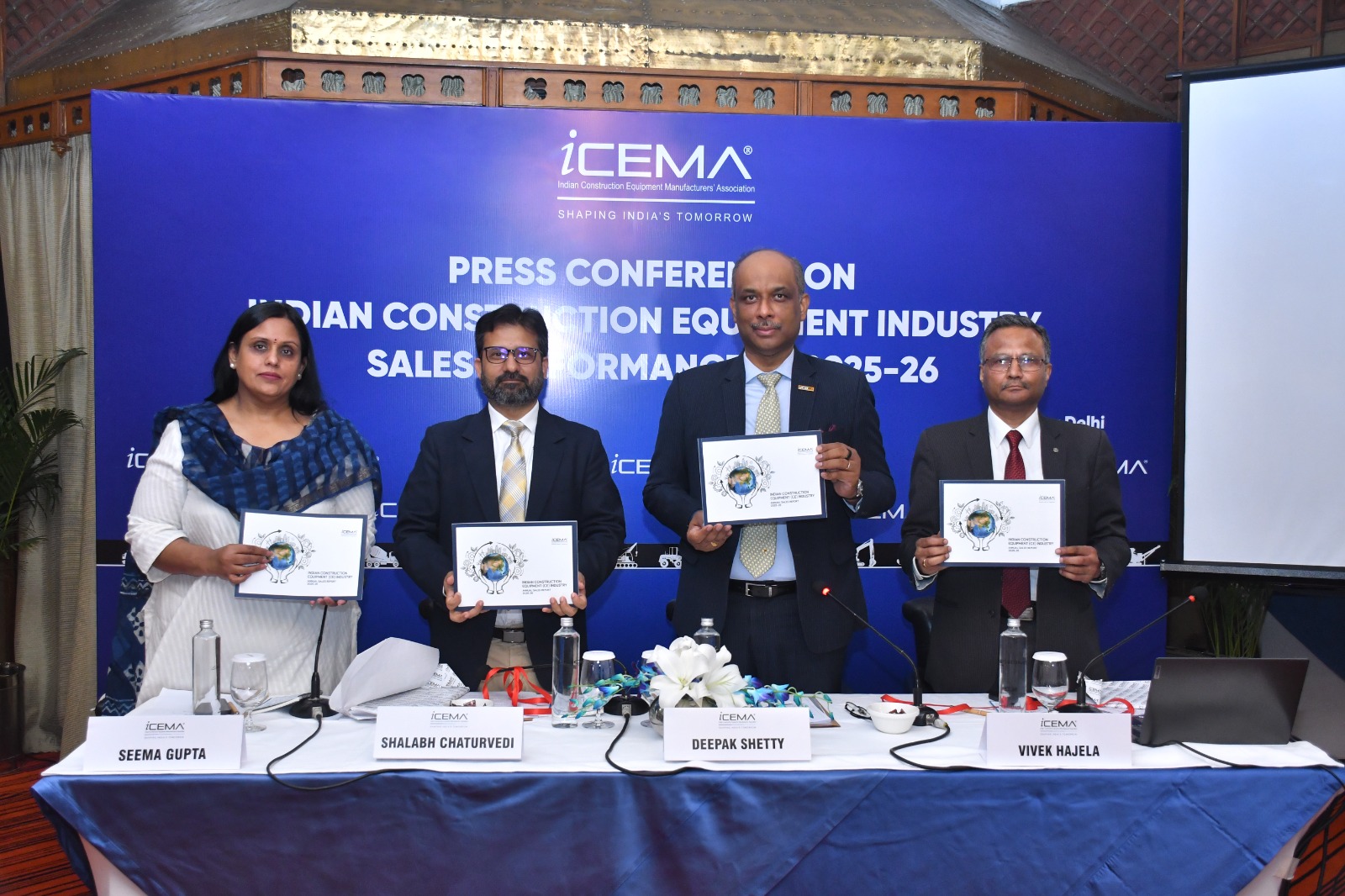
India’s construction equipment industry demonstrated resilience during FY 2025-26 despite facing slower domestic demand caused by delays in infrastructure execution and project implementation. According to the Indian Construction Equipment Manufacturers’ Association (ICEMA), the industry recorded total sales of 1,36,995 units during FY26, compared to 1,40,191 units in FY25, reflecting a marginal decline of nearly 2%.
While the domestic market witnessed temporary pressure, exports emerged as a major strength for the sector. Construction equipment exports from India surged by around 32% during the financial year, highlighting the growing global competitiveness of Indian-manufactured machinery. Industry experts believe the strong export performance reflects improved quality standards, competitive pricing, and increasing global confidence in India’s manufacturing capabilities.
India continues to remain the world’s third-largest construction equipment market. The sector was valued at nearly USD 10 billion in FY25 and is projected to grow to USD 14.76 billion by 2030, registering a compound annual growth rate of 8.3%.
ICEMA President and JCB India CEO & Managing Director Deepak Shetty said the temporary decline should not be viewed as a structural weakness in the sector. He explained that slower infrastructure execution, delays in project implementation, land acquisition issues, and slower disbursement cycles affected equipment demand during the year. However, he emphasised that the industry remains fundamentally strong due to continued government focus on infrastructure development.
The report showed that domestic demand, excluding non-OEM exports, declined by nearly 7% across most equipment categories. Imports increased by around 17%, particularly in earthmoving, material handling, and concrete equipment. At the same time, more than 95% of the equipment sold in India continued to be manufactured domestically, underlining the strength of the country’s manufacturing ecosystem.
Among various segments, earthmoving equipment continued to dominate the market with nearly 71% market share and sales of 97,236 units, despite a slight decline of 2%. Material handling equipment sales dropped by 10% to 15,290 units. Concrete equipment remained stable at 14,486 units, while road construction equipment registered positive growth of over 6% to reach 7,445 units. Material processing equipment also recorded modest growth during the year.
Industry leaders pointed out that several factors affected domestic infrastructure activity. National highway construction reportedly fell to a seven-year low because of delays in land acquisition and fewer project awards. Slower implementation of the Jal Jeevan Mission, contractor payment delays, rising crude oil and bitumen prices, and the introduction of CEV Stage V emission norms also increased costs across the sector.
Despite these challenges, the industry remains optimistic about long-term growth. ICEMA President Designate and Wirtgen India Managing Director Ramesh Palagiri said India’s infrastructure growth story remains strong, and faster project execution will help restore growth momentum.
The industry has also welcomed the Union Budget 2026-27, which announced a dedicated incentive scheme for the Construction and Infrastructure Equipment sector. ICEMA stated that the scheme is expected to support localisation of critical components, reduce import dependence, encourage high-technology manufacturing, and generate employment opportunities.
Experts believe that increased government capital expenditure, new freight corridors, high-speed rail projects, waterways, and coastal cargo initiatives will further boost demand for construction equipment in the coming years.
Subscribe Deshwale on YouTube
