




For the past two years, India’s IT sector has been quietly but firmly pushing employees back to the office. Hybrid attendance rules, fixed office days, and stricter monitoring of workplace presence have become the new normal. The debate over work from home seemed settled or at least, it was heading that way.
Then, in one speech, Prime Minister Narendra Modi changed the conversation entirely.
Why the PM brought up WFH
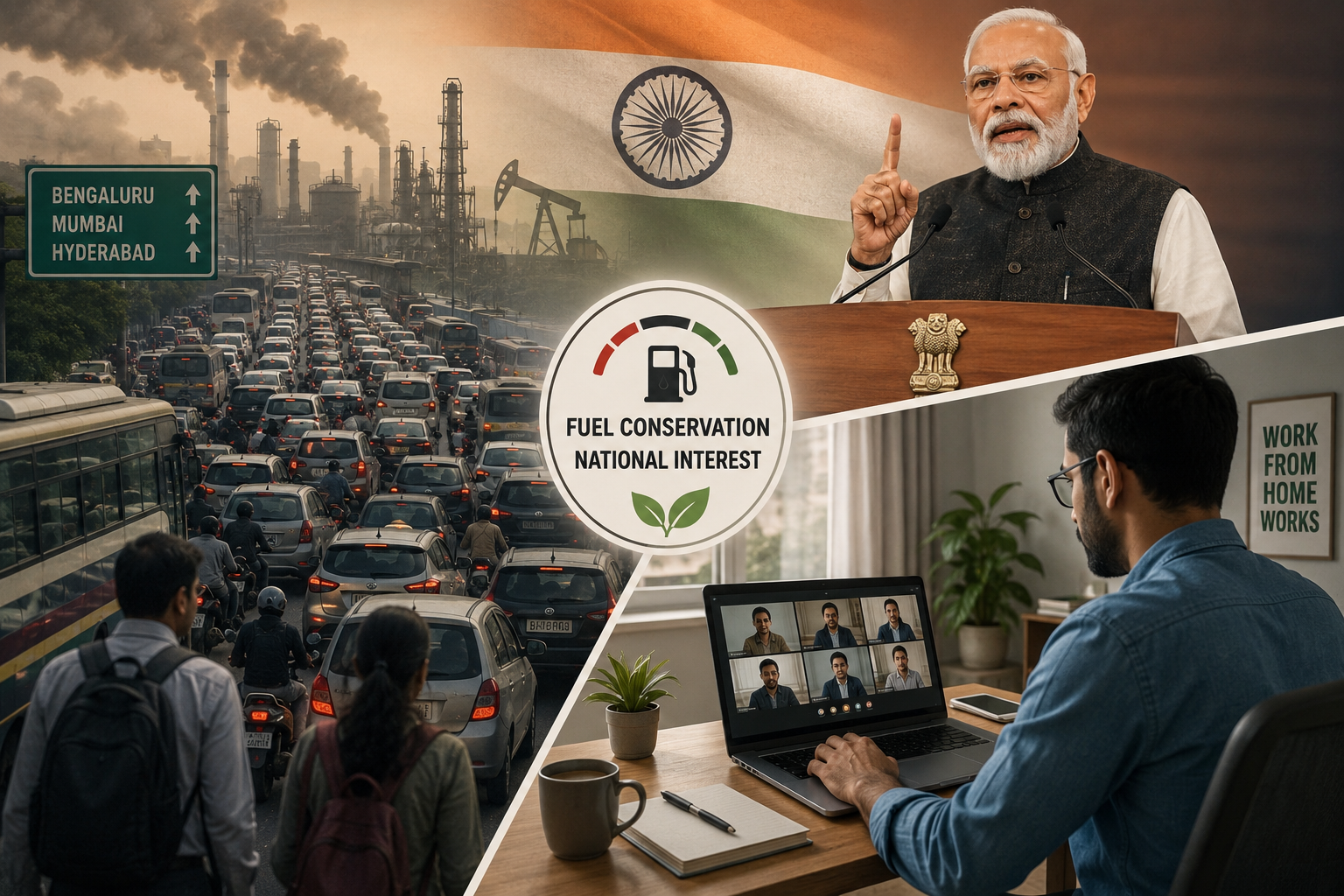
On May 11, 2026, addressing citizens in Hyderabad, PM Modi made an unusual appeal. He urged Indians and organisations to revive practices that became common during the Covid-19 pandemic: working from home, holding virtual meetings, using public transport, reducing unnecessary travel abroad, carpooling, and even switching to electric vehicles.
“We must prioritise work from home, online conferences, and virtual meetings again,” Modi said, stressing the need to reduce fuel consumption and dependence on imported energy.
This wasn’t just lifestyle advice. It was an economic signal.
India imports nearly 85% of its fuel needs and relies on the Strait of Hormuz for about 50% of its crude imports, 60% of its liquefied natural gas, and almost all of its liquefied petroleum gas (LPG) supplies. India spent $174.9 billion on crude and petroleum products about 22% of its total imports in the financial year ended March 2026.
The trigger is the ongoing conflict in West Asia. The war in Iran has severely disrupted traffic through the Strait of Hormuz, through which 20 million barrels of oil passed daily before the conflict began. India, which is the world’s third-largest oil importer, may be one of the countries most at risk from this disruption.
In simple terms: India is heavily dependent on oil it cannot produce itself, much of it flowing through a waterway that is now severely disrupted. Every litre saved at home matters.
Modi described conserving oil and other resources as a patriotic duty. “Patriotism is not only about the willingness to sacrifice one’s life on the border. In these times, it is about living responsibly and fulfilling our duties to the nation in our daily lives,” he said.
Union Minister Nitin Gadkari backed the appeal too. “The PM appealed on petrol and diesel. This is in the nation’s interest. We should use public transport,” Gadkari said.
An IT union seized the moment
Within days of the PM’s speech, India’s IT sector took notice not the companies, but the workers.
The Nascent Information Technology Employees Senate (NITES) wrote to the Ministry of Labour and Employment seeking a government advisory mandating work from home for the IT and IT-enabled services (IT/ITES) sector, citing fuel conservation, traffic reduction and broader national interest.
In a letter dated May 11 addressed to Labour Minister Mansukh Mandaviya, NITES requested that companies in digitally deliverable sectors be allowed to implement WFH “wherever operationally feasible” for a temporary period. The employee body argued that such a measure would help curb unnecessary travel, cut fuel usage, and ease urban traffic congestion.
The letter was signed by NITES President Harpreet Singh Saluja, who is also an advocate at the Bombay High Court.
The framing was deliberate and strategic. Saluja said the request was not aimed at creating confrontation with employers, but rather promoting collective national cooperation. “During the pandemic, employees and employers together proved that the Indian IT sector can function effectively under Work from Home arrangements,” the letter stated.
The letter also highlighted how lakhs of employees in major cities continue to spend hours commuting daily despite already having the infrastructure to work remotely.
NITES isn’t alone. The Forum for IT Employees (FITE) also weighed in, stating that advisories aimed at individuals are insufficient: “Employees do not have the authority to decide WFH policies, companies do. A clear directive is needed to make this effective.”
What makes this different from the pandemic debate
During Covid-19, WFH was a health measure. No one chose it; it was imposed out of necessity. Companies adapted, productivity held up, and the IT sector proved remote work could function at scale.
But the moment restrictions were lifted, companies began walking it back. Return-to-office became a business priority, dressed up in the language of collaboration, culture, and innovation.
Now, the argument has shifted entirely. NITES argued that remote work should be viewed as a national economic measure linked to fuel conservation and reduced infrastructure strain, not merely an employee benefit.
This reframing matters. When WFH is about employee convenience, companies can and do say no. But when it becomes tied to national energy security, fuel conservation, and the economic stability of the country, it enters a different conversation altogether.
India’s IT workforce numbers approximately 5.8 million people. If even a portion of them stopped commuting daily, the impact on fuel consumption, urban traffic, and city infrastructure would be significant.
Where do companies stand?
So far, most large organisations are staying cautious. Companies including Deloitte, EY, RPG Group, Tata Motors and Mercedes-Benz India said their existing hybrid work models would continue for now. KPMG said the announcement was being evaluated and “will be addressed suitably, keeping people, business and client commitments in mind.”
No major IT firm has announced a return to full-time WFH. The return-to-office push that has defined the past two years has not reversed yet.
And legally, companies are on firm ground. Existing rules in India do not grant employees a legal right to remote work, leaving the decision largely with employers. Unless the government issues a formal advisory or directive, companies are under no obligation to comply.
What NITES is really asking for is a shift in how India thinks about remote work from a perk negotiated between employee and employer, to a tool of public policy.
The pandemic showed it was possible. The infrastructure is already there. Millions of workers already have laptops, internet connections, and the experience of working from home for extended periods.
The question is whether the government treats PM Modi’s appeal as a message to citizens, or as a policy direction to industries. One requires individual goodwill. The other requires institutional action.
Whether the Labour Ministry issues any formal advisory remains to be seen. But the NITES letter has reopened a conversation many organisations believed was gradually settling after years of post-pandemic workplace adjustment.
For now, the offices remain open and the attendance trackers are still running. But with an energy crisis deepening, oil prices rising, and the PM himself asking people to stay home the case for WFH has never sounded less like a benefit request and more like a national argument.
Subscribe Deshwale on YouTube
