



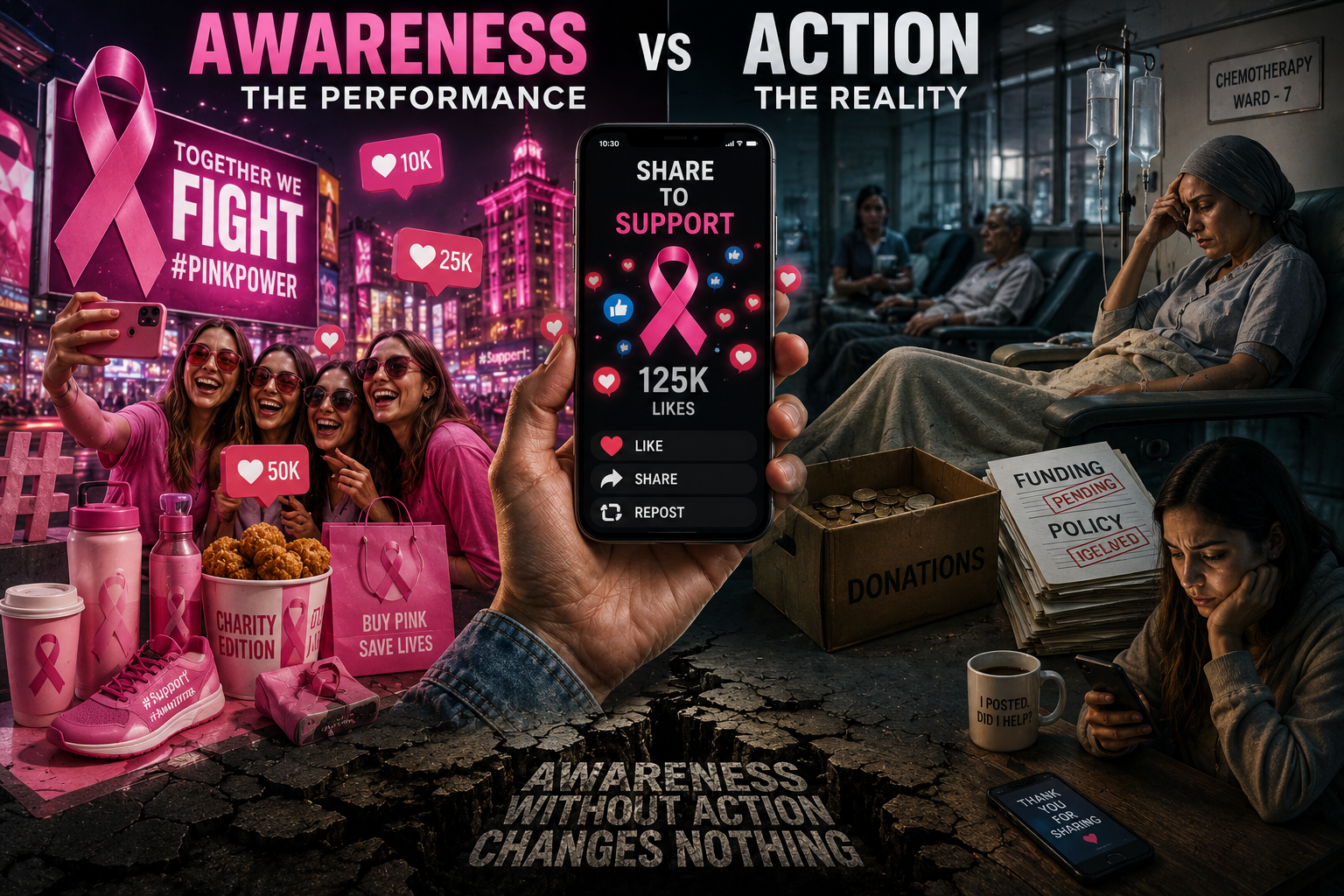
Every October, the world turns pink.
Pink ribbons on coffee cups. Pink lights on government buildings. Pink products in every supermarket aisle sneakers, water bottles, spatulas, even buckets of fried chicken. Companies run full-page ads. Celebrities post selfies. Hashtags trend. And somewhere in the middle of all this, a breast cancer patient is sitting in a chemotherapy chair wondering why, after decades of “awareness,” the disease still kills over 42,000 Americans every year.
Nobody is against awareness. That’s the problem.
When you ask people to do something they cannot argue with, something warm and virtuous and vague, you create a system where the act of caring feels identical to the act of helping. And in that gap between feeling like you’ve done something and actually doing something an entire industry has quietly taken root.
The campaign that changed nothing and everything
On March 5, 2012, a small San Diego nonprofit called Invisible Children uploaded a 30-minute documentary to YouTube. Within six days, the video had crossed 100 million views at the time, the fastest a video had ever gone viral. Celebrities from Rihanna to Bill Gates shared it. The White House put out a statement. Tech publications declared it “the most viral video of all time.”
The video was about Joseph Kony a Ugandan warlord who had led the Lord’s Resistance Army for decades, abducting children to turn into soldiers and committing atrocities across central Africa. The campaign’s goal was simple: make Kony famous, build global pressure, and get him arrested.
3.7 million people pledged their support. The US Senate passed a resolution condemning Kony. The African Union assembled a force of 5,000 troops to pursue him. And then nothing much happened. By the end of 2012, which Invisible Children had publicly declared as their deadline to capture Kony, he was still free. A follow-up video barely made a ripple, gaining 1.7 million views in 11 days compared to over 100 million in five days for the original.
Kony remains at large to this day.
In fairness, the picture is more complicated than a simple failure. LRA violence did fall dramatically in the years that followed dropping by 92% between 2012 and 2021, according to Invisible Children. The campaign secured tens of millions in US humanitarian aid and renewed international attention to a conflict that had been almost entirely ignored. Those are real outcomes.
But here is the thing: the 100 million people who watched that video, who changed their profile pictures and signed pledges and felt a genuine surge of moral urgency most of them did nothing more than that. And within weeks, they had moved on to the next thing trending on their feeds.
The campaign became the dictionary definition of what critics later called “clicktivism” the act of substituting a click for an action, a share for a sacrifice, a moment of digital solidarity for any meaningful change.
When good intentions meet dirty products
Now think about those pink buckets of fried chicken.
In 2010, Kentucky Fried Chicken partnered with Susan G. Komen for the Cure on a campaign called “Buckets for the Cure.” For every pink bucket of chicken sold, KFC donated 50 cents to breast cancer research. The campaign raised approximately $4 million. Komen celebrated. KFC got a flood of positive press.
Breast Cancer Action the nonprofit that actually coined the term “pinkwashing” in 2002 was furious. Not because the money wasn’t real, but because a chain selling high-fat food was using breast cancer to sell more of it, when diet is a documented risk factor for the disease. They launched a campaign called “What the Cluck?” in protest.
KFC was not alone. In 2011, Susan G. Komen partnered with Sally Beauty, whose products contained triclosan and phthalates chemicals linked to cancer risk. In 2003, Revlon put pink ribbons on cosmetics containing chemicals known to increase cancer risk. In 2010, Reebok marketed pink ribbon footwear priced at $50 to $100, capped its total donation at $750,000, and put no mechanism in place to alert consumers once that cap had been reached meaning people could buy pink sneakers thinking they were helping, long after the donation ceiling had been met.
The average “giveback” from a pink product or campaign is less than 10% of proceeds, according to The Breasties, a nonprofit focused on breast cancer community. And of all the money raised for breast cancer research in the United States, only 2% to 5% goes toward stage 4 metastatic breast cancer the kind that kills people.
The pink ribbon itself is not regulated by any agency. Any company, anywhere, can put it on any product without donating a single rupee or dollar to any breast cancer cause. And many do exactly that.
This is what “awareness” looks like when it becomes a business model. You’re not solving a problem. You’re selling the feeling of solving a problem.
The ice bucket challenge — A story worth getting right
Here is where the story gets more complicated, and more interesting.
In the summer of 2014, three young men living with ALS Anthony Senerchia, Pete Frates, and Pat Quinn took the Ice Bucket Challenge and launched what became a global cultural moment. 17 million people poured buckets of ice water on their heads. Videos went viral across every platform. Celebrities, politicians, and ordinary people participated. The ALS Association raised $115 million in a matter of weeks compared to just $2.8 million in the same period the previous year.
And then unlike most awareness campaigns something actually happened.
That money funded 560 research projects over the next decade. It identified 12 new genes linked to ALS. It helped the FDA approve two new treatments for the disease. The number of multidisciplinary ALS clinics in the United States more than doubled, from 100 to over 220. Annual research funding from the US National Institutes of Health grew from $52 million to an estimated $218 million. For every dollar raised through the Challenge, grantees reported generating $7.01 in follow-on funding bringing the total research impact to nearly $1 billion.
The Ice Bucket Challenge worked. It is one of the most effective awareness campaigns ever run, precisely because the awareness translated into money that translated into action.
But here is the part that rarely gets told.
When the ALS Association tried to run the Ice Bucket Challenge again in 2015, it failed to generate anything close to the original response. The viral moment could not be manufactured twice. After the initial surge, the Association found itself running multi-million-dollar deficits spending far more than it was bringing in as donations returned to pre-challenge levels. The pipeline of research they had committed to fund needed sustained support, but the public had already moved on to the next campaign, the next cause, the next hashtag.
The lesson from ALS is not that awareness campaigns don’t work. The lesson is that they work exactly once, by accident, when conditions align perfectly and that the moment the cameras turn away, the problem remains.
Awareness is now a product
There is a reason awareness campaigns are so popular among large organisations, and it is not purely altruistic.
They are cheaper than solutions. They generate positive press. They are impossible to argue against. And they shift responsibility quietly, gently from the institution to the individual.
Think about how most awareness campaigns end. Not with a structural change, or a policy reform, or a funded programme. They end with a message directed at you: know the signs, start the conversation, check yourself, be the change. The burden of solving the problem is placed on the person who was just informed about it.
Meanwhile, the organisation that ran the campaign has a press release about its commitment to the cause, a spike in brand sentiment, and no obligation to do anything further.
Breast Cancer Action saw this clearly when they launched their “Think Before You Pink” campaign. They were not fighting against awareness they were fighting against the idea that buying a pink product was a substitute for demanding real research funding, better treatment access, and honest conversations about what actually causes the disease.
“We’ve been aware for decades,” they said. “And we need to move beyond that into real action.”
The slacktivism trap
Psychologists have a name for what happens when people share a post about climate change, change their profile picture during a crisis, or wear a coloured ribbon for a week: moral licensing.
The idea is straightforward. When people do something they consider good even something small and symbolic they feel they’ve earned a kind of moral credit. That credit, once spent, reduces the likelihood that they’ll take a more demanding action later. In other words: sharing a post about poverty can actually make you less likely to donate to a poverty organisation.
A study conducted after Kony 2012 found that the video’s simplest, most emotionally direct version the one that went viral worked precisely because it reduced a complex political situation to a clear villain and a simple call to action. But that same simplicity was what made the follow-through so fragile. Once the villain wasn’t captured on schedule, and the nuance started emerging, the public lost interest. There was no framework for sustained engagement, because sustained engagement is harder to package than a viral video.
The problem with awareness campaigns is not that people are bad or lazy. It’s that these campaigns are specifically designed to produce the feeling of participation, not participation itself. They are extraordinarily effective at that one thing.
This is not an argument against ever raising awareness. There are causes where awareness genuinely matters where people are making decisions based on ignorance that information can correct. But awareness campaigns are most honest when they treat themselves as the beginning of a process, not the end of one.
The best campaigns in recent history share a common feature: they connected the emotional moment to a specific, immediate, irreversible action. The Ice Bucket Challenge asked for a donation, right now, before the video ended. It didn’t just ask people to “join the conversation.” It asked people to write a cheque.
The questions worth asking before participating in any awareness campaign are simple. Where does the money actually go? What percentage reaches the cause? Is the organisation running this campaign also selling products linked to the problem they claim to fight? And most importantly what happens after?
If the answer is nothing, then you are not part of the solution. You are part of the product.
The next time you see a campaign asking you to share, post, light a candle, or buy something pink, pause for a moment before you do.
Not to be cynical. Not to dismiss the cause. But to ask the one question that awareness campaigns are specifically designed to prevent you from asking:
And then what?
If there’s a clear, honest answer a funded programme, a policy goal, a direct path from your action to someone’s life changing then participate with everything you have.
If the answer is silence, or more posts, or a vague promise to “keep the conversation going,” then you are not being invited to help. You are being invited to feel like you’re helping.
Those are very different things. And someone, somewhere, is counting on you not to notice the difference.
Subscribe Deshwale on YouTube
