




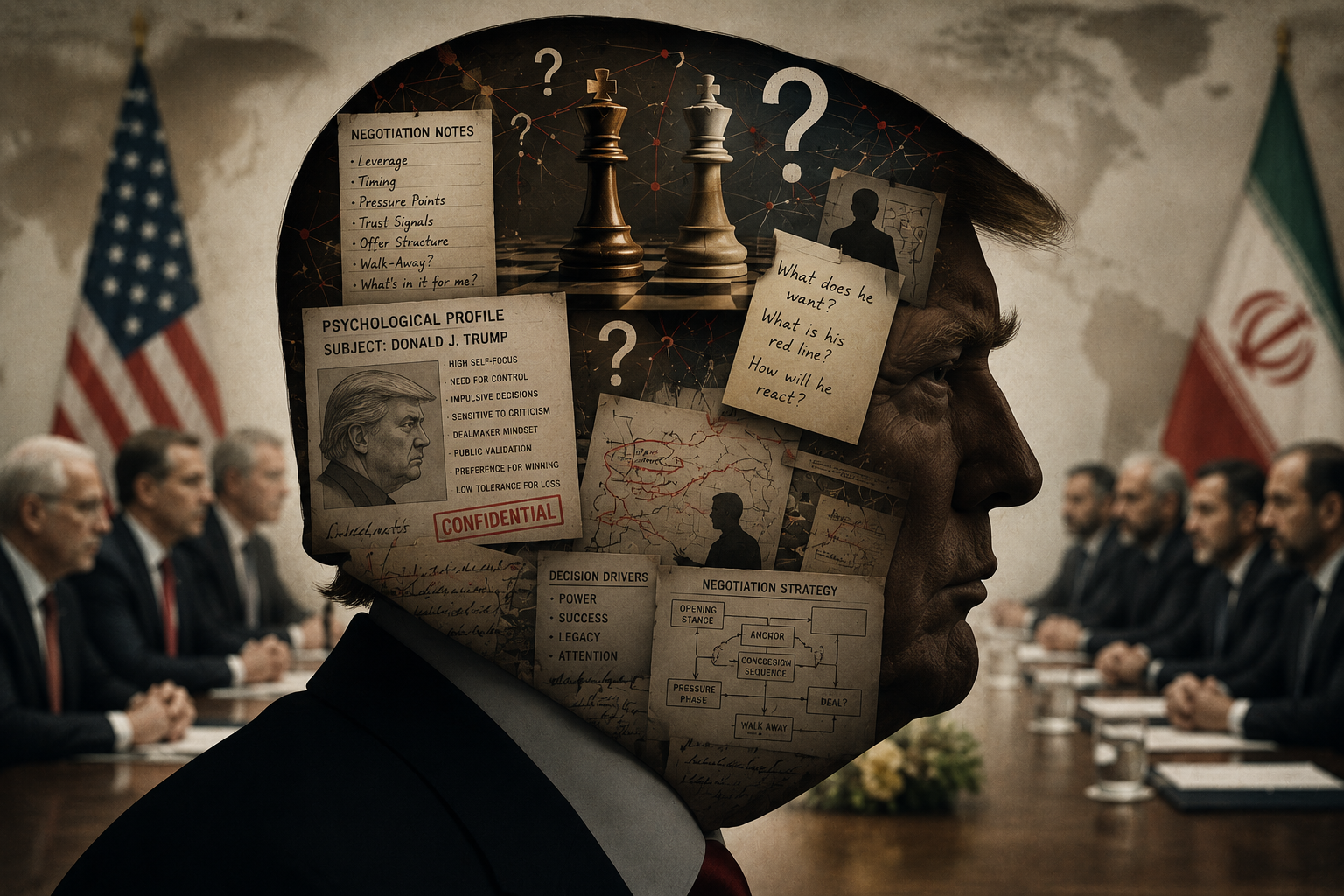
When the news broke this week that Iran had recruited senior psychologists to help craft diplomatic messages for Donald Trump tailoring every word to what Iranian officials described as his “psychopathic behaviour pattern” the reaction across Western media was swift and predictable. Sinister. Manipulative. A rogue state treating the US president like a patient.
Nobody stopped to ask the obvious question: hasn’t Washington been doing exactly this for over eighty years?
The story, first reported by investigative journalist Jeremy Scahill at Drop Site News, is genuinely interesting. An anonymous Iranian official confirmed that two senior psychologists had been added to the country’s negotiations advisory circle following the initial round of US-Iran talks in Islamabad in April. Their job was to analyse Trump’s decision-making patterns and help Iranian negotiators shape messages accordingly. The official even claimed it was working that Trump’s responses had “improved noticeably” since they started incorporating the psychologists’ recommendations. Whether that claim holds up is worth scrutinising. But the idea that deploying psychological expertise in high-stakes diplomacy is somehow a shocking act of bad faith? That is a narrative that requires a very selective memory.
The CIA invented this playbook
Go back to 1943. The US Office of Strategic Services the wartime predecessor to the CIA commissioned psychoanalyst Walter C. Langer to produce a comprehensive psychological profile of Adolf Hitler. Langer, along with Harvard’s Professor Henry Murray and two other specialists, worked through over a thousand pages of intelligence material and interviews with people who had personally met Hitler. The resulting 281-page report concluded that Hitler was “probably a neurotic psychopath bordering on schizophrenia.” It accurately predicted that as Germany began losing the war, Hitler’s behaviour would deteriorate and that he would ultimately take his own life rather than surrender.
This wasn’t a fringe exercise. General William Donovan, the OSS director, commissioned it specifically because understanding Hitler’s psychology was considered vital to shaping Allied strategy. Langer’s report became the founding document of a discipline of political psychology applied to intelligence that the CIA would institutionalise and refine for the next eight decades.
After the war, the CIA institutionalised what Langer had started. Dr. Jerrold Post, a Harvard-trained psychiatrist who spent 21 years at the agency, founded the CIA’s Centre for the Analysis of Personality and Political Behaviour. Over two decades, his unit produced psychological profiles of some of the most consequential figures of the twentieth century Saddam Hussein, Muammar Gaddafi, Kim Jong-il, Ayatollah Khomeini, Fidel Castro. These were not academic exercises. They were operational intelligence, delivered directly to American presidents and senior officials preparing for negotiations, crises, and confrontations.
The Camp David moment that nobody wants to remember
The most striking example, the one that should puncture the current outrage entirely is Camp David in 1978.
Before President Jimmy Carter sat down with Israeli Prime Minister Menachem Begin and Egyptian President Anwar Sadat for the negotiations that would produce the historic Egypt-Israel Peace Accords, he visited CIA headquarters at Langley. He told CIA Director Stansfield Turner that he didn’t just want political briefings on the two leaders he needed to be “steeped in their personalities.”
Post and his team quickly produced detailed psychobiographies of both men. On Begin, Post’s key insight was that the Israeli prime minister was deeply, almost obsessively, shaped by the Holocaust that his every decision flowed from a determination to prevent another one. On Sadat, Post identified what he called a “Nobel Prize Complex” , a profound desire to be remembered by history as a great statesman, to outshine his predecessor Gamal Abdel Nasser. Carter used these profiles throughout the thirteen days of negotiations. After it was over, he reportedly told the Post: “After spending 13 days with the two principals, I wouldn’t change a word.” The Camp David Accords were signed in September 1978; Begin and Sadat were awarded the Nobel Peace Prize that same December for their role in reaching them. The full Egypt-Israel Peace Treaty followed in March 1979. Post received the CIA’s Intelligence Medal of Merit in 1979 for his contribution to the entire process.
Let that sit for a moment. The United States used psychological profiling to understand and influence the negotiating behaviour of its own allies men it was ostensibly treating as equals at the table. And this is considered one of American diplomacy’s finest hours.
The selective outrage problem
Nobody in Washington expressed moral horror at Camp David. Nobody called it manipulation. Nobody said Carter was treating Begin and Sadat like patients. It was called smart diplomacy. Because when the Americans do it, it is statecraft. When Iran does it, it is evidence of malign intent.
The CIA didn’t stop at Camp David. For decades, it continued profiling both adversaries and allies. The Bulletin reported in 2011 that CIA and Defence Department analysts had compiled psychological assessments of hostile leaders like Gaddafi, Kim Jong-il, and Hugo Chavez but also allies and “other prominent officials.” As Jerrold Post himself put it, such profiling is “perhaps most important in cases where you have a leader who dominates society, who can act virtually without constraint.” He wasn’t talking only about dictators. He was describing the conditions under which any leader’s psychology becomes the decisive variable in a negotiation.
There is something almost ironic in the fact that Post, in the final years of his life, turned his analytical lens on Donald Trump himself profiling the American president the same way he had profiled Saddam Hussein and Kim Jong-il. Post called Trump a “dangerous, destructive charismatic leader” in a book published in 2019. Iran’s negotiators apparently reached a not entirely different conclusion, just from the other side of the table.
What Iran is actually doing
Strip away the framing and what Iran did is straightforward: faced with an adversary whose behaviour is genuinely difficult to predict through conventional diplomatic channels, it brought in specialists to help decode the signals and calibrate the responses. This is the same logic that drove Donovan to commission Langer in 1943. It is the same logic that sent Carter to Langley before Camp David.
The detail that Iran’s official described Trump’s patterns as “psychopathic” is the part designed to generate headlines. And it will. But remember that the CIA’s own profilers used terms like “malignant narcissism” for Saddam Hussein and diagnosed Castro as “highly neurotic and unstable.” The diagnostic language is provocative precisely because it is clinical rather than political. That doesn’t make it new.
What is genuinely new and genuinely worth examining is that a country under military and economic pressure is openly acknowledging it is using this approach, and claiming it is producing results. Whether Iran’s psychological strategy yields a durable nuclear agreement or simply helps smooth over a few rounds of talks remains to be seen.
But the shock? The outrage? That belongs to people who never looked too hard at what their own side has been doing since the Second World War.
Subscribe Deshwale on YouTube
