



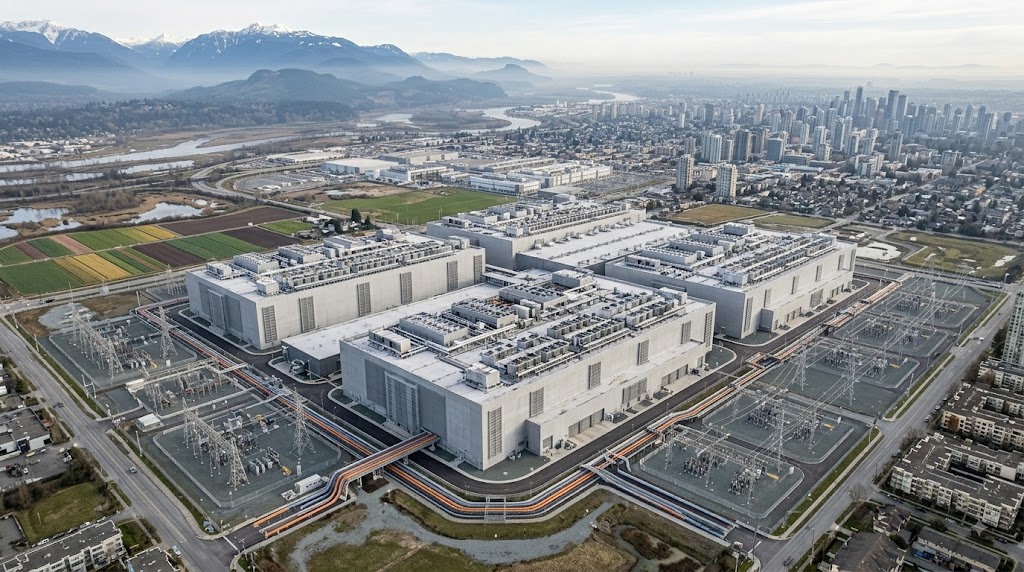
Nothing about the phrase “the cloud” prepares anyone for what it actually is: warehouses. Vast, windowless, climate-controlled sheds packed with server racks, drawing power on a scale that now rivals small nations.
These facilities cluster with striking precision into a handful of places on Earth, for reasons that have almost nothing to do with where the people using the internet actually live. Driven by the AI boom, this once-obscure branch of infrastructure has become one of the most contested pieces of real estate on the planet, sparking protests and moratoriums across four continents.
A sector outgrowing entire countries
The scale is hard to overstate. Global data centre electricity use reached roughly 415 terawatt-hours in 2024, growing at around 12 per cent a year since 2017 four times faster than overall global electricity demand. The International Energy Agency projects this will more than double to about 945 terawatt-hours by 2030, a figure slightly larger than Japan’s entire annual electricity consumption.
A United Nations University assessment published in mid-2026 calculated that by 2030, this demand will approach the combined annual electricity consumption of Pakistan, Bangladesh and Nigeria three countries home to over 650 million people.
Water use tells a similar story. Most data centres still rely on evaporative cooling systems that consume, rather than circulate, huge volumes of fresh water. Even the physical land footprint is set to exceed 14,500 square kilometres by 2030 roughly twice the size of greater Jakarta.
Why these buildings cluster where they do
Data centres don’t follow the population. They follow four things: electricity, connectivity, climate and government incentives.
Northern Virginia, the world’s largest data centre market, shows the power of pure infrastructure inertia. An estimated seventy per cent of global internet traffic passes through the region’s “Data Center Alley,” not because power is cheap there increasingly it isn’t but because decades of accumulated fibre-optic cable make every new facility more valuable simply for being near the others.
Ireland built its cluster differently: a naturally cool climate plus one of Europe’s lowest corporate tax rates. Data centres accounted for just 5 per cent of Ireland’s electricity in 2015; by 2025 that figure had climbed to 23 per cent, with several national projections putting it near a third of total consumption within the decade.
Singapore shows that economic strategy can override climate logic entirely. Its tropical heat and humidity make it one of the physically worst places on Earth to cool servers, yet the government has actively courted data centre operators anyway, and the country now hosts over 1.4 gigawatts of capacity, with data centres responsible for roughly seven per cent of national electricity use. A December 2025 climate-suitability analysis found nearly 7,000 of the world’s roughly 8,800 operational data centres sit in zones too hot for efficient cooling once measured against the ideal range Singapore among 21 countries where every single facility falls into that category.
Iowa represents a newer model: cheap wind power, inexpensive land and aggressive tax breaks have turned former farmland into a genuine data centre hub, showing that raw power availability increasingly matters more than fibre density or climate.
The backlash
What makes this moment distinctive isn’t just the pace of construction it’s the speed and spread of organised resistance, a force that barely existed five years ago and has already won real victories.
The clearest case is the Dutch town of Zeewolde, where a local council approved a Meta hyperscale facility in December 2021. Campaigners fought back regardless, winning a national moratorium on new hyperscale developments and a Senate vote blocking the land sale Meta needed. Meta abandoned the project by mid-2022, and the Netherlands now restricts any hyperscale facility over 70 megawatts to two designated sites.
Ireland’s fight has been messier: the national grid operator, not any elected body, imposed a moratorium on new data centre grid connections in 2021 out of blackout concerns. When that pause lapsed in December 2025, campaigners found no equivalent political victory to defend, and environmental groups are now suing to overturn the replacement rules.
The US has moved fastest. In July 2026, New York became the first state to impose a formal moratorium, when Governor Kathy Hochul signed a one-year pause on permitting for any new data centre drawing 50 megawatts or more, citing grid strain and rising bills for ordinary ratepayers. Dozens of other US localities and several states have since passed or proposed similar restrictions.
The other side of the argument
The backlash doesn’t exist without a genuine counter-case. Data centre construction is projected to require trillions of dollars in infrastructure investment through 2030, and proponents point to real local benefits: construction jobs, tax revenue, and for governments like Singapore’s, a deliberate bet on becoming indispensable digital infrastructure.
The core criticism isn’t that these benefits are fictional — it’s that they’re often negotiated behind closed doors, leaving residents unable to weigh the trade-off until construction is already underway, and that permanent local jobs after construction rarely match the ongoing cost in higher electricity bills.
A map still being redrawn
What emerges is an unusual moment: a category of building still expanding near-exponentially, even as grids near their limits, water-stressed regions push back, and organised resistance hardens across multiple countries at once. For three decades, the internet’s geography was decided by engineers chasing fibre and cheap power. It is now, for the first time, being actively contested by the people who live next to what those engineers built.
Subscribe Deshwale on YouTube
