



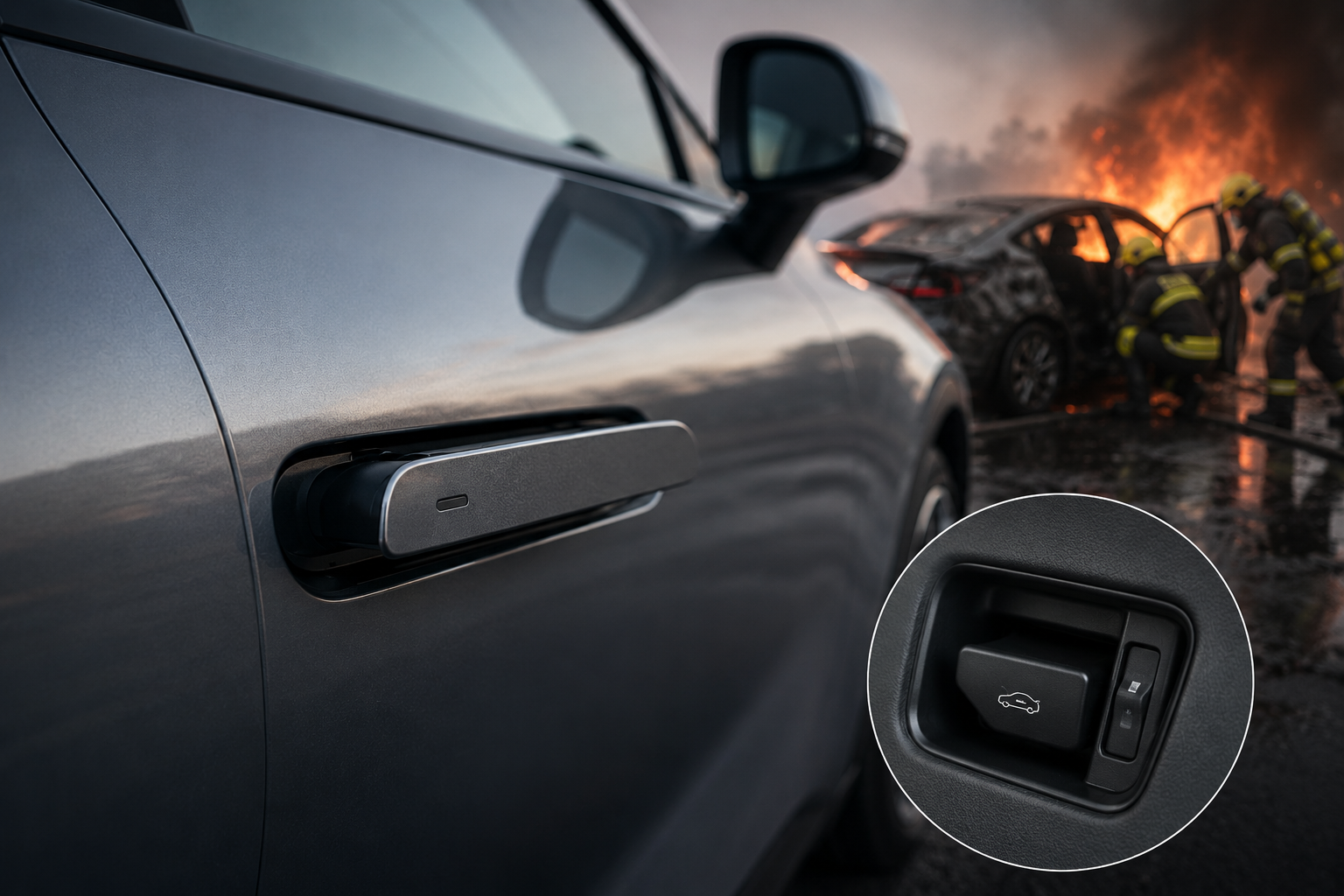
China just recalled 43 lakh cars over a design element most Indian buyers barely think twice about: the door handle. Tesla, Xiaomi, Leapmotor, Xpeng and several other automakers are now racing to fix flush-fitted handles that regulators fear could trap people inside a car during a crash or fire. From 2027, China will ban the design outright on new vehicles. India, meanwhile, has no comparable rule on its books even though the same handles are already sitting on cars in Indian showrooms today.
The China recall wasn’t triggered by a spreadsheet of statistics. It followed real, documented incidents most notably the death of a Xiaomi SU7 driver after a crash and fire, where bystanders reportedly could not get the doors open. That single case, amplified by public outrage, pushed regulators to act on a design flaw that had been quietly spreading across the industry for years.
The problem itself is simple to understand. Flush handles sit level with the car’s body and pop out electronically when you unlock the vehicle, giving it a smoother, more futuristic look. But if the car loses power after a collision which is common in serious crashes, especially in EVs, that electronic pop-out mechanism can fail. Most cars do have a manual backup release tucked somewhere inside the door, but it’s often hidden, unlabelled, and unfamiliar even to the person driving the car every day. In a panic, with smoke or flames involved, finding it can take precious seconds nobody has.
Here’s where the story stops being a China problem. Tesla’s Model Y with its signature flush handles has been on sale in India since its Mumbai showroom opened in mid-2025, followed by the longer Model Y L launched this April. It isn’t alone. Mahindra fits electric flush-fitting handles on the BE 6, XEV 9e and XEV 9S, and mechanical flush handles on the XUV700 and the newly launched XUV7XO. Tata Motors and its British arm Jaguar Land Rover offer pop-out handles across several models, including the Range Rover Evoque and Velar. BYD, whose China-market EVs are also built around this same flush-handle design language, is steadily expanding its India lineup too. In other words, this isn’t a hypothetical future risk for the Indian market; the handles are already here, on real roads, in real traffic.
And yet, India has no regulation that specifically addresses this. Unlike China’s new rule, which mandates a minimum hand-operable space on every door and a functioning mechanical release, no equivalent requirement appears to exist in India’s current motor vehicle safety standards. The closest thing on the horizon is the draft Bharat NCAP 2.0 update, which proposes checking “ease of occupant escape” as part of a new post-crash safety category. But Bharat NCAP remains a voluntary star-rating exercise, not a binding safety law; a car can score poorly on escape-friendliness and still be sold, registered, and driven, exactly as before.
Industry voices have already started flagging this gap. Puneet Gupta, Director for India and ASEAN at S&P Global Mobility, has pointed out that if China, the world’s largest car market, felt compelled to ban the design entirely, that alone should prompt India to take the safety concern seriously. He also noted that battery drainage in feature-loaded EVs raises the odds of an electronic handle failing exactly when it’s needed most, in the middle of a crash.
None of this means every flush-handled car on Indian roads is a ticking hazard. Manufacturers do build in mechanical backups, and the vast majority of drivers will never need to use one in an emergency. But that’s precisely the nature of a safety blind spot; it doesn’t show up in everyday driving, only in the rare, worst-case moment when a design choice made for aesthetics suddenly has to double as a rescue mechanism.
What makes India’s situation more pointed is the timing. The flush-handle trend is still expanding here: more EV launches, more premium SUVs, more manufacturers chasing the same sleek, Tesla-inspired look at the exact moment the world’s biggest auto market has decided the risk isn’t worth it. China spent years watching this design spread before one tragic case forced its hand. India has the rare advantage of watching that story unfold in real time, before its own version of that moment arrives.
Whether that turns into an actual rule, a mandatory minimum for manual releases, clearer in-cabin labelling, or a Bharat NCAP requirement with real teeth is still an open question. For now, the handles keep shipping, the showrooms keep opening, and the regulation keeps waiting.
Subscribe Deshwale on YouTube
