



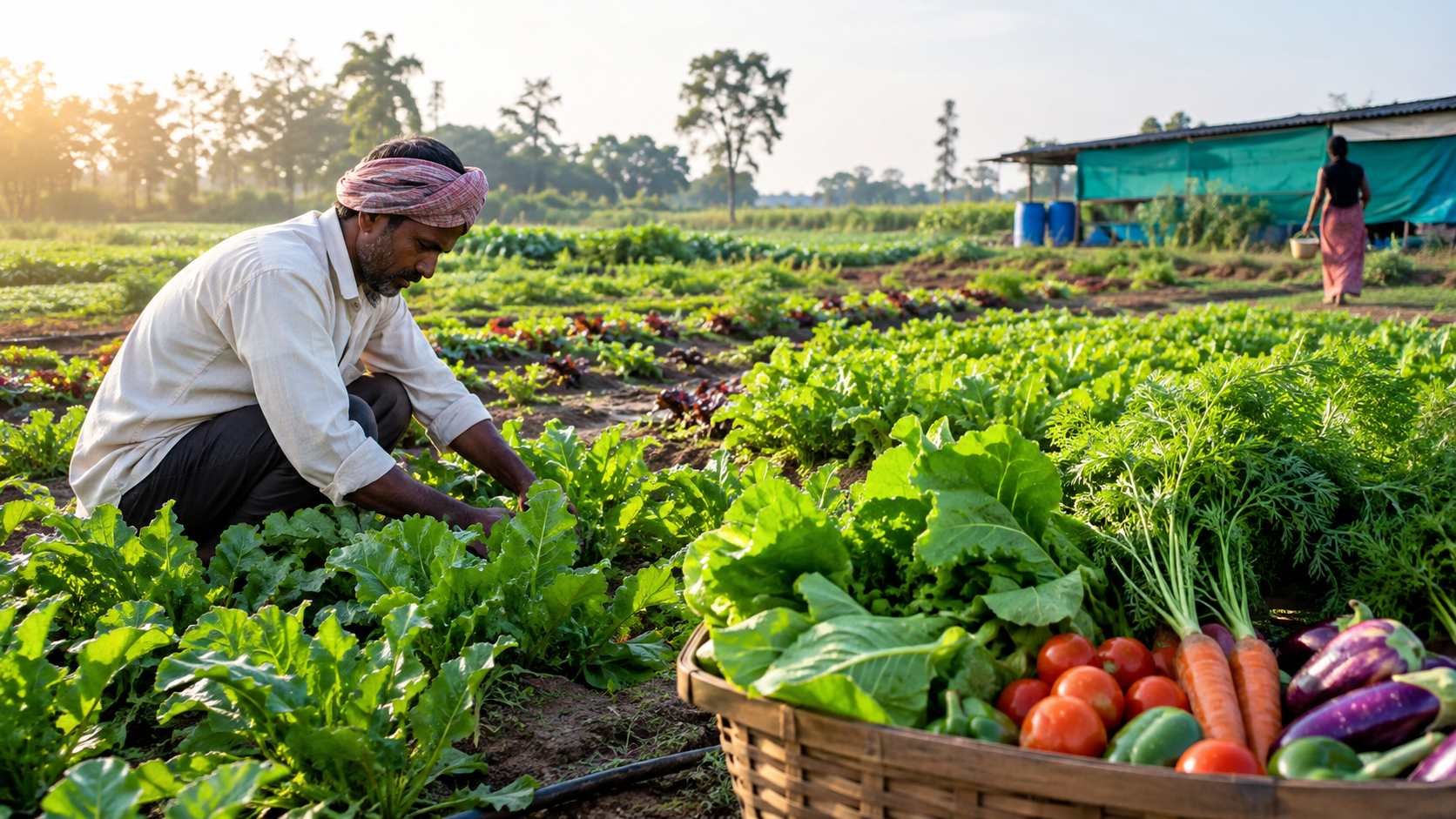
Most of us have stood at a vegetable stall and wondered the same thing. Where did this come from? What was sprayed on it? And is the “organic” tag on that pile of spinach even true?
A few farms in India now offer a different answer. You pay for a plot of land, and the vegetables grown on it are yours. You do not have to buy farmland or learn farming.
This is the rent-a-farm model, and it is slowly catching the attention of city families. But beyond the fresh produce, a bigger question is worth asking: who actually gains the most?
Gill Organics in Punjab runs the first kind of model. Customers get a plot of about 150 square yards for a six-month season. They choose the vegetables, and the farm team grows them and looks after the plot.
The harvest reaches their home every week. The service is available in Patiala, Chandigarh Tricity and Ludhiana.
According to the company’s website, a six-month subscription costs Rs 35,000 in Patiala and Rs 40,000 in the other two areas, delivery included. Founder Mantaj Sindhu says one plot can cover around 60 to 70 per cent of the weekly vegetable and salad needs of a family of four or five.
Vaksana Farms in Tamil Nadu offers something different. It is a 14-acre permaculture farm near Rettanai village, and customers there do some of the growing themselves.
Co-founder Kiruba Shankar says a plot is around 3,000 square feet and costs Rs 15,000 a month. The farm helps with water, electricity and manual labour.
For Shankar, the point is not a cheap basket of vegetables. It is to let people experience what growing food really involves, including its uncertainty.
Sindhu says the idea began in Dublin, where he saw small patches of land from which people picked produce and paid for what they took. It made him wonder if farmers could have more certainty.
Farmers usually spend money on growing a crop long before they know what price it will fetch. If customers commit to a full season, a farm knows its buyers before the crop is even grown. That is a real advantage.
But the picture is incomplete. It is not clear how much of the subscription money ends up with farmers or farm workers, or whether they earn more than they would by selling in a mandi.
Scaling is also slow. Sindhu says Gill Organics works across six acres, and that soil quality and the time needed to convert land to organic cultivation limit how fast it can grow.
Under India’s organic standards, conversion generally takes two to three years. A small farmer without savings may struggle to wait that long.
Now the customer side. Rs 35,000 for six months works out to about Rs 5,800 a month, or roughly Rs 1,350 a week. At Rs 40,000, it is about Rs 6,700 a month, or Rs 1,540 a week.
For that, a family gets a share of its weekly vegetables, not all of them. Whether this is cheaper than your local vendor depends on what your household spends today. It is worth doing that sum before signing up.
This is not necessarily a cheaper way to buy vegetables. You are paying for access: a say in what is grown, and more confidence about how it is grown.
At Vaksana, you also pay in time. A plot in Tamil Nadu is of little use to someone living far away, since the model depends on taking part.
Demand seems strong. Sindhu says Gill Organics can serve around 200 families, while its waiting list has grown to nearly 3,000. That is about 15 times its capacity.
These are the founder’s figures, and a waiting list is not the same as paying customers. Still, it hints at how many urban families want a trusted source of vegetables, and how few can get one.
Many people turn to these models because they do not trust the “organic” label in the market. Yet in a subscription, you are still trusting someone’s word unless there is proof.
India has certification systems for organic produce, including NPOP and PGS-India, and food sold as organic is expected to carry the Jaivik Bharat logo. It is not clear from available reports whether either farm holds such certification.
A customer should ask before paying.
The honest answer is: it depends on the farm and on the family. Farms can gain steadier demand and better planning. Customers gain trust and a closer link to their food, if they can afford it and live nearby.
But these gains are not equal. For now, rent-a-farm looks like a promising option for a small group of urban families and a few well-run farms, not a replacement for the neighbourhood vegetable seller.
Whether it can grow into something that helps ordinary farmers and ordinary budgets is still an open question.
Subscribe Deshwale on YouTube
