



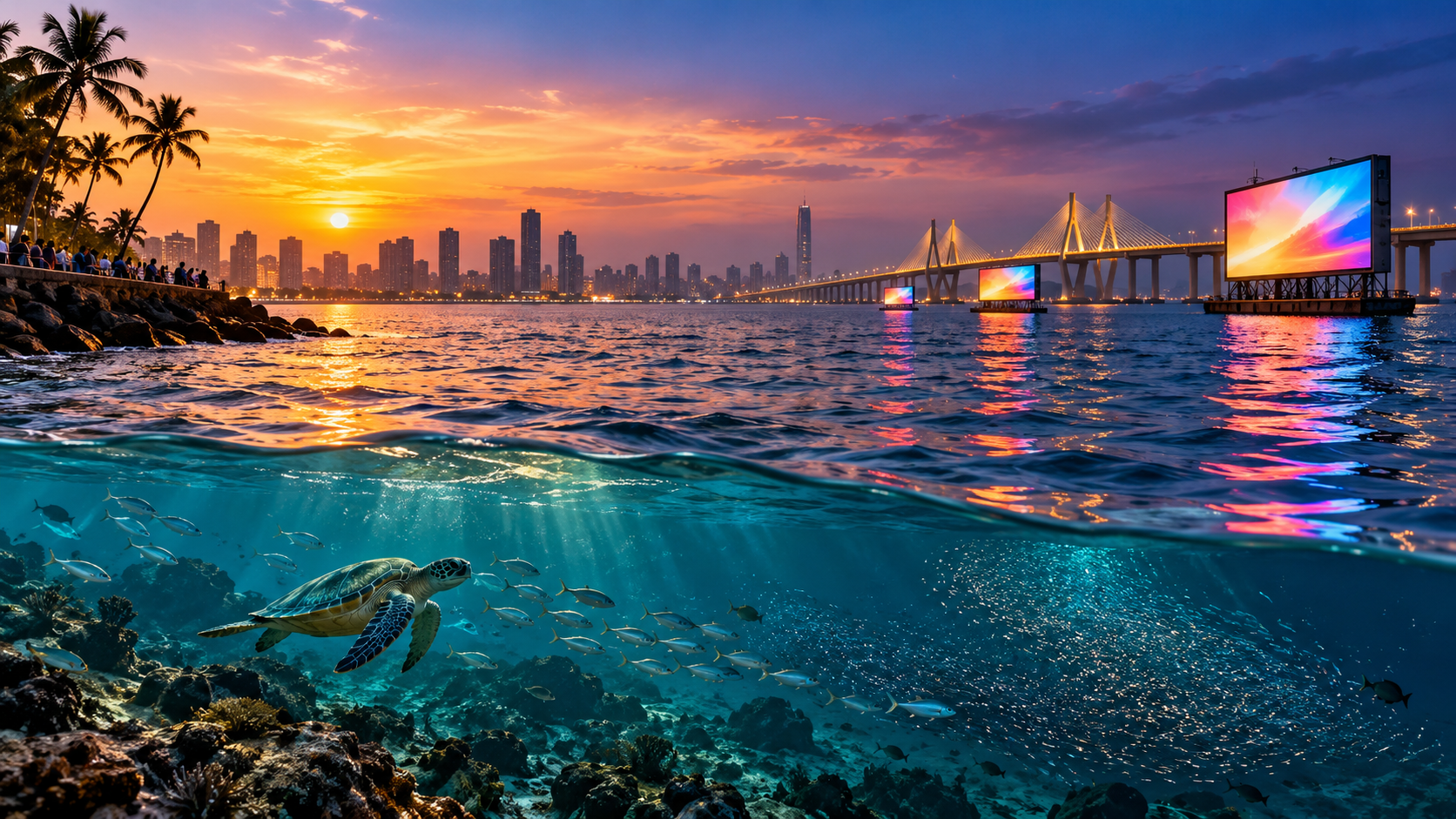
For many Mumbaikars, the sea is more than a beautiful view. It is where people go for an evening walk, spend time with family, watch the sunset or take a break from the city’s busy routine. For fishing communities, it is also a source of livelihood. Beneath its familiar blue surface, the sea supports countless forms of marine life.
Now, a proposal to introduce floating digital billboards along Mumbai’s coastline has raised an interesting question: how can the city find new ways to fund development while protecting the natural environment that makes its waterfront special?
The Maharashtra Maritime Board (MMB) plans to introduce advertising installations at around 20 coastal locations. These include places such as Juhu Beach, Lotus Jetty at Worli and the Bandra-Worli Sea Link jetty. The initiative aims to generate revenue for port facilities and water transport infrastructure.
The idea has a practical purpose, but the location calls for careful thought. The sea is not simply another space for advertisements. It is a living environment that deserves attention even when its needs are not immediately visible.
A New Idea for Mumbai’s Waterfront
Advertising has become part of everyday city life. We see it on buildings, at railway stations, in shopping centres and along busy roads. Taking it onto the water, however, introduces a different set of questions.
The MMB’s proposal aims to make better commercial use of its waterfront assets. Advertising agencies would manage the installations through a tender-based arrangement, potentially creating an additional source of income for the board.
Generating revenue for infrastructure is a reasonable goal. Better transport facilities and improved public infrastructure can make a difference to the people who use them every day.
But development also involves understanding where an idea is being introduced. A busy road and a coastal habitat do not work in the same way. What appears to be a simple advertising screen to someone standing on the shore may have effects that are less obvious beneath the water.
What Happens When Artificial Light Reaches the Sea?
One of the main concerns surrounding floating digital billboards is artificial light at night.
Research discussed in The Times of India report indicates that around 22% of the world’s coastal waters are consistently exposed to artificial light at night. Streetlights, fishing boats and offshore installations are among the sources.
Experts cited in the report also point out that white and blue-rich LED light can penetrate water, potentially reaching depths of up to 40 metres under certain conditions. This matters because many marine organisms depend on natural patterns of light and darkness.
Consider zooplankton, tiny organisms that play an important role in the marine food chain. Many species move towards the surface after sunset to feed and return to deeper water during the day. This daily movement is influenced by natural light.
Artificial lighting can disturb these patterns, potentially changing feeding behaviour and the relationship between predators and prey. The effects may extend beyond these tiny organisms to other parts of the marine food web.
The difficulty is that such changes are not always visible from the shore. People may see a brightly lit screen, but they cannot easily see how the light affects life beneath the waves.
The Wildlife We Often Overlook
Mumbai’s coastline is also connected to the lives of marine animals, including Olive Ridley turtles. Artificial lighting can disorient hatchlings, drawing them towards bright urban areas instead of helping them find their way towards the sea.
This is why experts stress the importance of protecting darker coastal habitats and considering wildlife when planning new installations.
The report also discusses environmental impact assessments and light-free buffers around important wildlife habitats. These are important considerations because the effects of artificial lighting can vary according to the location, brightness, colour and operating hours of a display.
Every coastal site has its own conditions. Understanding those conditions before approving an installation can help authorities make better-informed decisions.
A Lesson Mumbai Can Learn From New York
Mumbai is not the first city to face questions about advertising on waterways. New York banned floating digital billboards on its rivers in 2019, citing concerns about public nuisance and safety.
The two cities have different circumstances, so their approaches need not be identical. Still, the example shows why commercial ideas involving public waterways deserve careful consideration.
For Mumbai, another important question concerns coastal permissions. The Maharashtra Coastal Zone Management Authority has raised concerns about the clearances required for the proposed installations, according to related reporting.
Before the project moves forward, the relevant environmental and regulatory requirements need to be addressed. The aim should be to understand what is appropriate for each location rather than assume that the same solution will work everywhere.
Can Mumbai Find the Right Balance?
Mumbai needs better infrastructure, and finding new ways to fund it is worth exploring. At the same time, the city’s coastline is valuable for reasons that cannot be measured in advertising revenue alone.
Authorities could consider independent environmental assessments, carefully selected locations and limits on brightness and operating hours before allowing illuminated installations. Experts have also suggested measures such as warmer light sources and timers to reduce light pollution. Any such safeguards would need scientific assessment and regulatory approval.
Some locations may prove suitable with strict controls, while others may need to be excluded altogether. The decision should depend on evidence, not just commercial potential.
For residents, the hope is simple: that Mumbai continues to grow without losing the natural spaces that give the city its character.
Progress is not only about finding new ways to use what a city has. It is also about knowing what deserves to be protected.
Mumbai’s coastline belongs to more than the businesses that may see an opportunity there. It matters to the people who walk beside it, the communities that depend on it and the marine life that quietly sustains it. Finding the right balance between development and conservation would be a meaningful step towards a city that values both its future and its natural heritage.
Subscribe Deshwale on YouTube
