



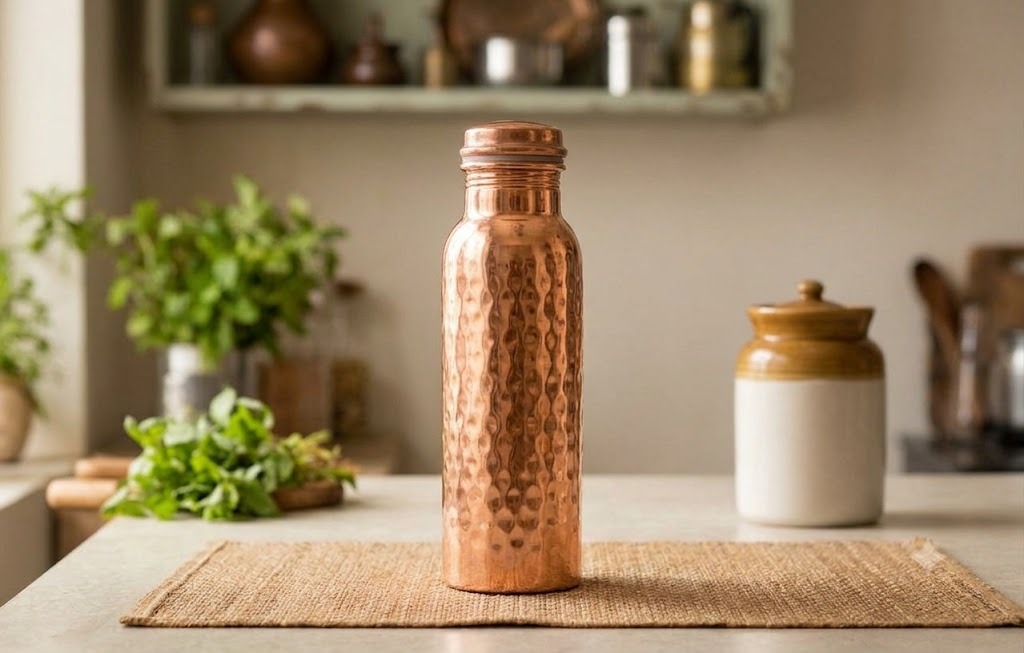
Every morning, people begin their day with small routines they rarely question. Some drink warm water, others reach for a steel bottle, while some prefer water stored overnight in a copper vessel. In many Indian households, this habit has been passed down through generations. Today, copper bottles have also found a place in wellness stores and online shopping carts, often accompanied by promises of better health.
But when tradition meets modern marketing, an important question deserves attention: are we choosing copper bottles because research supports their benefits, or because familiar practices and attractive claims make them appealing?
A Familiar Tradition Finds a New Market
Copper vessels have a long history in Indian households and traditional practices. Their appeal is easy to understand. A reusable bottle is practical, connects people with family traditions and offers an alternative to disposable plastic bottles.
Today, copper bottles are also marketed as lifestyle and wellness products. Their polished finish, premium packaging and health-focused descriptions can make an everyday drinking habit feel like a health upgrade.
There is nothing wrong with valuing tradition or choosing a bottle that suits your lifestyle. The concern begins when a traditional practice is presented as a scientifically proven solution to several health problems without sufficient evidence.
What Happens Inside a Copper Bottle?
A study published in Applied Water Science in 2022 examined how much copper entered drinking water stored in a copper container over different periods.
Researchers tested water samples after 12, 24, 48, 72, 96 and 168 hours. They found that copper concentrations increased as storage time increased. The study’s results table reported a concentration of 0.813 milligrams per litre after seven days, although its abstract gave a slightly different figure of 0.823 milligrams per litre.
The researchers reported that the measured concentrations remained below the drinking-water limits they referenced from the World Health Organization and the United States Environmental Protection Agency. However, the experiment involved a particular container and water sample. The results cannot guarantee that every copper bottle will release the same amount of copper under different conditions.
The practical lesson is simple: copper can enter water during storage, and the amount may increase over time. But more copper in the water does not automatically mean greater health benefits.
Can Copper Really Help Purify Water?
Research offers an interesting finding here. In a 2009 laboratory study, scientists stored water containing E. coli, Salmonella Typhi and Vibrio cholerae in copper pots overnight. The bacteria were no longer recoverable using the conventional culture methods employed in the experiment. Water stored in glass bottles used as controls did not show the same result.
The findings suggest that copper can help reduce certain bacteria under specific conditions. However, they do not prove that a copper bottle can remove every harmful microorganism or make contaminated water safe in all circumstances.
For families choosing how to store drinking water, this distinction matters. Water that looks clear is not necessarily safe to drink, and a copper vessel should not replace reliable water treatment when it is needed.
Where Does Science End and Marketing Begin?
Copper is an essential nutrient that the body needs in small amounts. However, this does not establish that drinking water stored in copper vessels improves digestion, causes weight loss, strengthens immunity beyond normal nutritional needs or prevents disease.
A 2020 evidence brief from the US Agency for Healthcare Research and Quality reported that its review had found no primary studies establishing health benefits from drinking water stored in copper vessels. This describes the evidence available to that review at the time; it does not mean that every possible benefit has been permanently disproved. It does show why broad health claims need stronger evidence before they are presented as established facts.
Safety also deserves attention. Excessive copper intake can cause nausea, vomiting, abdominal pain and diarrhoea. Long-term exposure to high amounts can damage the liver and kidneys. People with Wilson’s disease, a condition that affects how the body handles copper, may be particularly vulnerable.
Make an Informed Choice
A copper bottle does not have to be a miracle product to remain a meaningful part of someone’s daily routine. People can value tradition without accepting every health claim attached to it.
Choose safe drinking water, keep your bottle clean and follow appropriate care instructions. Do not assume that storing water for longer makes it healthier or that copper alone can make unsafe water safe to drink.
Perhaps the real lesson is not to abandon old habits, but to ask better questions about them. Tradition can inspire curiosity, but evidence should guide our health decisions.
Subscribe Deshwale on YouTube
