



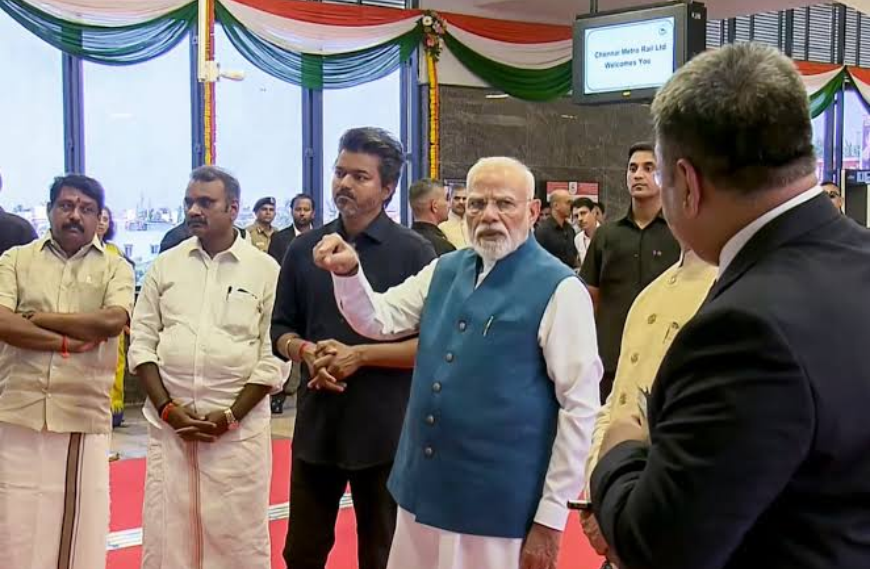
For people travelling across Chennai every day, a shorter journey can mean more time with family, less time stuck in traffic and fewer worries about reaching work on time. The city has taken another step towards improving urban transport with the opening of a new stretch of Chennai Metro Rail Phase II.
Prime Minister Narendra Modi inaugurated the Poonamallee–Vadapalani stretch on 11 October 2026, alongside Tamil Nadu Chief Minister C Joseph Vijay. The project, built at a cost of around ₹4,900 crore, is expected to improve connectivity between Chennai’s western suburbs and the existing Metro network. <Cite refs={[“turn461159search1″,”turn461159news6”]}/>
11 Stations Connect Western Chennai
The newly opened stretch covers approximately 15 kilometres and includes 11 elevated Metro stations. It forms part of Corridor 4 under Phase II of the Chennai Metro project.
The stations are Poonamallee Bypass, Poonamallee Bus Stand, Poonamallee Government Hospital, Karayanchavadi, Kumananchavadi, Kattupakkam, Ayyappanthangal, Thelliyagaram, Porur Bypass, Porur Junction and Vadapalani.
The route connects residential neighbourhoods in western Chennai with Vadapalani, where passengers can connect to the existing Phase I Metro network. This could make daily travel easier for people who currently depend on road transport for parts of their journeys. <Cite refs={[“turn461159search1″,”turn461159news6”]}/>
What Commuters Need to Know
Regular passenger services on the new stretch began on 11 October, with limited operating hours on the opening day. From 12 October, services are scheduled to operate between 7 am and 9 pm.
According to the published service schedule, trains run every 10 minutes during peak hours, from 8 am to 11 am and 5 pm to 8 pm, from Monday to Saturday. During non-peak hours, the interval is 15 minutes. On Sundays and public holidays, trains are scheduled to run every 15 minutes throughout the day.
Passengers should check official Chennai Metro Rail updates before travelling, as service timings may change. <Cite refs={[“turn461159search1”]}/>
A Double-Decker Structure and Driverless Technology
The new corridor features a 3.7-kilometre double-decker structure, an engineering feature that allows transport infrastructure to share a limited urban space. It also includes advanced signalling systems designed to support driverless train operations. <Cite refs={[“turn461159news6″,”turn461159search0”]}/>
These features form part of Chennai’s wider effort to expand its public transport network as the city grows. However, the practical benefit for commuters will depend on reliable services, convenient connections and how easily people can access the stations.
What Comes Next for Chennai Metro?
The inauguration marks the opening of the first operational stretch of Phase II, rather than the completion of the entire expansion project. Further development will be important for extending Metro connectivity to more neighbourhoods.
For commuters, the real test will be whether the new route reduces dependence on road travel and makes everyday journeys more predictable.
The opening is a significant step in Chennai’s transport expansion. Its lasting value, however, will be measured not by the inauguration ceremony, but by how effectively the service meets the needs of people who use it every day.
Subscribe Deshwale on YouTube
