



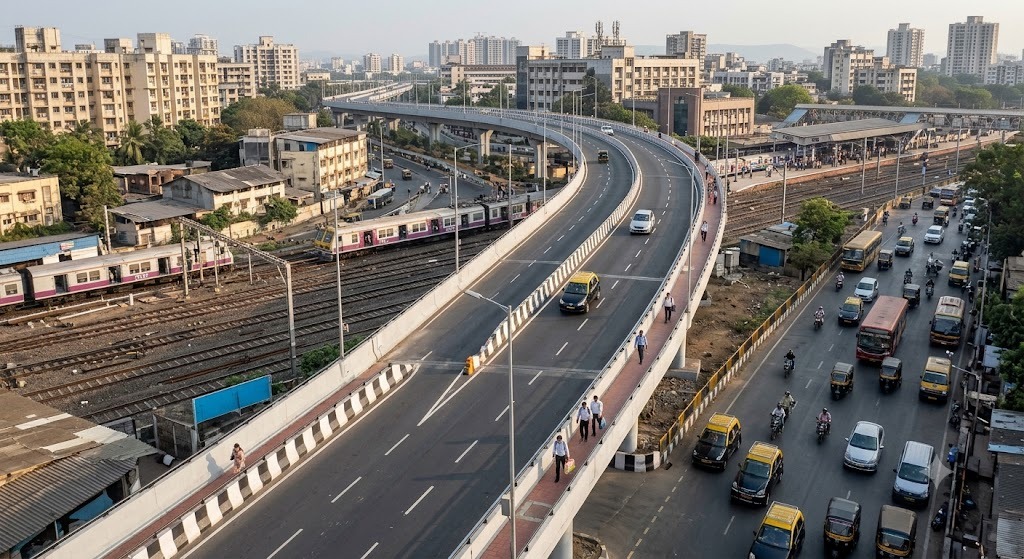
In Mumbai, a journey of just a few kilometres can sometimes take far longer than expected. A railway station may be nearby, yet reaching it can require a detour. Two neighbourhoods may lie on opposite sides of a railway line, but crossing between them can consume valuable time. For office-goers, students, shopkeepers and families, these daily challenges are part of city life.
Three new bridges in Sion, Vidyavihar and Goregaon East were inaugurated on October 22, 2026. Together, the projects cost approximately ₹538 crore and are expected to improve connectivity and make several everyday journeys more convenient.
Their real value, however, will not be measured only in construction costs or the length of the structures. It will also be reflected in the time and effort they could save for ordinary residents.
Sion: A Better Connection for Daily Commuters
The new Sion railway overbridge replaces a century-old structure that was declared unsafe in 2019. Its reconstruction was also necessary to accommodate the planned fifth and sixth railway lines between Chhatrapati Shivaji Maharaj Terminus and Kurla.
Built at a reported cost of ₹60 crore, the new bridge is 61 metres long and provides four vehicular lanes, compared with two on the earlier structure. It also includes a dedicated footpath connecting commuters to Sion railway station, along with an underpass to facilitate pedestrian and vehicular movement.
For people travelling to work, catching a train or crossing the area on foot, these facilities could make everyday movement more convenient.
A bridge may appear to be just another concrete structure, but for someone carrying shopping bags or rushing to catch a train, a better connection can make a practical difference.
Vidyavihar: A Journey That Could Take Less Time
Some infrastructure projects take decades to become reality. The Vidyavihar east-west connector is one such example. Conceived in 1991 and taken up for construction in 2016, the project has finally reached the opening stage.
Built at a reported cost of ₹178 crore, the bridge connects Ramchandra Chemburkar Marg on the eastern side with Lal Bahadur Shastri Marg on the western side of the railway station.
The BMC expects the connection to reduce travel time between the two sides from around 30 minutes to approximately 10 minutes.
For daily commuters, a potential saving of 20 minutes could mean reaching home earlier, spending more time with family or having a little breathing space between work and personal responsibilities. The actual benefit will depend on traffic conditions and the route taken, but a more direct connection could remove a familiar obstacle for local residents.
Goregaon East: Looking Beyond One Road
The third project is a 1.26-kilometre elevated flyover in Goregaon East, built as part of the Goregaon-Mulund Link Road project. It connects General Arun Kumar Vaidya Marg with Santosh Nagar on Dadasaheb Phalke Chitranagari Marg.
The flyover is expected to ease congestion around nearby junctions and improve movement towards the eastern suburbs. It is also part of a wider effort to strengthen east-west connectivity, which includes tunnels planned beneath Sanjay Gandhi National Park.
The flyover is an important step, although the wider benefits of the Goregaon-Mulund Link Road will depend on the completion of the remaining parts of the project.
The Real Measure of Better Connectivity
A city’s progress is not only about how quickly vehicles move. It is also about how much easier life becomes for the people who depend on those roads.
Three bridges will not eliminate all of Mumbai’s traffic problems. Their benefits will depend on effective traffic management, safe pedestrian access and how well the surrounding road network functions.
Still, better connections can remove everyday obstacles that residents have learned to accept as normal.
When a journey becomes shorter and simpler, the benefit extends beyond the road. It can mean less time travelling and more time living.
That is the promise these three bridges bring to Mumbai.
Subscribe Deshwale on YouTube
