



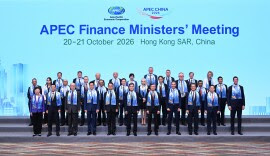
Hong Kong has hosted the Asia-Pacific Economic Cooperation (APEC) Finance Ministers’ Meeting for the first time, bringing finance leaders and representatives of international organisations together to discuss regional economic stability, financial co-operation and sustainable growth.
Held on October 20 and 21, 2026, the meeting took place as economies across the Asia-Pacific region face uncertainty over trade policies, geopolitical tensions and changing financial conditions. The discussions focused on how countries can maintain economic connections, manage risks and build a more resilient future.
The meeting concluded on October 21 with the release of the 2026 APEC Finance Ministers’ Joint Statement, reaffirming the commitment to building an open, dynamic, resilient and peaceful Asia-Pacific community by 2040. The statement highlighted the shared ambition of promoting prosperity for people across the region and for future generations.
Why the Meeting Matters
APEC brings together economies from across the Asia-Pacific region to discuss issues affecting trade, investment and economic development. According to Hong Kong Chief Executive John Lee, the participating economies represent approximately three billion people and account for more than 60 per cent of global gross domestic product (GDP).
This scale makes regional co-operation important. Decisions and discussions concerning investment, financial stability and trade can influence businesses, workers and consumers across many economies.
Welcoming delegates, Lee described the gathering as a historic occasion for Hong Kong and part of APEC China 2026. He also highlighted the city’s position as an international financial centre, supported by its legal and regulatory framework and its connections with mainland China and global markets.
A Call for Open Trade and Financial Co-operation
China’s Minister of Finance, Lan Fo’an, who chaired the 2026 meeting, called on participating economies to implement the consensus reached at the APEC Economic Leaders’ Meeting. He emphasised multilateralism and practical co-operation in fiscal and financial affairs as ways to support regional stability and long-term economic growth.
Hong Kong Financial Secretary Paul Chan also stressed the need for economies to work together amid geopolitical tensions and uncertainty surrounding trade policies.
He said regional economies should protect the smooth flow of trade and investment while remaining alert to financial risks and developing new sources of long-term growth.
Speaking during a session on the global and regional economic and financial outlook on October 20, Chan highlighted the importance of connected markets. Open trade and investment channels, he argued, can help capital reach productive uses and allow technologies to spread across borders.
His remarks reflected a central challenge for the region: maintaining economic stability while ensuring that businesses and economies can continue to adapt to changing conditions.
Finance for Digital and Sustainable Development
Alongside the main meeting, the Hong Kong Monetary Authority and the APEC Business Advisory Council organised two thematic seminars on October 20.
The first examined how finance could support digitalised, inclusive and sustainable supply chains. The second focused on mobilising capital for nature-related initiatives and expanding regional financial co-operation.
The discussions brought attention to two areas of growing importance: using financial systems to make supply chains more connected and efficient, and finding ways to direct investment towards environmental priorities.
Christopher Hui, Hong Kong’s Secretary for Financial Services and the Treasury, said prosperity could not be secured by individual economies acting alone. He highlighted partnership, innovation and resilience as important elements of future economic development.
These themes underline how regional financial discussions now extend beyond traditional banking and public finance to include technology, supply chains and environmental sustainability.
Showcasing Hong Kong Beyond Finance
The meeting also provided delegates with opportunities to experience Hong Kong’s cultural heritage and urban attractions.
Organised visits included Victoria Peak, the Hong Kong Museum of Art, the Hong Kong Palace Museum, Xiqu Centre, the Chinese Culinary Institute and Ocean Park. Delegates also took a boat tour of Victoria Harbour.
After the meeting, Lee and other Hong Kong officials met Lan at Government House to exchange views on economic and financial developments in mainland China and Hong Kong.
Looking Ahead
The meeting concluded with a renewed emphasis on co-operation, financial stability and sustainable growth across the Asia-Pacific region. However, the success of these commitments will ultimately depend on how participating economies put them into practice.
For businesses and ordinary people, stronger regional economic links can matter through investment opportunities, employment, trade and access to new technologies.
Hong Kong’s first hosting of the APEC Finance Ministers’ Meeting was therefore more than an international gathering. It provided a platform for economies to discuss shared challenges and explore ways to support a more connected and resilient regional future.
Subscribe Deshwale on YouTube
