



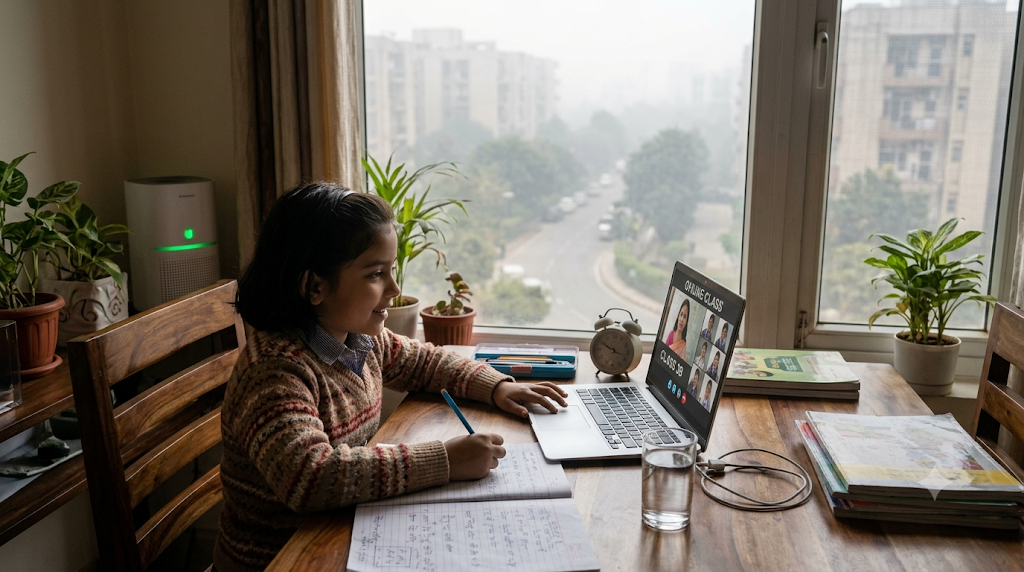
A school morning usually begins with familiar sounds. The alarm rings, breakfast is prepared, uniforms are taken out and children hurry to get ready. But in Delhi-NCR, winter sometimes brings an unexpected change to this routine. Instead of packing school bags and waiting for the school bus, children may find themselves attending classes from the dining table.
For many families, this possibility has become a familiar part of the pollution season. As air quality worsens during winter, schools and parents begin preparing for changes in outdoor activities and, if necessary, classroom arrangements. What may appear to be a small adjustment in the school timetable can affect the routine of an entire household.
When the dining table becomes a classroom
Imagine a parent preparing breakfast while keeping an eye on a child’s online class. A notebook is open, a mobile phone is being used for lessons and an office meeting is about to begin.
For working parents, managing these responsibilities together is not always easy. Someone has to make sure the child joins the class on time, completes homework and understands the lessons. Sometimes, grandparents or other family members step in to help.
Parents in Delhi-NCR have shared how they take turns managing their children’s schedules during pollution-related school disruptions. One parent may take leave from work while the other handles responsibilities on another day. Some families also depend on relatives for childcare.
These everyday adjustments show how a change in school arrangements can influence the lives of people beyond the classroom.
The extra effort behind online learning
Online education has made it possible for children to continue studying without travelling to school. However, younger students often need someone nearby to guide them.
Unlike a regular classroom, where teachers manage the learning environment, studying at home requires children to remain attentive despite distractions. Parents may have to help them open lesson links, arrange notebooks, understand instructions and complete assignments.
For mothers and fathers working from home, this can mean attending office meetings while helping children with schoolwork. For those who travel to their workplaces, arranging supervision becomes another responsibility.
The support of grandparents and other family members also becomes valuable during such periods. Their presence can help children maintain a familiar routine when their usual school environment changes.
Not every child has the same facilities
While online classes offer convenience, the experience is not equally easy for every family.
Some children have personal laptops, smartphones and reliable internet connections. Others depend on a shared mobile phone or have limited access to digital facilities.
For a child whose parents work outside the home, attending a scheduled online class can become particularly difficult. Families working in domestic services, shops, factories and other occupations may not have the flexibility to supervise lessons during the day.
This reminds us that access to education is not only about having a school or a teacher. Children also need the facilities and support required to participate in learning.
Schools can help by providing recorded lessons, flexible schedules and printed study material for students who cannot attend live online classes.
Schools are preparing beyond the classroom
The changing winter conditions have also encouraged schools to take preventive steps.
On November 5, reports said that several private schools in Delhi were planning to postpone outdoor activities after Diwali until air quality improves. Some schools have installed air purifiers, placed indoor plants in classrooms and advised students to wear masks when stepping outside.
The Directorate of Education has also directed government and private schools to organise special awareness assemblies on November 5 and 6. These sessions aim to educate children about the effects of firecrackers on the environment and encourage safer festive practices.
Schools have been asked to use activities such as poster-making, essay-writing, drawing and debates to help children understand environmental protection.
These efforts show how schools can become more than places of academic learning. They can also help children develop habits that contribute to healthier surroundings.
Keeping childhood and learning connected
A change in the learning environment does not have to mean a complete break from education. Children can continue reading, writing, solving problems and exploring new subjects at home.
Parents can make these days more comfortable by maintaining regular study hours, allowing breaks and encouraging children to spend some time away from screens. Schools can also keep lessons interactive without making children sit in front of devices for unnecessarily long periods.
At the same time, online learning cannot fully replace the experience of attending school. Friendships, playground activities, classroom conversations and group learning are all important parts of growing up.
As another winter approaches, families, teachers and schools are once again preparing to adjust to changing conditions. The aim is not simply to keep lessons running, but to make sure children remain safe, supported and connected to their education.
A dining table may temporarily become a classroom, a grandparent may become a study companion and a parent may take on an additional role after office hours. These small efforts often go unnoticed, but together they help children continue learning through changing circumstances.
Ultimately, every family hopes for the same thing: a winter in which children can enjoy their school days, meet their friends and play outdoors without having to worry about the air they breathe.
Subscribe Deshwale on YouTube
