



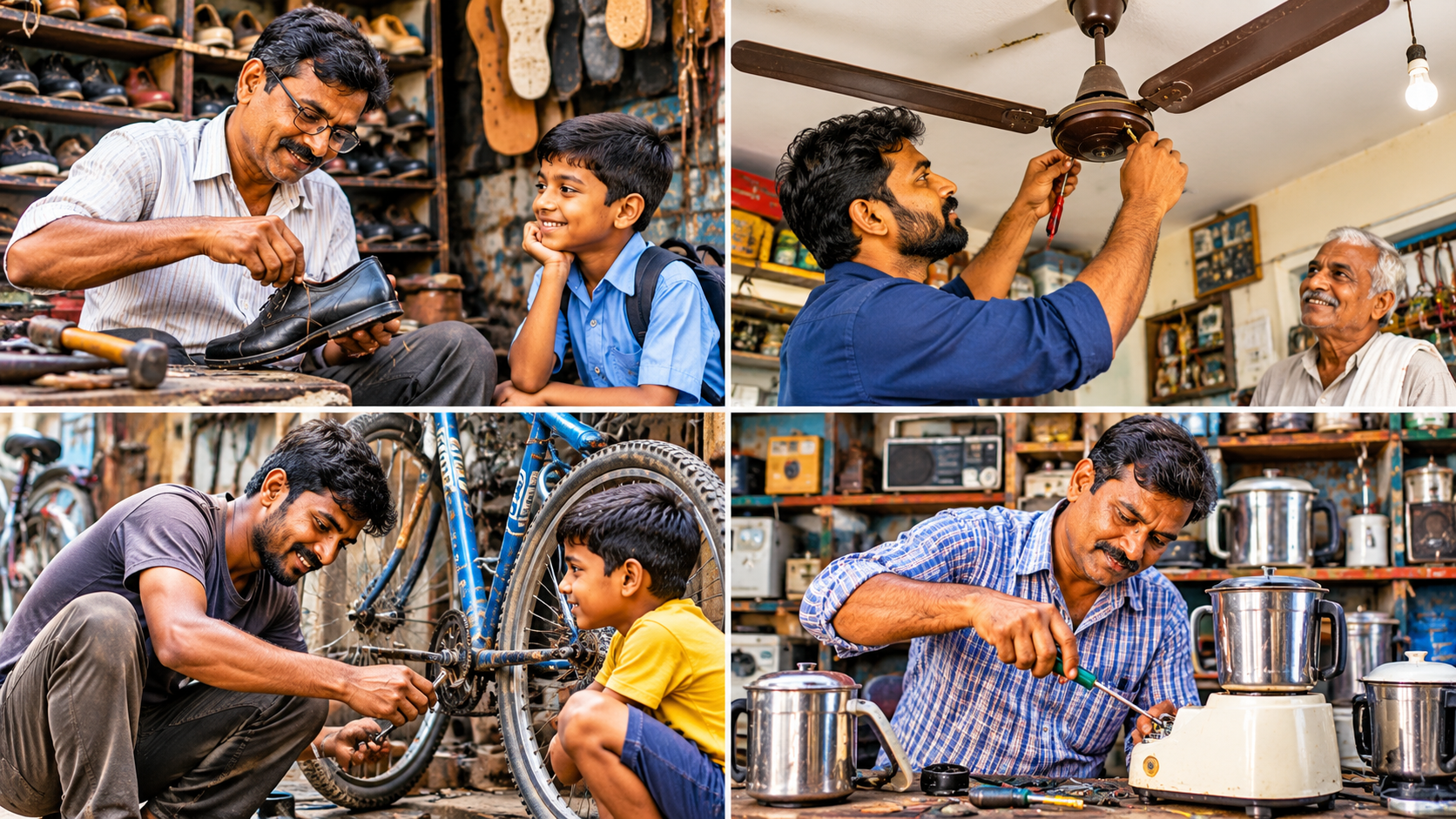
Remember the time someone at home asked you not to throw away an old fan because the neighbourhood electrician might be able to fix it? Or when a parent took your school shoes to the cobbler instead of buying a new pair? These small moments are part of growing up in many Indian households.
Even today, in countless neighbourhoods, people carry broken objects to familiar little shops, hoping they can be made useful again. A faulty mixer, a torn school bag, a damaged bicycle or an old pair of sandals often finds its way into the hands of someone who knows how to repair it.
Behind these everyday moments are people whose skills quietly make life easier for others. They may not have large workshops or fancy equipment, but they have something valuable: experience, patience and the ability to understand how things work.
The Shops We Keep Returning To
Think about the repair shops around your home. There may be a cobbler sitting with his tools near a busy street, an electrician working from a small shop or a bicycle mechanic who knows exactly how to fix a loose chain.
For many families, these are familiar faces. You may have visited the same person for years, sometimes even taking your children’s shoes or bicycles to someone who once helped your own family.
There is a certain comfort in that familiarity. You explain the problem, the repairer takes a look and, quite often, suggests a simple solution. Sometimes, all an object needs is a little adjustment, a new part or careful stitching.
What makes these relationships special is the trust built over time. A customer returns not only because a repair is needed, but also because they know where to go.
Experience That Cannot Be Learnt Overnight
Repairing something is not always as simple as picking up a tool and getting to work. It requires observation, practical knowledge and patience.
An experienced electrician may recognise a problem after checking a fan’s wiring. A cobbler knows how to stitch a damaged shoe so it can be worn again. A bicycle mechanic understands how to adjust brakes, tighten chains and check tyres.
Many repairers develop these abilities through years of practice. Some learn from their parents or senior workers, while others gain experience by working with different products and solving everyday problems.
Every successful repair reflects time spent learning a skill. It also reminds us that practical knowledge is valuable, even when it comes from a small neighbourhood workshop rather than a formal classroom.
A Small Habit With a Bigger Meaning
Repairing things is not only about saving money. It is also about recognising the value of something we already own.
A repaired school bag can accompany a child through another term. A working fan can continue serving a family during summer. A fixed bicycle can help someone reach work, school or the local market.
This familiar habit also connects with India’s growing conversation about responsible consumption and reducing waste.
In December 2022, the Department of Consumer Affairs launched the Right to Repair India portal. It brings together repair-related information and support from participating brands, helping consumers explore ways to maintain and repair their products.
In May 2025, a government committee submitted recommendations for a Repairability Index, initially covering smartphones and tablets. The idea is to help consumers understand how easily a product can be repaired. However, in a parliamentary reply in February 2026, the government stated that there was no specific legal requirement for electronic products to display the index through QR codes or online platforms at that time. These initiatives are steps towards making repair information more accessible.
The People Behind Everyday Convenience
We often remember the shopkeeper who knows our usual order or the vegetable seller who remembers what our family likes. Repairers can become just as familiar.
A mechanic may remember the bicycle he repaired last month. A cobbler may recognise a regular customer by the shoes they bring in. These small interactions make neighbourhoods feel connected.
Their work may happen away from the spotlight, but it plays a useful role in everyday life. They help families maintain their belongings, find practical solutions and continue using things that still have value.
Of course, not every broken item can be repaired safely or economically. Some products need professional attention, while others may have reached the end of their useful life. But when a repair is possible, it is worth considering.
A Little More Appreciation
The next time you pass a cobbler sitting beside his tools or a mechanic carefully fixing a bicycle, take a moment to notice the skill involved.
These workers do more than repair objects. They help preserve useful habits, pass on practical knowledge and build relationships with the people around them.
Perhaps the next time something at home stops working, we can pause before deciding to replace it. There may be someone nearby who can help make it useful again.
Sometimes, giving an old object a second life begins with a simple visit to the little shop around the corner. And behind that second chance is a person whose work deserves to be appreciated.
Subscribe Deshwale on YouTube
