


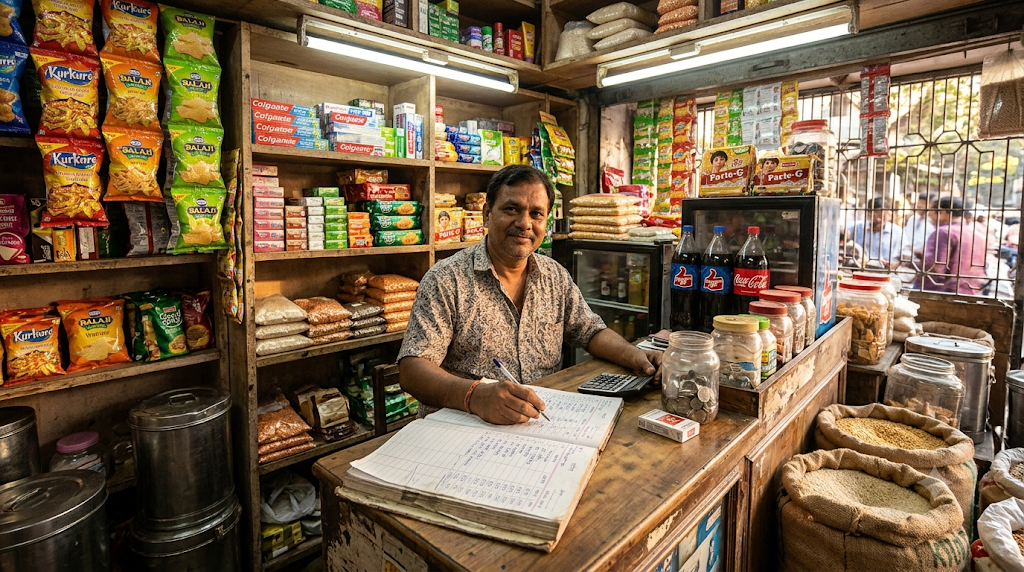
Imagine walking into a neighbourhood grocery shop and asking for a packet of biscuits, a little sugar and some tea leaves. The shopkeeper puts everything in a bag, opens a small notebook and writes down the amount against your name. You do not take out your wallet or count the money. Instead, you simply say, “I’ll settle it at the end of the month.”
For many Indian families, this was once a familiar experience. Before QR codes and instant payment notifications became part of everyday shopping, some local stores offered another way to manage purchases. It was called udhaar, and the small notebook used to record these transactions was known as the khata.
It was not a payment method in itself. It was a written account of goods purchased on credit, with payment to be made later. But behind those handwritten entries was something more meaningful: a relationship built through familiarity and trust.
The Little Notebook Behind the Counter
In many neighbourhood shops, a thick notebook had a special place near the counter. Its pages carried customer names, dates and amounts. Whenever a regular customer bought groceries on credit, the shopkeeper would record the purchase in the notebook.
Rice, flour, cooking oil, sugar and other household essentials could be added to the account. Some shopkeepers maintained separate pages for each family, while others used a running account to track purchases.
Customers usually settled their dues at an agreed time, often weekly or monthly. The shopkeeper kept track of the purchases, while the customer was expected to remember the responsibility of paying the amount.
It was a simple arrangement, but it required honesty from both sides.
When the Shopkeeper Knew the Family
One familiar sentence heard at local shops was, “Please add it to my account.”
The shopkeeper often knew the customer’s family, their shopping habits and sometimes even their preferences. A regular customer did not always need to explain every purchase. Over time, the shopkeeper became familiar with the household’s everyday needs.
However, credit was not automatically available to everyone. It depended on the shopkeeper’s willingness, the customer’s payment history and the relationship they shared.
This familiarity made the khata more than just a notebook. It became a record of everyday interactions between people who saw each other regularly.
More Than Just a Way to Pay Later
The khata system also offered flexibility to families. A household might need groceries before a salary arrived or face an unexpected expense during the month. In such situations, buying essential items on credit could provide temporary support.
This practice has not completely disappeared. A February 2023 analysis by the Centre for Economic Data and Analysis (CEDA) at Ashoka University, using CMIE household survey data from September to December 2022, found that 30.2% of Indian households had outstanding credit with local shops. The analysis identified local shop credit as the most common borrowing source among the sources it examined.
This figure reflects household credit from local shops in 2022. It should not be interpreted as the percentage of families using traditional khata notebooks.
For shopkeepers, offering credit also requires careful management. They have their own suppliers, expenses and payments to make. Maintaining a customer’s account therefore involves responsibility on both sides.
Cash, Coins and Handwritten Accounts
The khata was never the only way people paid for everyday purchases. Cash and coins remained familiar parts of shopping, while credit accounts offered another option for customers who preferred to settle their bills later.
A customer could pay for one purchase in cash and add another to the khata. The notebook simply helped the shopkeeper remember what had been bought and what was still owed.
For many families, this arrangement became part of their monthly routine. The account was settled when convenient, and the next month often began with a fresh set of entries.
From the Khata to the QR Code
Shopping has changed considerably with the arrival of digital payments. Today, customers can scan a QR code, enter an amount and complete a transaction within seconds.
The Unified Payments Interface (UPI) was introduced through a pilot launch in April 2016 and was rolled out publicly in August 2016, according to the National Payments Corporation of India (NPCI).
Digital payments have made everyday transactions quicker and more convenient. Yet, traditional practices have not necessarily disappeared. Some neighbourhood shops accept cash and UPI payments while continuing to maintain credit accounts for regular customers.
In such shops, a QR code and a handwritten notebook can still exist side by side. One records an instant digital payment, while the other keeps track of purchases to be paid for later.
A Small Notebook, A Lasting Memory
For people who grew up visiting neighbourhood grocery stores, the khata may bring back familiar memories: the shopkeeper turning through its pages, a parent’s monthly shopping list and the simple request to add a purchase to the account.
The way people pay has changed, but the importance of trust in everyday transactions remains.
A QR code may complete a payment in seconds, while a khata records a promise to pay later. Both have their place in today’s changing shopping habits.
And somewhere behind a familiar neighbourhood counter, that little notebook may still be keeping track of more than just groceries. It may also be holding years of everyday relationships.
Subscribe Deshwale on YouTube
