









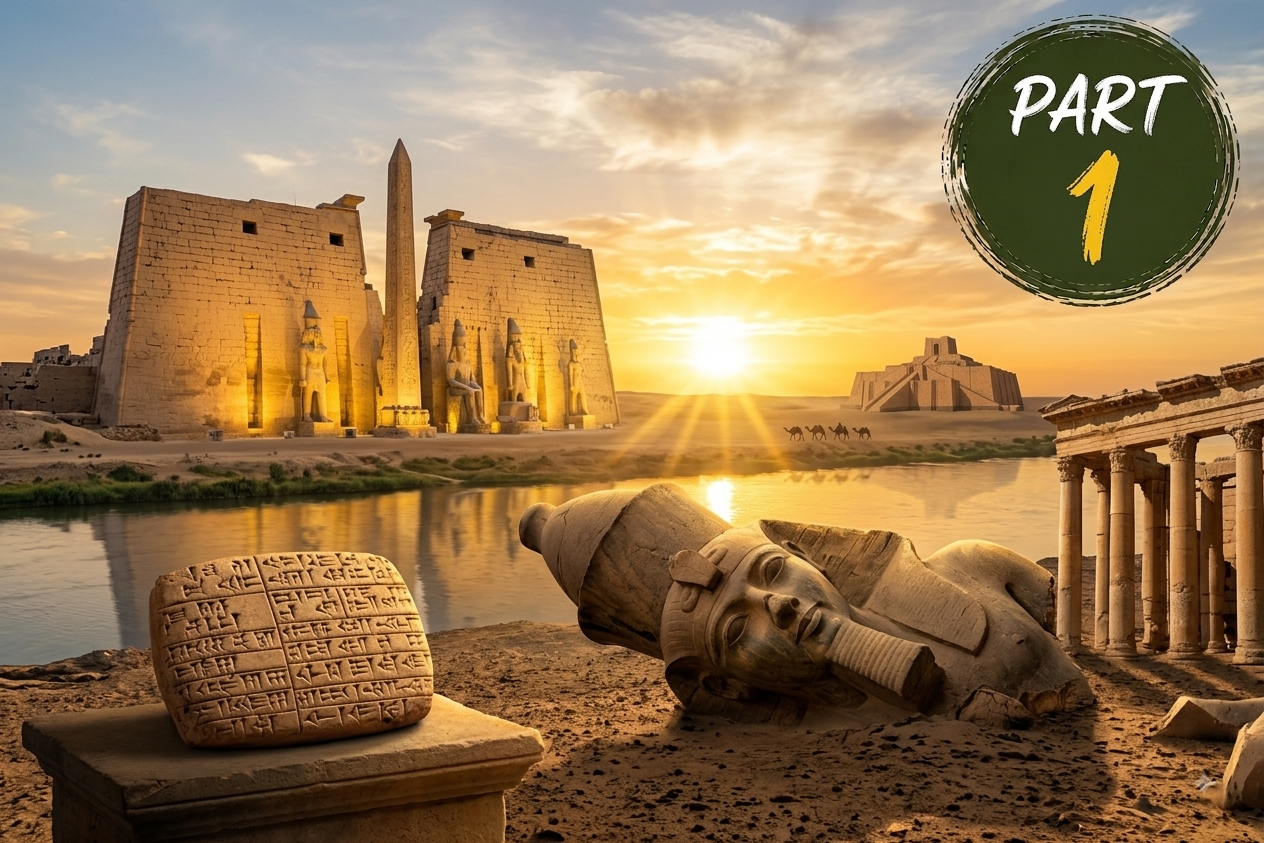
AI Generated image
There was a time when the gods of Mesopotamia, Egypt, Greece and Rome were not archaeological subjects studied in museums and history books. People prayed to them, built temples for them, offered food and sacrifices, organised festivals in their honour and believed that kings ruled with divine authority. Religion was woven into government, agriculture, law, kingship and everyday life. Yet many of these once-powerful religious traditions eventually disappeared, leaving behind ruins, inscriptions, statues and stories.
There is no simple answer to how a religion disappears. People do not usually wake up one morning and collectively decide that their gods no longer exist. Political patrons can disappear, conquests can destroy temples, priesthoods can collapse and new religions can replace older ones. Languages can die, sacred texts can become unintelligible and populations can migrate. Sometimes an older religion is absorbed into another tradition and changes so extensively that historians can no longer consider its later form the same religion.
When the temples of Mesopotamia fell silent
Some of humanity’s oldest organised religions developed in Mesopotamia, between the Tigris and Euphrates rivers. Sumerian religion flourished for thousands of years, with gods such as An, Enlil, Enki, Inanna and Utu. Cities including Uruk, Ur and Nippur developed major temples, priesthoods and elaborate religious institutions. These temples were not simply places where people prayed. They owned land, employed workers and played an important role in managing agriculture and the wider economy.
Sumerian religion eventually disappeared as an independent living tradition, but this was not a sudden rejection of its gods. Sumerian culture was gradually absorbed into Akkadian-speaking Babylonian and Assyrian civilisation. Gods were identified with one another, myths were rewritten and languages changed. Babylonian and Assyrian religious traditions survived for centuries longer, but their organised temple systems eventually disappeared as well. Their gods remained alive only through clay tablets, inscriptions and archaeological discoveries.
Ancient Egypt provides an even more extraordinary example. Egyptian religion survived for more than three thousand years and underwent countless changes while remaining deeply connected with society. Ra, Osiris, Isis, Horus, Anubis, Thoth and Amun became some of the most recognisable gods in human history. Egypt experienced foreign invasions and changing rulers, yet its religious traditions repeatedly adapted.
Persians ruled Egypt, Alexander the Great conquered it, Greek-speaking Ptolemies governed the country and Rome eventually absorbed it. Egyptian religion survived these changes, but Christianity gradually transformed the religious landscape during the Roman period. Traditional temples lost patronage, priesthoods declined and imperial policies increasingly favoured Christianity. By late antiquity, the institutions required to maintain the old religious system had largely disappeared.
The gods themselves were not erased. Their temples and images survived, but the rituals that gave them religious meaning stopped being continuously practised. One of humanity’s longest-lasting religious traditions therefore became extinct as an organised faith.
The Greek and Roman religious worlds
Ancient Greek religion was never one centrally organised system. Zeus, Athena, Apollo, Artemis, Aphrodite, Poseidon, Demeter and Dionysus were worshipped in different cities and regions, often with local traditions. There was no single Greek church or universally binding creed. Each city maintained its own sanctuaries, festivals and religious institutions.
When Rome absorbed Greek culture, the Greek gods did not immediately disappear. Zeus became associated with Jupiter, Aphrodite with Venus, Ares with Mars and Artemis with Diana. The old gods therefore survived through cultural adaptation. Roman religion itself was highly diverse, incorporating native Roman traditions, Greek influences and foreign cults. Isis was worshipped across the empire, Cybele came from Anatolia and Mithras became associated with a mystery cult that attracted soldiers and other mobile communities.
Christianity eventually changed this religious landscape. As Christian emperors increasingly favoured Christianity, traditional temples lost political and financial support. Sacrifices and other pagan practices were increasingly restricted, and the old religious institutions gradually became marginal.
The transformation was not instantaneous, but over generations the religious systems that had accompanied the ancient Mediterranean civilisations ceased to function as dominant public religions. Their gods survived in literature and mythology, but their temples no longer served the communities that once depended on them.
The lesson is important: religious extinction is rarely a single event. A civilisation can survive a political change, but if its temples lose funding, its priests disappear and its children are raised in another faith, the chain of religious transmission can eventually break.
Subscribe Deshwale on YouTube


