









AI Generated image
The disappearance of ancient religions was not limited to Mesopotamia, Egypt, Greece and Rome. Across Europe, Asia and the Americas, religious systems that once shaped societies were transformed by conquest, conversion, migration and cultural change. Some disappeared completely, while others survived through mythology, folklore, language and traditions that became part of newer religions.
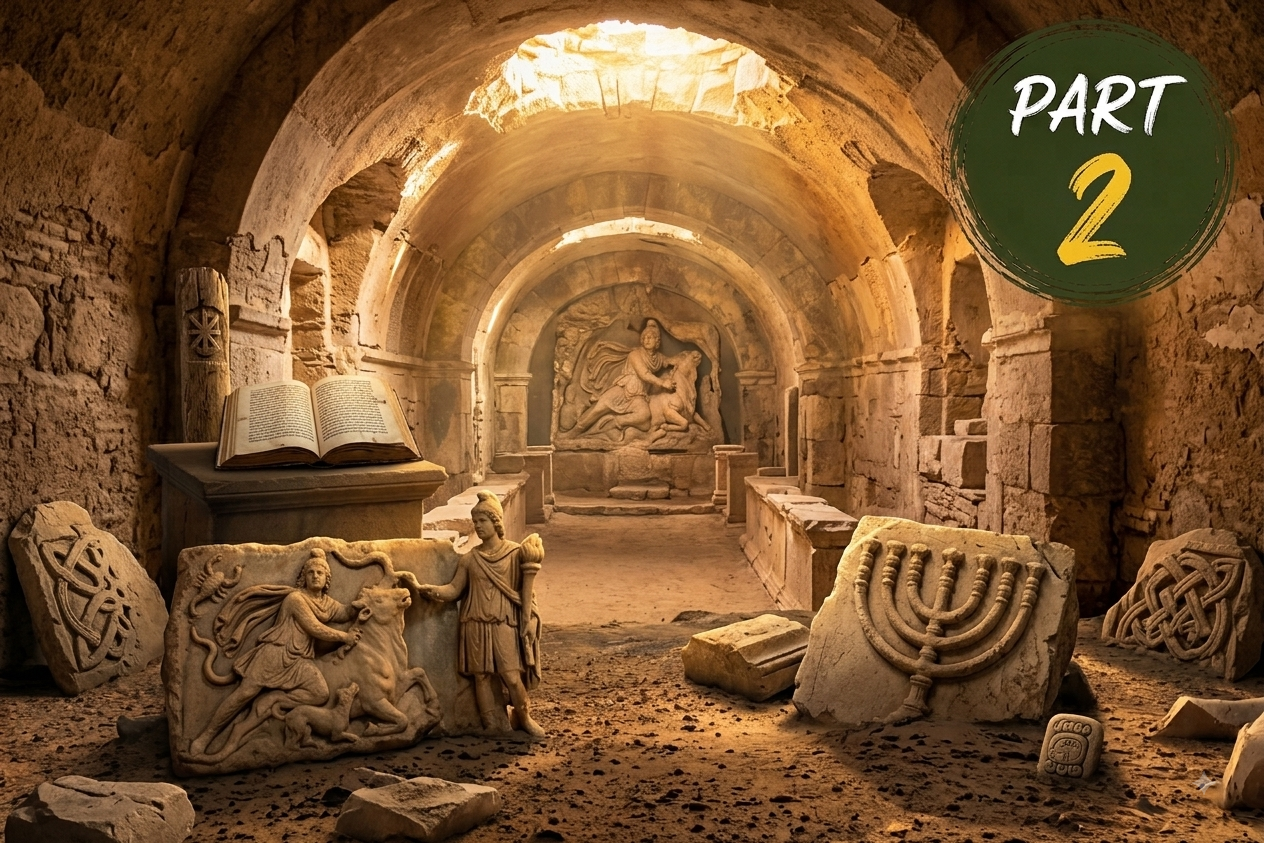
Mithraism is one of the most famous and frequently misunderstood examples. The Roman cult of Mithras was a mystery religion centred on initiation and ritual groups known as Mithraea. It was particularly associated with soldiers, merchants and other mobile populations of the Roman Empire. Hundreds of Mithraic sites have been discovered, but very little of the religion’s own literature survived. Historians therefore depend heavily on inscriptions and archaeology.
Mithraism eventually disappeared, but it should not be portrayed simply as a religion that almost defeated Christianity. The surviving evidence does not support that popular narrative. Its disappearance was part of the wider transformation of the Roman religious world.
Zoroastrianism tells a very different story because it did not actually disappear. It remains a living religion. What vanished was the enormous Zoroastrian religious and political world associated with the pre-Islamic Persian empires. The Achaemenid, Parthian and especially Sasanian states supported Iranian religious traditions on a large scale.
After the Arab-Muslim conquest of Persia in the seventh century, the political environment changed. Over the following centuries, conversion to Islam, migration, demographic changes and the decline of Zoroastrian institutions reduced the religion’s numerical and political prominence. Yet Zoroastrian communities survived. It is therefore more accurate to describe Zoroastrianism as ancient and diminished rather than extinct.
Europe’s gods after Christianity
Before Christianity spread across Europe, there was no single European pagan religion. Celtic, Germanic, Norse, Slavic, Baltic, Finnic and other communities had their own gods, rituals and sacred traditions. Christianisation took place over centuries through missionaries, kings, political alliances, conversion of elites and legislation.
In Scandinavia, the worship of Odin, Thor, Freyr and Freyja eventually ceased as an organised public religion. However, the mythology survived remarkably well. Thor’s name remains in Thursday, while Norse stories survived through folklore, literature and later Icelandic writings.
The Norse religion itself was not centrally organised like a modern church. Worship involved local sacred places, household rituals, sacrifices, ritual specialists and political leaders. As Scandinavian societies Christianised, these institutions were progressively replaced. The mythology survived its religion.
The ancient Celtic religious traditions are much harder to reconstruct because Celtic communities left relatively little indigenous religious literature. Historians rely on archaeology, inscriptions and accounts written by Greeks and Romans, including Julius Caesar. Gods such as Lugus, Taranis and Cernunnos are known, but their exact roles and the beliefs surrounding them remain uncertain.
Pre-Christian Slavic religion presents a similar problem. Gods such as Perun and Veles appear in historical sources and later folklore, but there is no extensive surviving theology comparable to Greek or Norse traditions. Much of what is popularly called Slavic mythology today has been reconstructed from fragmentary evidence.
Religions that travelled across continents
Manichaeism was one of the most remarkable missionary religions of the ancient world. Founded by Mani in the third century CE in the Persian world, it spread west into the Roman Empire and east through Central Asia into China. Its theology centred on a cosmic struggle between Light and Darkness and developed scriptures, clergy and missionary networks.
At one point, Manichaeism existed across an enormous part of Eurasia. Yet persecution, political changes and competition with Christianity, Zoroastrianism, Buddhism and Islam gradually weakened it. In China, it survived for centuries under changing circumstances before eventually disappearing as a major independent religion.
The Maya provide another important warning against calling religions simply “dead”. Maya civilisation experienced political collapse in many regions, but Maya people did not disappear. Maya languages are still spoken, communities remain and elements of Indigenous religious practice continue, sometimes intertwined with Christianity.
The same is true in the Americas. Aztec religion included gods such as Huitzilopochtli, Tlaloc and Quetzalcoatl, while the Inca religious system included the worship of Inti and other deities. European conquest destroyed temples, disrupted priesthoods and caused catastrophic population losses through warfare and disease. Yet many Indigenous traditions survived through syncretism, with older sacred figures, places and rituals becoming connected with Catholic saints and festivals.
A religion, therefore, does not always disappear completely. Sometimes its original institutions die while fragments of its beliefs continue inside the traditions that replace it.
Subscribe Deshwale on YouTube


