



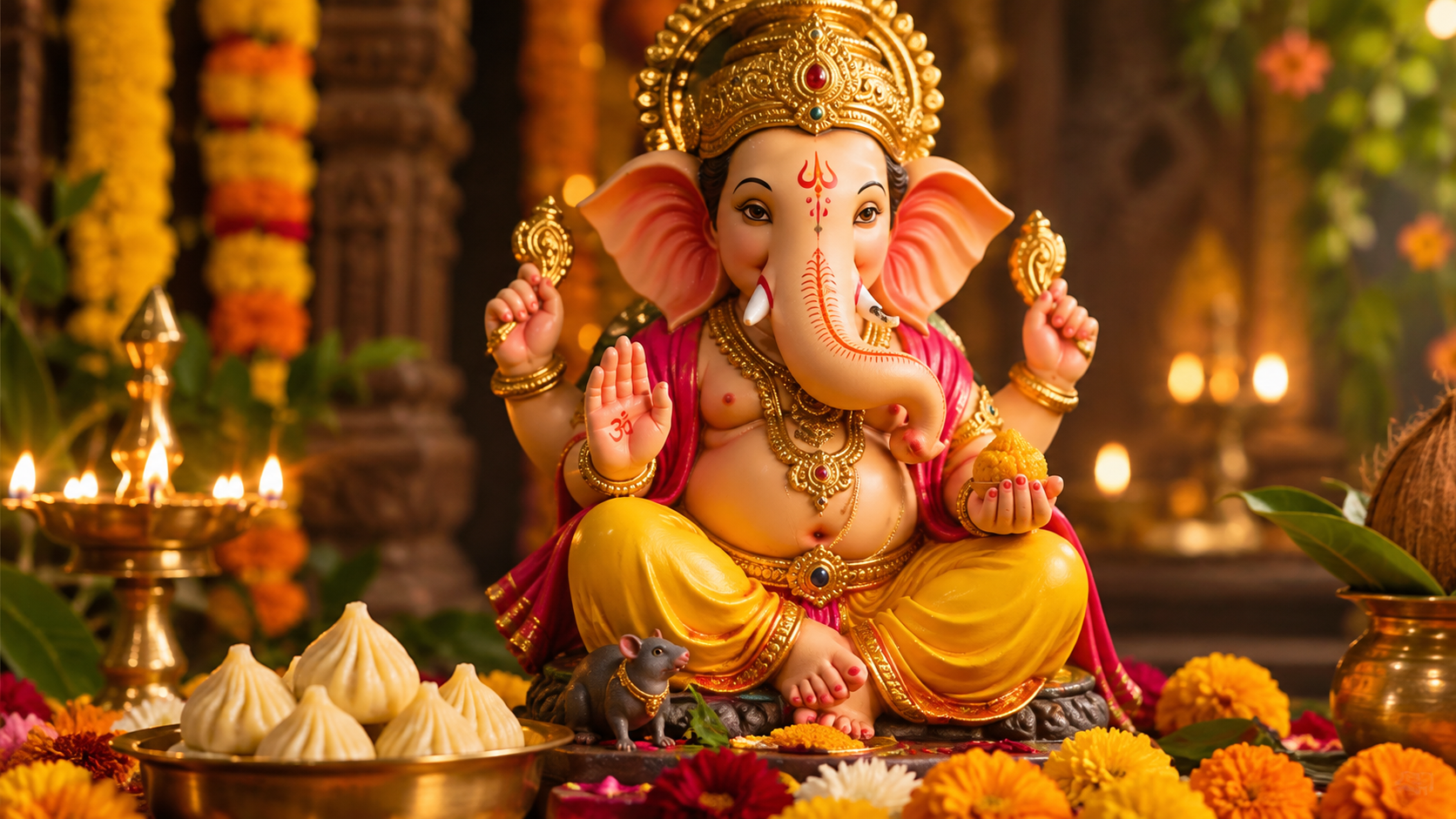
Every Ganesh Chaturthi, millions of people bring home an idol of Lord Ganesha, offer modaks, and immerse themselves in devotion for ten days. Yet very few pause to ask a simple question why does Ganesha look the way he does? The elephant head, the large ears, the broken tusk, the round belly none of it is random. Each feature carries a philosophy that has quietly survived thousands of years, even as the rituals around it have evolved.
Let’s start with the most obvious feature the elephant head. According to popular legend, Goddess Parvati created Ganesha from turmeric paste to guard her home while she bathed. When Lord Shiva returned and was stopped by the boy, a fierce battle followed, ending with Shiva severing the child’s head. To console a grieving Parvati, Shiva ordered his attendants to bring the head of the first creature they found, which happened to be an elephant. This is why Ganesha is worshipped with a human body and an elephant head a union of two very different forms of intelligence, human reasoning and animal instinct.
The large ears are not just a physical trait borrowed from the elephant. In Hindu symbolism, big ears represent the ability to listen more and speak less. Ganesha is often described as a deity who absorbs everything around him praise, criticism, and prayers alike without reacting impulsively. It’s a quiet reminder that wisdom often begins with listening carefully before forming an opinion.
Then there’s the trunk, perhaps the most versatile part of Ganesha’s form. An elephant’s trunk can uproot a tree and also pick up a single grain of rice. This dual capability is meant to represent adaptability the idea that true strength lies in being powerful when needed, yet gentle and precise in everyday matters. It’s often seen as a lesson in balance, something modern life constantly tests.
Ganesha’s small eyes are another detail that carries meaning. Unlike the large, watchful ears, his eyes are depicted as narrow and focused. This is generally interpreted as a call for concentration the ability to focus on one’s goal without getting distracted by everything happening around you. In a culture that increasingly struggles with short attention spans, this symbol feels almost prophetic.
The large belly, often the subject of light-hearted jokes and comparisons, has a deeper interpretation as well. It’s said to represent the capacity to digest both the good and bad experiences of life with equanimity. Just as the stomach processes food without discrimination, Ganesha’s belly symbolizes the wisdom to accept life’s ups and downs without losing balance.
One of the most striking features is the broken tusk. According to one popular account, when the sage Vyasa asked Ganesha to be the scribe for the Mahabharata, Ganesha agreed on the condition that Vyasa recite without pausing. Midway through, his writing tool broke, and rather than stop, Ganesha broke off one of his own tusks and continued writing. This single act has come to represent sacrifice and the idea that a wise person must sometimes give up something valuable to complete something greater than themselves.
Even Ganesha’s vehicle, the small mouse or “mushak,” holds meaning that often gets overlooked. It may seem unusual for a large, heavy deity to ride a tiny creature, but this contrast is intentional. The mouse represents desire and the tendency of the mind to nibble away at everything in its path, much like a rodent. By keeping the mouse under control, Ganesha symbolizes mastery over one’s own desires and impulses rather than being ruled by them.
Finally, the modak that Ganesha holds in his hand is more than a favourite sweet. It represents the sweetness of spiritual knowledge that comes only after patient effort, much like the layered process of making the sweet itself. It’s a reminder that wisdom, like a modak, cannot be rushed.
What makes Ganesha’s form so enduring is that it was never meant to be just a religious image. It was designed as a set of life lessons wrapped in symbolism, easy to remember and pass down generations without needing a textbook. Every time someone folds their hands before a Ganesha idol, they are, often unknowingly, standing before a complete philosophy on how to listen, focus, adapt, sacrifice, and control desire.
So this Ganesh Chaturthi, when you sit in front of the idol at home or at a pandal, takes a moment longer than usual. Look at the ears, the trunk, the belly, and the tusk not just as features of a beloved god, but as a quiet, thousand-year-old message about how to live a more balanced life.
Subscribe Deshwale on YouTube
