



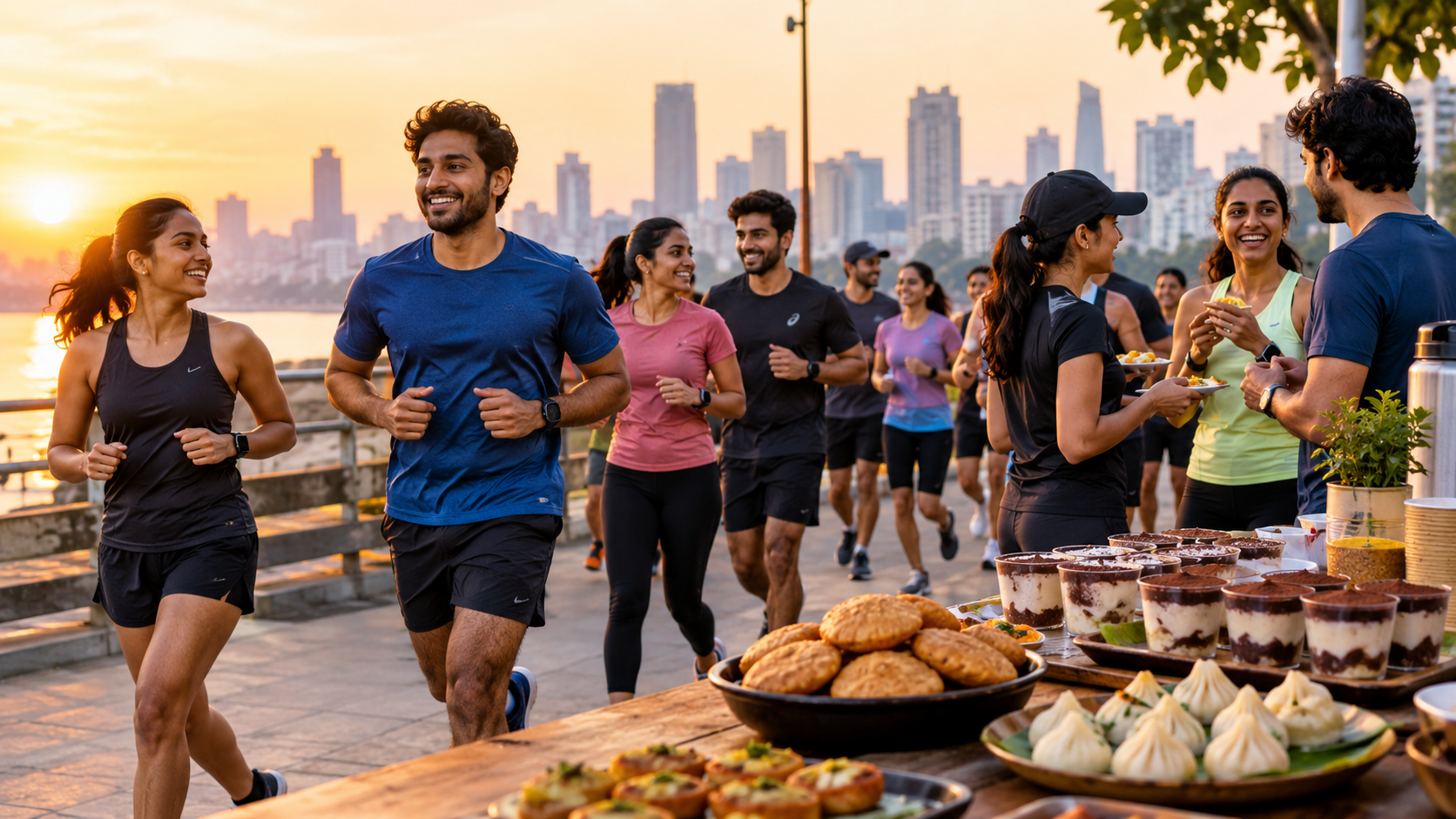
It is 5 am, and hundreds of people across Indian cities are waking up early. But they are not doing it just to run. They are doing it for kachoris, tiramisu, modak, and something even more important: company.
Across Tier 1 and Tier 2 cities, run clubs have quietly changed shape. What used to be a fitness activity has slowly turned into a social one. Running is still part of it, but it is no longer the main reason people show up.
Take the Bikaner Run Club, which went viral for its kachori run. Runners finished their route and sat down together to enjoy deep-fried kachoris, calling it their own version of a Sunday cheat day. It was less about timing and more about togetherness.
In Bengaluru, Stride Run Club has taken this idea further. Their runs move from one bakery to another, covering five to seven kilometres. At each stop, runners get a small bite and a stamp, which lets them move to the next bakery. The run usually ends with a dance party, not a finish line photo.
Sidharth Yadav, founder of Stride Run Club Bengaluru, says the idea came from his own habit of cafe hopping in Indiranagar. He wanted people to discover new places, eat along the way, and meet others while doing it. Running, in his format, is simply the thread that connects everything else.
Hyderabad has its own version. The Hyderabad Stride run club organises tiramisu and ice-cream runs, where participants chase a moving food cart instead of a stopwatch. Founder Eswar designed it this way to make running feel less intimidating and more fun for people who would otherwise never try it.
Mumbai joined the trend too, but gave it a local twist. The Hundred Mile Society organised a modak run after Bikaner’s kachori run went viral online. Founder Karun Aranakkal chose ukadiche modak specifically because it was light on the stomach, safe to eat without choking mid-run, and still felt rooted in Mumbai’s own culture.
None of these runs are competitive. The food is served in small portions, not as a full meal. And that detail matters, because it tells you what these events are actually built for.
Ask the people attending, and the pattern becomes clear. Pratyush Mathur, a 29-year-old IT professional from Pune, joined a run club for both running and socialising, and admits the social part matters just as much to him. He also points out that some members use these communities to promote their own businesses, and most people are supportive of that.
Sowmya Inamdar, a 28-year-old tech lead in Bengaluru, had wanted to start running for years but never managed to stick with it. What finally worked was discovering a run club on Instagram. For her, the appeal was never just fitness. It was the experience of moving through the city with a community, stopping for small, enjoyable moments along the way.
Social media has clearly played a big role in this shift. Running alone can look repetitive online, but add food or a cultural twist, and suddenly there is a story worth sharing. Aranakkal admits this is exactly why the modak run came together, after clips of the kachori and tiramisu runs started doing well online.
But does mixing food with exercise actually make sense? Dr Harsh Kapoor, chairman at Metro Centre for Liver & Digestive Diseases, Metro Group of Hospitals, explains that eating small amounts of food during light exercise like walking or slow jogging is generally not risky for a normal person. However, heavier foods high in fat and sugar, like kachori and tiramisu, can cause bloating or acid reflux if eaten during a run.
Yadav adds another concern: eating solid food while actually running can be a choking risk, especially when someone is breathing heavily. That is why most of these food runs are walked or jogged slowly, rather than run at speed.
Dr Kapoor also notes that these events are not designed around athletic performance, so a small treat is unlikely to undo anyone’s effort. But that does not mean people should treat it as a free pass to overindulge.
Interestingly, everyone involved seems to agree on one thing: these runs are not meant for serious athletes. They exist for a different kind of person, someone who is a little shy, a little unmotivated, or simply looking for a reason to leave the house at 5 am.
As Eswar puts it, the real goal is to get people running who never would have tried otherwise. The food is just the reason they show up. The running is almost incidental, and so, it seems, is the point.
That is the real story here. Somewhere between the kachori stall and the dance party, the running stopped being the main character. And for thousands of people finally stepping outside their homes at dawn, that might be exactly why it works.
Subscribe Deshwale on YouTube
