



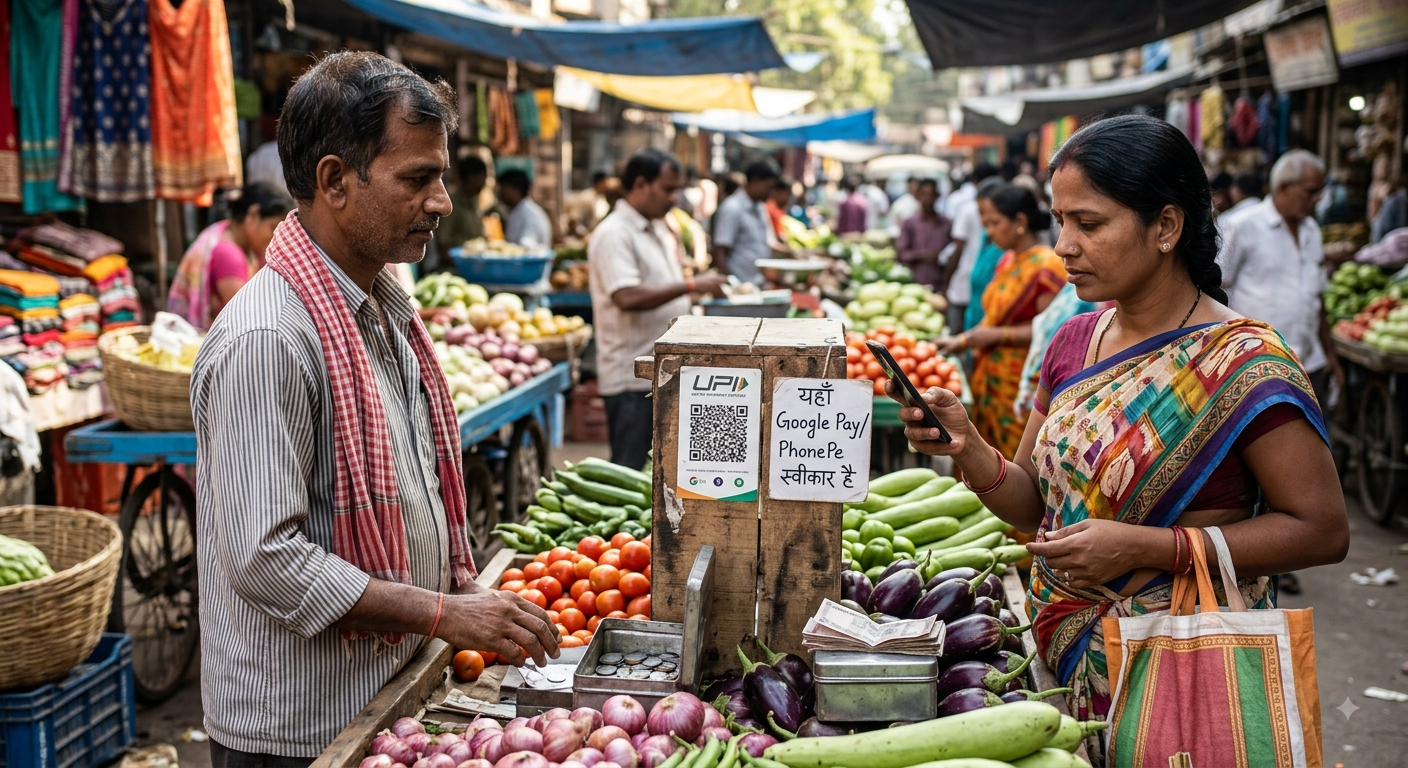
For millions of Indians, making payments through UPI has become a daily habit. A simple scan of a QR code, a few taps on the phone and money is transferred instantly. From vegetable vendors and street food sellers to large businesses, UPI has changed the way India pays.
But this decade-long experiment of free digital payments may soon see a change as the government considers allowing banks and payment companies to charge merchants a fee on certain UPI transactions. The government has not yet finalised the charges or the exact rules. However, discussions are reportedly around introducing a merchant discount rate (MDR), a small fee paid by businesses to banks and payment companies for processing digital payments.
While consumers and person-to-person UPI transactions are expected to remain free, the proposed charges could apply to selected merchant transactions, especially higher-value payments made at larger businesses.
Since its launch in 2016, UPI has grown into one of the world’s largest real-time payment systems. According to official data, UPI recorded 23.6 billion transactions worth nearly ₹29.87 trillion in July alone. More than 550 million people currently use the platform, making it one of India’s biggest digital success stories. Unlike traditional payment systems, UPI was built as an open network where multiple companies can operate together. Apps like Google Pay and PhonePe compete for users while still allowing customers to make payments across the same system.
One of the biggest reasons behind UPI’s success has been its easy adoption among small businesses. A shopkeeper, taxi driver or street vendor does not need expensive card machines to accept payments. A printed QR code is enough.
The absence of merchant charges also encouraged small businesses to accept digital payments without hesitation. However, introducing fees raises concerns about whether it could affect the growth of this network.
Researchers suggest that merchants played a major role in making UPI successful. According to economists Abhinav Motheram and Sharon Buteau, areas with stronger merchant networks saw higher UPI adoption. They believe that while charges on large businesses may have limited impact, fees reaching small merchants could slow down digital payment growth.
One possible proposal under discussion is to charge only on transactions above ₹2,000 at larger merchants. Such payments make up a small share of transaction volumes but account for a significant portion of the total payment value.
The reason behind introducing charges is also linked to the cost of running UPI. Although users experience it as free, maintaining the system requires investment in servers, security, transaction processing and fraud prevention. For years, the government has supported banks and payment companies to keep the service free.
As Reserve Bank of India governor Sanjay Malhotra pointed out, “Someone will have to pay the cost” of maintaining the digital payment ecosystem. However, experts believe the challenge is finding the right balance. A small fee for a large retailer may not have much impact, but the same charge could affect small businesses operating with limited profit margins.
For many Indians, UPI is not just a payment method anymore. It has become a symbol of India’s digital transformation, allowing even small vendors to participate in the formal economy.
Countries like Brazil have also introduced successful instant payment systems with different pricing models, showing that digital payment networks can remain popular even with certain charges for businesses.
The future of UPI will depend on how carefully the pricing system is designed. The goal is to make the system financially sustainable without affecting the convenience and accessibility that made it popular.
India’s first challenge was building the world’s largest digital payment network. The next challenge is ensuring that making it sustainable does not take away the simplicity that made millions of Indians adopt it.
Subscribe Deshwale on YouTube
