 Deshwale
Mandala Art: The Beautiful Patterns That Teach Us the Art of Patience
In brief · AI summary Mandala art is a circular design of repeated patterns that has deep roots in Hindu and Buddhist spiritual traditions, and it is now also popular among artists and hobbyists. Tibetan Buddhist monks create intricate sand mandalas that are swept away and dispersed into flowing water, reflecting the teaching of impermanence. The article presents mandala drawing as a way to slow down, practise patience and appreciate beauty that grows from simple beginnings.
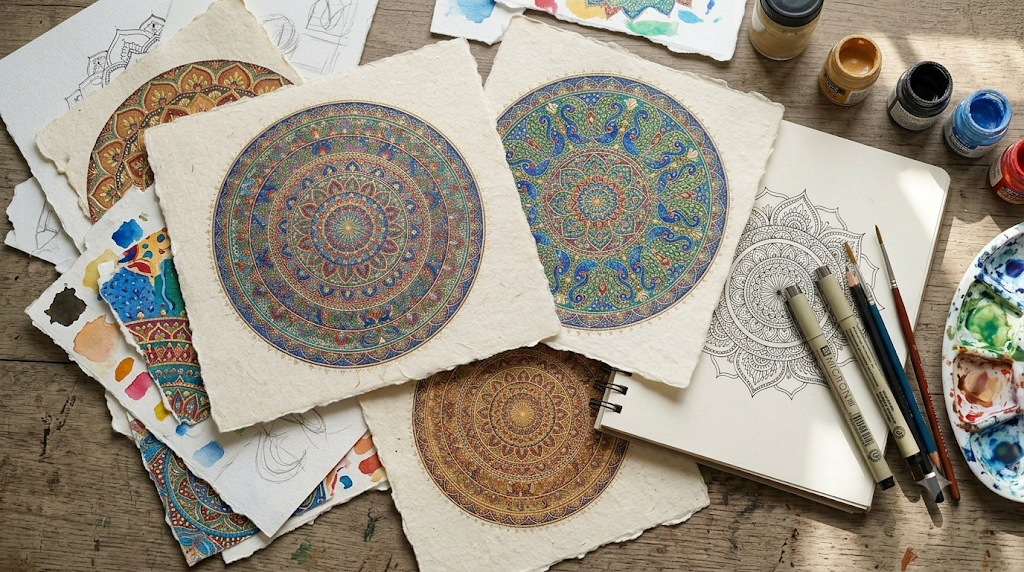
Have you ever sat with a pen and paper, started drawing a small circle and slowly filled the space around it with lines, dots, petals and tiny shapes? Before you realise it, a simple drawing has turned into something beautiful. This is one of the things that makes mandala art so special.
At first glance, mandalas look like decorative circular patterns. Their designs can be colourful, detailed and almost impossible to stop looking at. But behind these patterns lies a much deeper story. For centuries, mandalas have held an important place in spiritual traditions, particularly in Hinduism and Buddhism. Today, they have also found a place in sketchbooks, art studios and the everyday lives of people who enjoy drawing.
Where Did Mandala Art Begin?
The word ‘mandala’ comes from Sanskrit and is commonly translated as ‘circle’. However, its meaning goes beyond a simple geometric shape. In traditional religious settings, a mandala can represent the universe, spiritual order and the relationship between different parts of existence.
Mandalas have a long history in Indian religious traditions, particularly in Hindu and Buddhist practices. They were not created merely to make a space look beautiful. Their designs carried symbolic meanings and were used in rituals, meditation and spiritual visualisation.
In Vajrayana Buddhist traditions, mandalas often represent a sacred universe or a celestial palace. Their carefully arranged circles, squares, gates and central figures have specific meanings. The centre is particularly important because it is often occupied by the principal deity around whom the rest of the design is organised.
In Hindu traditions, geometric diagrams known as yantras have a related spiritual purpose. They are used in worship and meditation and often contain carefully arranged geometric shapes. Although mandalas and yantras share certain features, they are not exactly the same thing.
Why Do Mandalas Have So Many Patterns?
One of the most fascinating things about mandala art is its symmetry. A small shape drawn near the centre can be repeated around it, creating a design that looks balanced from every direction.
Artists often begin with a central point and gradually work outwards. They use circles, triangles, squares, petals, dots and repeated lines to build the design. As each layer takes shape, the drawing becomes more detailed.
There is no single pattern that every mandala must follow. Some are made with simple black lines on white paper, while others use bright colours and complicated geometric arrangements.
The beauty lies in how small elements come together to form one complete picture. A single dot may not seem important, but when it becomes part of a larger design, it contributes to something much more beautiful.
The Sand Mandalas That Are Made to Be Destroyed
One of the most surprising traditions associated with mandala art comes from Tibetan Buddhism.
Buddhist monks create intricate sand mandalas using millions of tiny grains of coloured sand. The process requires great concentration and patience. They carefully place the sand to create detailed geometric designs, sometimes spending days or even weeks completing a single mandala.
But what happens after all that effort?
The finished mandala is eventually swept away. The coloured sand is collected and traditionally dispersed into flowing water.
For someone seeing it for the first time, this may seem unusual. Why spend so much time creating something only to dismantle it?
The answer lies in the Buddhist understanding of impermanence, the idea that everything in life changes and nothing remains permanent. The act of creating and then dismantling the mandala represents this teaching. The distribution of the sand is also associated with sharing its blessings with the wider world.
It is a reminder that beauty does not always have to last forever to have meaning. Sometimes, the experience of creating something is just as important as the finished result.
From Sacred Spaces to Everyday Sketchbooks
Over time, mandala designs have reached people far beyond traditional religious settings. Today, many artists create mandala-inspired drawings for decoration, greeting cards, wall art, notebooks and colouring books.
Some people enjoy making these patterns as a hobby after work. Others use them in art workshops or simply spend a quiet afternoon filling a page with repeated shapes.
For a beginner, getting started does not require expensive equipment. A pencil, compass, ruler, fine-tip pen and a sheet of paper are often enough. Starting with a small circle and dividing it into equal sections can make the process easier.
Modern decorative mandala drawing should not be confused with traditional religious practice. Although the designs may look similar, their purposes and meanings can be quite different.
The Beauty of Taking One Step at a Time
We live in a world where most things are expected to happen quickly. Messages arrive instantly, work moves from one task to another and even our free time is often filled with screens.
Mandala drawing offers a different kind of experience. It asks us to slow down, notice small details and give attention to one part of a design before moving to the next.
A line may need to be redrawn. A pattern may not look right the first time. But with every small addition, the picture gradually becomes complete.
Perhaps that is what makes mandala art interesting even for people who have never studied drawing. It shows how something beautiful can grow from simple beginnings.
A circle, a few lines and a little patience can create an artwork that catches the eye. And sometimes, the real beauty of mandala art is not just in what we see on the paper, but in the time and care that went into creating it.
Subscribe Deshwale on YouTube