



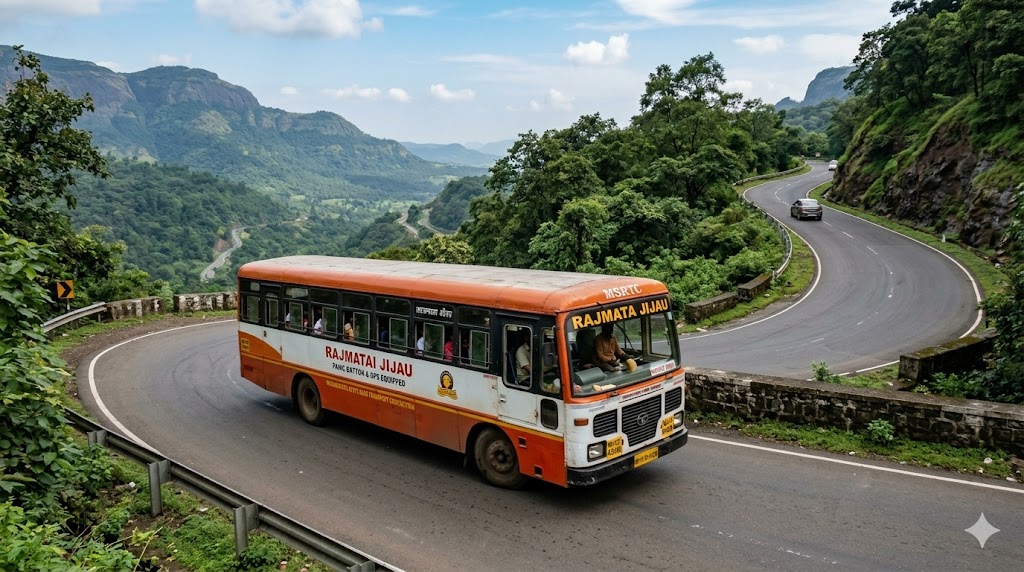
Next week, the Maharashtra State Road Transport Corporation flags off 50 high-tech buses under the “Rajmata Jijau” brand, equipped with panic buttons and live tracking. But beyond the ribbon-cutting and the fresh paint lies a deeper question: is this a genuine revolution for the common commuter, or just a digital facelift for a legacy system that has long tested the patience of rural Maharashtra?
The red bus has always been the heartbeat of rural Maharashtra. For decades, the Maharashtra State Road Transport Corporation, or MSRTC, has been the only link between remote villages and the buzzing energy of Mumbai or Pune. The term ST stands for State Transport, but for the average person in a village in Vidarbha or Konkan, the ST is not just a vehicle; it is a lifeline. It is a service that carries students to colleges and farmers to markets. However, that lifeline has often felt neglected. These new buses are designed to change that perception by bringing high tech features to the masses. The state government is ready to launch 50 brand new buses next week equipped with modern safety technology, including panic buttons and live tracking. This move is not just a cosmetic upgrade. It represents a fundamental shift in how the state views the dignity and safety of the common commuter.
A New Standard for Women Passengers
The primary driver behind this technological overhaul is the safety of women. For a long time, female commuters on long distance night routes have felt a sense of vulnerability. These 50 new buses feature a dedicated panic button system. If a passenger feels threatened or senses trouble, she can press the button to alert the driver and a central control room simultaneously. This is a massive leap from the days when a passenger had to shout to get attention in a noisy moving vehicle. The integration of technology here acts as a silent guardian. It creates a psychological sense of security that is often missing in public transport. The state is finally acknowledging that infrastructure is not just about moving people from point A to point B, but about how they feel during that journey.
Security Benefits for Male Passengers
While the focus is often on women, the male passenger also gains significantly from this upgrade. Men in transit often face different but equally pressing security concerns, such as pickpocketing or physical altercations during crowded hours. The presence of CCTV cameras acts as a deterrent against theft and rowdy behaviour that often goes unchecked in older buses. Furthermore, the panic button is a universal safety tool. A male passenger experiencing a medical emergency, like a sudden heart attack or a stroke, can use the system to get immediate attention. In the rough and tumble of intercity travel, where passengers are often strangers to one another, having a formalised distress signal reduces the reliance on the whims of the crowd. It provides a structured way for men to seek help without the fear of being ignored in a chaotic environment.
Global Benchmarks in State Transport
When we look at how other nations manage their state bus services, the MSRTC still has a long road ahead. In Japan, the bus systems are marvels of punctuality and cleanliness, where GPS tracking is so precise that a delay of sixty seconds is considered an anomaly. South Korea has integrated its buses with advanced heating and cooling systems even at bus stops, making the wait as comfortable as the ride. In Switzerland, the postal buses or PostBus navigate treacherous Alpine passes with a level of mechanical precision and multi-modal connectivity that remains the gold standard for hilly terrains. Even in Rwanda, the government has made massive strides in digitising the bus fleet to ensure cashless payments and safety in a post conflict economy.
In contrast, North Korea operates a highly centralised but aging fleet in Pyongyang, where buses are often overcrowded and rely on trolley systems that reflect a lack of modern spare parts. Countries like Singapore and Germany show us that public transport can be both a luxury and a right. These global examples suggest that while 50 buses are a start, they are only a fraction of what a globalised Maharashtra deserves. We are still catching up to the world, but at least we have started the engine.
The Logistics of Real-Time Tracking
The inclusion of Global Positioning System, or GPS technology, is perhaps the most practical upgrade for the daily commuter. For years, waiting for an ST bus at a dusty roadside stand was a game of patience and guesswork. You never knew if the bus was ten minutes away or two hours delayed. The new fleet will be linked to a central command centre. This allows the MSRTC to monitor the exact location and speed of every bus. If a bus breaks down in the middle of a ghat section, the authorities will know exactly where to send help. This data can eventually be fed into passenger apps. It makes the state transport system more reliable and predictable. This is the kind of smart infrastructure that actually impacts the life of a villager who needs to reach a hospital in the city on time.
Financial Health and Fleet Expansion
There is a bigger story behind these 50 buses. The Transport Minister, Pratap Sarnaik, has indicated a massive plan to induct nearly 8000 new buses into the fleet by the end of 2026. This includes a mix of electric vehicles and fuel efficient diesel models. The MSRTC has been through a rough financial patch, especially after the pandemic and various internal strikes. Investing in new buses is a bold move to win back the trust of the public. These first 50 buses are named after Rajmata Jijau, which adds a layer of cultural identity to the service. However, the real test lies in maintenance. It is easy to launch a shiny new bus with a ribbon cutting ceremony. The challenge is to ensure that the panic buttons actually work six months from now and the cameras are not covered in dust. The state has promised a budget for upkeep, but we have seen how quickly public assets can deteriorate without a strict protocol.
Demanding Better Instead of Worshipping
As citizens, we often fall into the trap of praising basic infrastructure as if it were a divine gift. We must remember that these buses are paid for by the taxpayer. The provision of safe and clean transport is a fundamental duty of the state, not an act of charity by the politicians. Instead of blindly worshipping the authorities for a small batch of 50 buses, the public must keep demanding higher standards. We should be asking why only 50 buses have these features and not the entire fleet of thousands. We should be asking why the stations remain in a state of disrepair even as the buses get a facelift. Constant public scrutiny is the only thing that keeps the bureaucracy moving. If we stop demanding better, we settle for mediocrity and the authorities stop feeling the pressure to perform.
Technical Specifications and Routes
The buses are designed to be more aerodynamic than the old square shaped models. This helps in fuel efficiency and stability at higher speeds on the highway. Inside, the seating is more ergonomic with a 3 by 2 arrangement that allows 55 passengers to sit comfortably. This is a significant improvement over the 40 seater standard buses, intended to reduce overcrowding on busy corridors.
The initial 50 buses will be deployed on high demand corridors to address the chronic issue of overcrowding. The Mumbai to Pune route, which is the gold mine for MSRTC, will see a significant chunk of these new buses. Other routes include Nashik to Pune and the heavily travelled Aurangabad to Pune section. There is also talk of deploying them on the Kolhapur to Mumbai route where private players currently dominate the market. By placing these high tech buses on competitive routes, the MSRTC is making a clear play for the middle class commuter who currently avoids the “Lalpari.”
The Cost of Modernity
When it comes to the wallet, the “Rajmata Jijau” buses will be positioned between the ordinary diesel buses and the premium Shivneri service. While the standard ordinary bus fare remains the baseline, these new models will carry a slight premium due to the added facilities. For instance, if a standard ticket on a specific route is Rs. 320, the new service might be priced at approximately Rs. 380 to Rs. 400.
However, the 50% concession for women under the Mahila Samman Yojana will still apply, making the ticket roughly Rs. 190 to Rs. 200 for female passengers. Senior citizens above 75 will continue to travel for free. This pricing strategy is a bit of a gamble. The MSRTC is trying to recover some of the investment costs while keeping the service accessible to the rural population. It remains to be seen if the rural commuter is willing to pay an extra Rs. 60 or Rs. 70 for a panic button and a GPS tracker.
Launch Ceremony and Depot Locations
The official launch is set for March 24, 2026. The Chief Minister will lead the ceremony to flag off the first batch. These 50 buses will be distributed among key depots to ensure a wide reach. The Pune Division is expected to receive a large portion, specifically for the Swargate and Shivajinagar depots. The Nagpur Division is also slated to receive a batch for its eight depots to strengthen the network in Eastern Maharashtra. Mumbai will see these buses at the Parel and Kurla depots. These locations have been chosen because they handle the highest volume of intercity traffic.
The Human Element in High-Tech Transit
Despite all the talk about sensors and digital boards, the bus remains a human space. The drivers and conductors are the ones who will have to manage this new technology. Training is a major part of this rollout. A driver who is used to a basic steering wheel now has to understand an integrated dashboard with emergency alerts. There is also the question of the public. Will commuters use the panic buttons responsibly or will there be cases of false alarms?
The transition might be a bit clunky at first. I suspect there will be some confusion during the first few weeks of operation. The staff might struggle with the software and the control room might be overwhelmed with data. But this is a necessary growing pain for a state that wants to modernise its legacy systems.
Connectivity and the Rural Urban Divide
The deployment of these buses is expected to focus on high traffic routes connecting rural hubs to major cities. This helps in bridging the gap between different economic zones of Maharashtra. When a worker from a small town in Satara can travel to Pune in a safe and monitored environment, it increases labour mobility. Better transport leads to better economic outcomes.
The MSRTC is effectively competing with private bus operators who have dominated the luxury and safety segment for years. By offering panic buttons and GPS at a government regulated fare, the state is providing a high quality alternative to the common man. It is a social equaliser. The ST bus was always meant to be the common man’s carriage, and these upgrades ensure it stays relevant in the twenty first century.
A Step Towards Integrated Transport
This launch is a signal that the state is looking at transport as an integrated network. The data from these buses can be used to plan better routes and schedules. If the GPS shows that a particular route is always congested at 5 PM, the MSRTC can adjust its frequency. This is data driven governance in action. It moves away from the old method of arbitrary scheduling based on tradition rather than demand. The panic button feature also links the transport department with the police department more effectively. It is a multi agency approach to public safety.
The Challenge of the Road Ahead
It is heartening to see this change but we must remain cautious. The state transport corporation has a history of grand announcements that sometimes fizzle out due to lack of funds or political changes. The cost of these 50 buses is significant, and the cost of the proposed 8000 buses will be astronomical. Where is this money coming from? Is it through a public private partnership or a direct government grant? The sustainability of this model is crucial. We don’t want these buses to become junk in five years because of a lack of spare parts for the high tech components. The technology is great, but the mechanics on the ground need to be equipped to fix it.
Actually, I think the most interesting part will be the response from the passengers in the smaller towns. They are the ones who have dealt with the worst of the old fleet for so long. Seeing a bus with CCTV and a panic button might feel like a big deal to someone who has only seen such things in movies. It changes the perception of what a government service can be. It makes the passenger feel respected. There might be some hiccups with the digital boards or the GPS signal in the deep forest areas of the Sahyadris, but that is to be expected.
The important thing is that the step has been taken. The move toward a more secure and tech enabled transport system is finally real for the MSRTC. It is no longer just a plan on a piece of paper in a Mantralaya office. It is a physical reality that will start rolling out from the bus depots next week. Let us hope the maintenance crews are as ready as the drivers are for this new chapter in the history of the state’s transport. In the end, the success of this project will not be measured by the launch event, but by the safety of the millionth passenger who uses that panic button when they need it most. This is a significant moment for Maharashtra’s infrastructure. It is a moment where technology meets the common man on the highway. We should expect some initial glitches, but the direction is definitely the right one for a modern state.
