






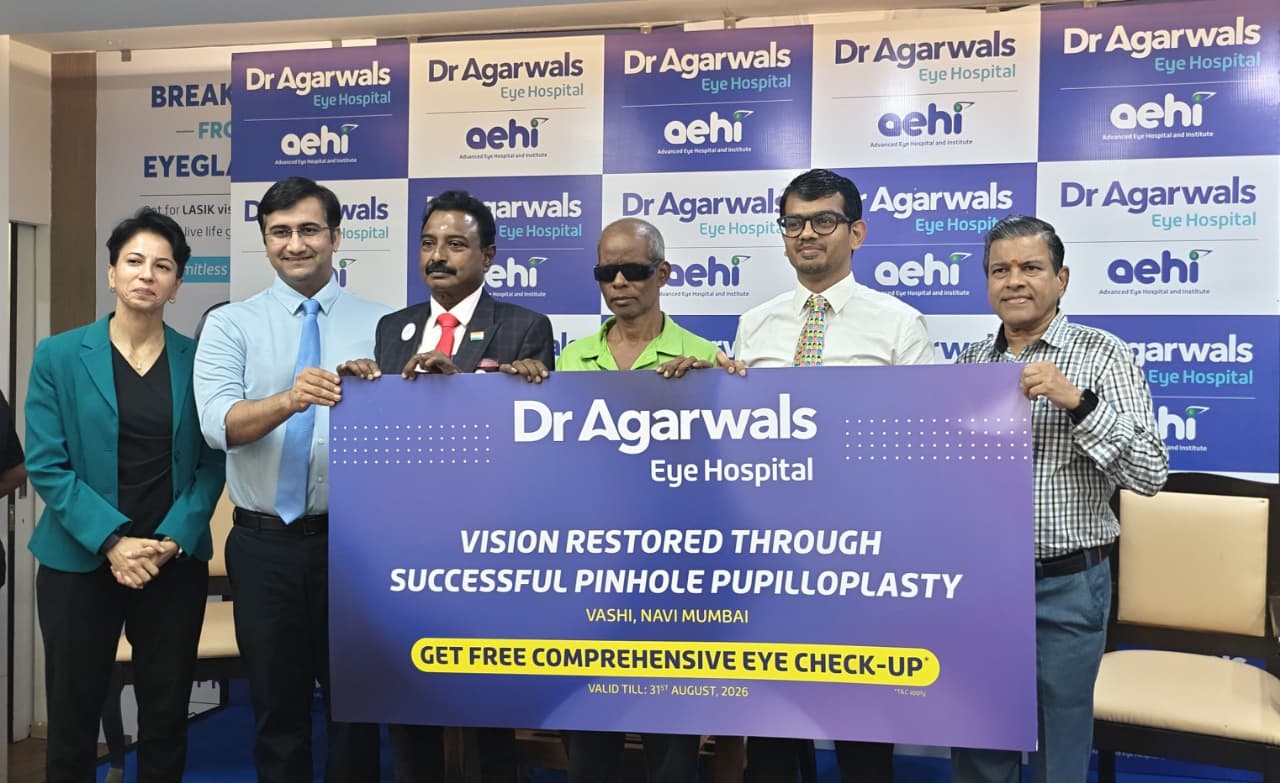
A 62-year-old Navi Mumbai resident has regained his eyesight after undergoing a rare and complex dual eye surgery at Dr Agarwals Eye Hospital. The procedure combined cataract surgery with Pinhole Pupilloplasty (PPP), helping restore vision without the need for a corneal transplant.
Subhash Vishnu Chache, a resident of Vashi, had been living with two serious eye conditions in his left eye a mature cataract and a dense corneal scar. Together, these conditions severely blocked light from entering the eye, leaving him with extremely poor vision. His right eye was also significantly affected, making everyday activities such as recognising faces, reading and moving around without assistance increasingly difficult.
Seeking a solution, Chache visited Dr Agarwals Eye Hospital in Vashi, where he was examined by consultant ophthalmologist Dr Pratik Yeshwant Gogri. After detailed investigations and consultation with Dr Vandana Jain, he was referred to the hospital’s specialist surgical team at its Wadala facility.
The surgery was performed by cataract surgeon Dr Smit M. Bavariya. Instead of carrying out a routine cataract operation, the team decided to combine cataract removal with Pinhole Pupilloplasty, a specialised technique used in selected patients with corneal scarring.
According to Dr Bavariya, removing the cataract alone would not have restored the patient’s vision because the scar on the cornea would have continued to distort incoming light. During Pinhole Pupilloplasty, surgeons carefully reshape and reduce the size of the pupil so that light enters through a smaller central opening. This allows clearer and more focused light to reach the retina, significantly improving vision even in eyes with corneal scars.
The surgery lasted around one hour, considerably longer than a standard cataract procedure due to its complexity. Performing both procedures in a single operation also helped the patient avoid a corneal transplant, reducing surgical risks, recovery time and possible complications.
Following the surgery, Chache’s distance vision improved dramatically to 6/9, while his near vision improved to N8, enabling him to read standard print comfortably. He can now recognise faces, watch television and move around independently activities that had become nearly impossible before treatment.
Dr Pratik Gogri said the patient’s condition initially appeared challenging, but careful evaluation confirmed that he was a suitable candidate for the combined procedure. He added that accurate diagnosis and selecting the right surgical approach played a key role in achieving a successful outcome.
Dr Vandana Jain, Chief Strategy Officer and Head of Clinical Services at Dr Agarwals Eye Hospital, Vashi, said managing patients with both corneal and lens disorders requires detailed planning and close coordination among specialists. She noted that the hospital continues to strengthen its clinical capabilities through advanced technologies, including its robotic cataract surgery suite.
Padmashri Dr S. Natarajan, Chief Clinical Services at Aditya Jyot Eye Hospital, a unit of Dr Agarwals Eye Hospital, said complex procedures such as combined cataract surgery and Pinhole Pupilloplasty demand specialised expertise, advanced infrastructure and strict clinical protocols to ensure patient safety.
Pinhole Pupilloplasty was developed by renowned ophthalmic surgeon Dr Amar Agarwal, Chairman of Dr Agarwals Eye Hospital, more than a decade ago. The technique was designed to improve vision in carefully selected patients with corneal scarring while reducing dependence on donor corneal transplants.
Clinical data involving 257 patients showed average vision improving from 20/125 before surgery to 20/32 afterwards, with nearly 85% of patients achieving driving-quality vision. The technique has also contributed to a 15–25% reduction in corneal transplant surgeries in clinical practice.
Expressing his happiness after the operation, Chache said the surgery had transformed his life. He thanked the doctors for restoring his eyesight and giving him the confidence to carry out daily activities independently once again.
Subscribe Deshwale on YouTube


